
Putting an End to the "Vast Minority of Judges": Why We Need the Judges Act
Last edited: 2026-07-27
Justice is like the chastity of Caesar's wife—it must be above suspicion. This should be the pride of those who administer justice. But is our judiciary truly beyond suspicion? Are the core figures who exercise judicial power—the judges—truly worthy of our trust? This depends on the quality of their adjudication. Factors affecting adjudication quality can be broadly divided into judicial integrity, professional competence, and case-handling attitude.
A quick Google search of historical news reveals a former High Court division chief judge suspected of taking bribes while in office; the Liang Po-hsun and Chou Po-lun cases sparked suspicions of lobbying of judges by Ch'en Che-nan; a judge was exposed by internet users for impersonating an attorney and committing sexual assault; and a judge fled to mainland China after running up massive gambling debts. This is the integrity of our "vast minority" of judges.
We saw that even after 16 years, the latest judgment in the Su Chen-ch'ang (Su Ch'in-an) case still departed from the rules of evidence under the Code of Criminal Procedure, finding three defendants guilty based on confessions and pitifully meager items that could hardly be called evidence. Then there is the "classic" case of "passing the horn as evidence"—in a sexual assault case where the victim stated that the defendant demanded she perform oral sex, the judge did not understand what it meant and asked for the physical evidence to be passed around. This is the professional competence of our "vast minority" of judges.
"Insiders" all know that many judges, perhaps because of backlogs too heavy to clear in time, will have judicial assistants write judgments, and some judges do not even read them before issuing them as judgments without changing a single word. We have also heard of cases where appellate appeals are dismissed by simply "copying and pasting" the first-instance judgment, completing the second-instance judgment with even the same errors as the first-instance one. This is the case-handling attitude of our "vast minority" of judges.
Shortly before the formulation of the Consumer Debt Clearance Act, I once heard a high-ranking official from the Judicial Yuan who came from a senior judge background say, "What is there to help these card-debt slaves? They are just a bunch of people who love designer brands and max out their cards recklessly; they brought this upon themselves." This is the mindset of our "vast minority" of judges toward the underprivileged or vulnerable groups in society.
Good judges certainly do exist. However, a judge who earnestly writes constitutional interpretation petitions due to ambiguities in legal provisions often has them formally dismissed by the Grand Justices, or even viewed askance by some legal professionals. A judge who was still laboring away over case files ten days before her due date ended up having a miscarriage. Even a conscientious judge is treated as nothing more than a good civil servant, receiving the treatment of a good civil servant; at most, "insiders" know about it and feel a tiny sense of honor, and that is all.
Regarding judicial integrity, the Judicial Yuan intends to regulate it through an ethics "code"—what will the effect be? Who knows. As for professional competence, "judges handle cases independently, and judicial administration cannot interfere." And whether a judge's mindset toward the underprivileged or vulnerable groups in society is correct is related to the education and training of judges. Yet none of these core issues facing judicial power have a transparent and public mechanism for review. One wonders whether those government officials and legislators who constantly curse judges for lacking trust in judicial quality while repeatedly running to court to sue each other are even aware of these problems.
Eliminating bad judges and rewarding good ones are the only ways to ensure the quality of adjudication. Such a simple truth, yet the current system completely fails to achieve this effect.
We urgently hope to improve the quality of adjudication. Because of this urgent need for quality adjudication, we urgently need the "Judges Act," which has failed to be enacted because it involves not only judicial power but also executive, examination, and control powers and thus could not be agreed upon; after civic groups and officials deliberated for more than a decade, entering and leaving the Legislative Yuan several times only to fail to reach a consensus, it remains unpassed.
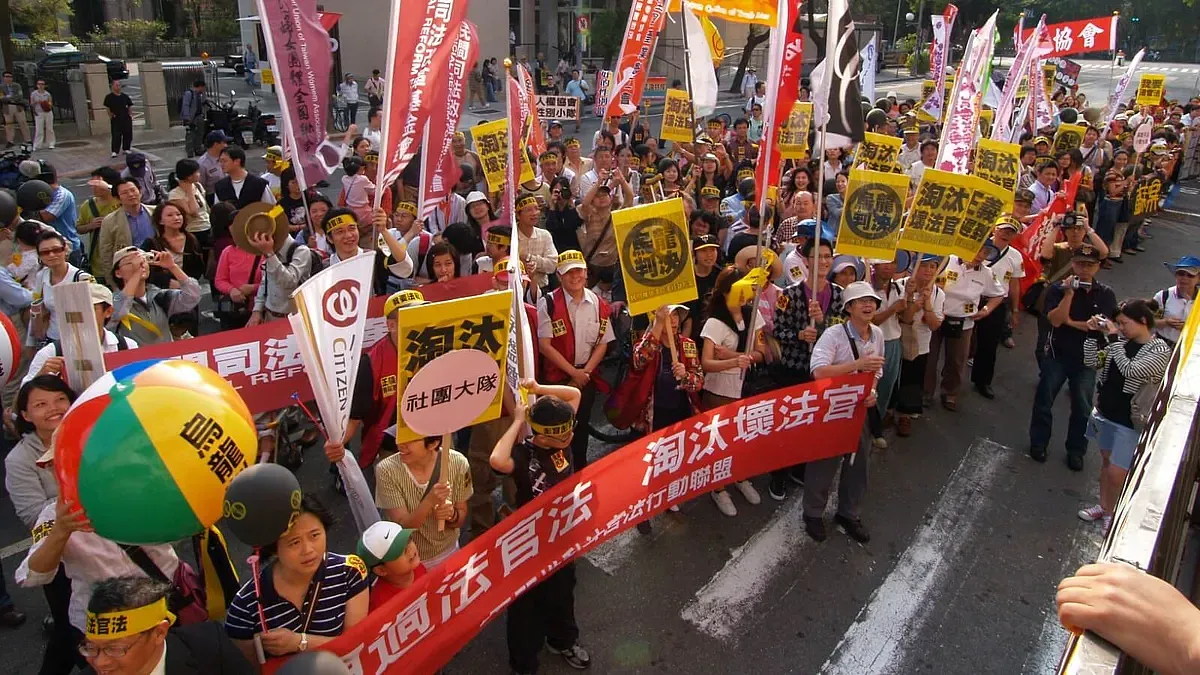
To this end, the Coalition for the Promotion of the Judges Act launched the "I Want the Judges Act" protest march on October 27, strongly urging the Legislative Yuan to pass the Judges Act during this legislative session. Whether it is the government or the Legislative Yuan, please do not let us down again. We certainly do not want any more "vast minority of judges" to continue to impair the chastity of the judiciary.
This article was published in the China Times on October 19, 2007; this is the complete original text.
This article is an AI-generated translation of the original Chinese text. In the event of any discrepancy, the Chinese version shall prevail.