
Results of the Project on Non-Publicity of Investigations
Last edited: 2026-07-27
This article was published in the Taiwan Bar Journal, September 2009 Issue
I. Background
Article 245, Paragraph 1 of the Code of Criminal Procedure stipulates that "[t]he investigation shall not be public." Investigative authorities such as the police, prosecutors, and investigation bureaus are obligated to keep investigative materials obtained during criminal investigations—such as searches, raid footage, surveillance camera stills, suspects' names or photographs, and crime details—confidential and refrain from disclosing them to the public. However, in daily television and print social news, suspects are routinely exposed to the viewing public before even entering formal judicial proceedings. Under the principle of non-publicity of investigations, "publicity" is supposed to be the exception, yet it appears to have become the "rule" in everyday news media.
The purpose of this project is to understand the extent to which relevant investigative authorities have leaked confidential information to the public during investigations, and to take necessary actions against such behavior in order to safeguard human rights1. To achieve this goal, the first step is to collect instances of such public disclosures and quantify them. After all, we have become so accustomed to seeing "publicized investigations" that we have lost our vigilance regarding the severity of such conduct. By attempting to aggregate the volume of publicized investigations, we can begin to comprehend how many lives are affected each day and month before any judicial determination of guilt is ever made. The second step is to categorize the collected forms of disclosure. Different types of conduct have varying impacts on individual rights: some acts should be strictly prohibited, while others may be justified under exceptional circumstances. Through the statistical analysis of this data, we hope to present a more fact-based depiction of the violations of the non-publicity principle by investigative agencies like the police, prosecutors, and investigation bureaus, thereby turning this phenomenon into an issue of public concern and opening up possibilities for discussion and reform.
II. Data Collection Methodology
Investigative authorities disclose confidential matters under investigation in a myriad of ways. Among these, disclosures made to news media outlets inflict the most severe harm on individual rights, and this method of disclosure also has the greatest impact on the individuals concerned (such as suspects or their families and friends). Furthermore, investigative agencies often have strong incentives to leak information to the media2; therefore, such public disclosures became the primary focus of data collection for this project.
Data collection for this project spanned five months, from March to July 2009. Television news was closely monitored daily during two time slots: from 12:00 PM to 2:00 PM and from 6:00 PM to 8:00 PM, totaling four hours per day. Segments suspected of violating the principle of non-publicity of investigations were recorded, and daily statistical compilations were conducted.
III. Electronic Media Data Collection
(A) Regarding electronic media data collection, three types of violations were categorized and recorded:
- Disclosure of evidence-gathering footage: This category comprises videos filmed by relevant investigative authorities during the execution of searches and arrests, shot entirely for their own investigative needs. Such footage is often used as evidence in subsequent criminal trials to establish criminal facts. Yet, prior to any indictment, it is already exposed to the viewing public3. At times, this footage depicts suspects being coerced into confessions or subjected to searches while in a state of undress. Aside from creating a public impression of guilt before trial, such disclosure represents a severe violation of human rights. Regardless of whatever interests might be served by disclosing this footage, it is exceedingly difficult to justify the resulting infringement.
- Disclosure of evidence-gathering photographs: This data can be broadly divided into two types. The first consists of stills extracted from the aforementioned evidence-gathering footage—meaning that while the investigative authorities did not hand over the entire video to the media, they released selected screenshots. The second type consists of photographs taken when investigative authorities bring suspects back to the crime scene for reenactments. Such reenactment photographs are tantamount to forcing the accused to incriminate themselves, and the investigative authorities' subsequent release of these photos constitutes a grave violation of human rights.
- Disclosure of surveillance camera footage: Cases involving the disclosure of surveillance footage not only implicate the human rights of the suspects, but may also impact third parties entirely unrelated to the crime, such as a convenience store clerk being held hostage. Third parties have the right to demand that their images not be broadcast to the public; therefore, this type of disclosure involves multiple rights holders, and the severity of its infringement warrants serious attention.
(B) Collection Standards
- The aforementioned three types of footage are by nature investigative materials belonging to the investigative authorities and should never be made public during an investigation. Therefore, regardless of whether the footage clearly shows the suspect's face or depicts criminal evidence, as long as it was provided by the investigative agencies, it was recorded and collected.
- Unlike the aforementioned investigative footage, surveillance footage may be provided not only by investigative authorities, but also by village wardens or local merchants. Cases subject to the least ambiguity are those where the news media explicitly attributes the source of the footage to a specific agency4. Secondly, if investigating officers are seen explaining the case alongside the footage as it plays, it can also be inferred that the footage was provided by the investigative authorities. Finally, even if the investigators do not provide simultaneous commentary during the broadcast, but instead explain the case details immediately after the footage concludes, it is similarly presumed that the broadcasted footage was provided by the investigative agencies.
(C) Statistical Data
The chart below shows the total number of violations of the principle of non-publicity of investigations by various agencies from March to July. Taking March as the month with the lowest figures, there were 27 cases of disclosed evidence-gathering footage, 5 cases of disclosed evidence-gathering photographs, and 30 cases of disclosed surveillance footage, totaling 62 cases. June recorded the highest number with a total of 101 cases, with a monthly average of 87.2 cases.
Figure 1: Statistics on the Number of Violations of the Principle of Non-Publicity of Investigations by Investigative Authorities

The following are statistical charts of cases involving violations of the principle of non-publicity of investigations by investigative authorities from March to July, categorized into three groups based on the violating agency: the National Police Agency (including various local police departments and precincts), the Coast Guard Administration, and the Ministry of Justice (including investigation bureaus or local prosecutors' offices). Taking the National Police Agency as an example, its subordinate units in March recorded 21 cases of disclosed evidence-gathering footage, 4 cases of disclosed evidence-gathering photographs, and 30 cases of disclosed surveillance footage, totaling 55 cases in March. June recorded the highest number, with a total of 97 cases.
Regarding units under the jurisdiction of the National Police Agency, there were a total of 403 violations of the principle of non-publicity of investigations over the five-month period, averaging 80.6 cases per month; units under the Coast Guard Administration recorded a total of 11 violations over five months, averaging 2.2 cases per month; and units under the Ministry of Justice recorded a total of 22 violations over five months, averaging 4.4 cases per month.
Figure 2: Statistics on Violations by Subordinate Units of the National Police Agency

Figure 3: Statistics on Violations by Subordinate Units of the Coast Guard Administration

Figure 4: Statistics on Violations by Subordinate Units of the Ministry of Justice

(D) Analytical Explanation
As shown in Figure 1, from March to mid-July, the monthly number of violations of the principle of non-publicity of investigations by investigative agencies averaged 87 cases per month. This means that at least 87 alleged perpetrators still in the suspicion stage were completely exposed to the public eye each month. Furthermore, these disclosures may have involved the suspects' friends and family, crime victims, or entirely unrelated third parties. The sheer volume of such cases warrants serious attention.
A comparison of Figures 2, 3, and 4 above reveals that the number of violations by units under the National Police Agency vastly exceeds that of the other two agencies, by a factor of several dozen. This is because the jurisdiction of the National Police Agency encompasses the vast majority of criminal cases—ranging from murder to petty theft—putting a larger volume of relevant cases within its purview, which in turn leads to a correspondingly higher number of violations.
Regarding the types of conduct, violations by National Police Agency subordinates primarily consisted of the disclosure of surveillance footage. This is mainly because police departments serve as social order maintenance units; surveillance cameras have long been regarded as vital tools for maintaining public security and are widely installed by police agencies, becoming useful tools for solving crimes after they occur. However, their public disclosure also raises concerns regarding human rights infringements.
IV. Conclusion
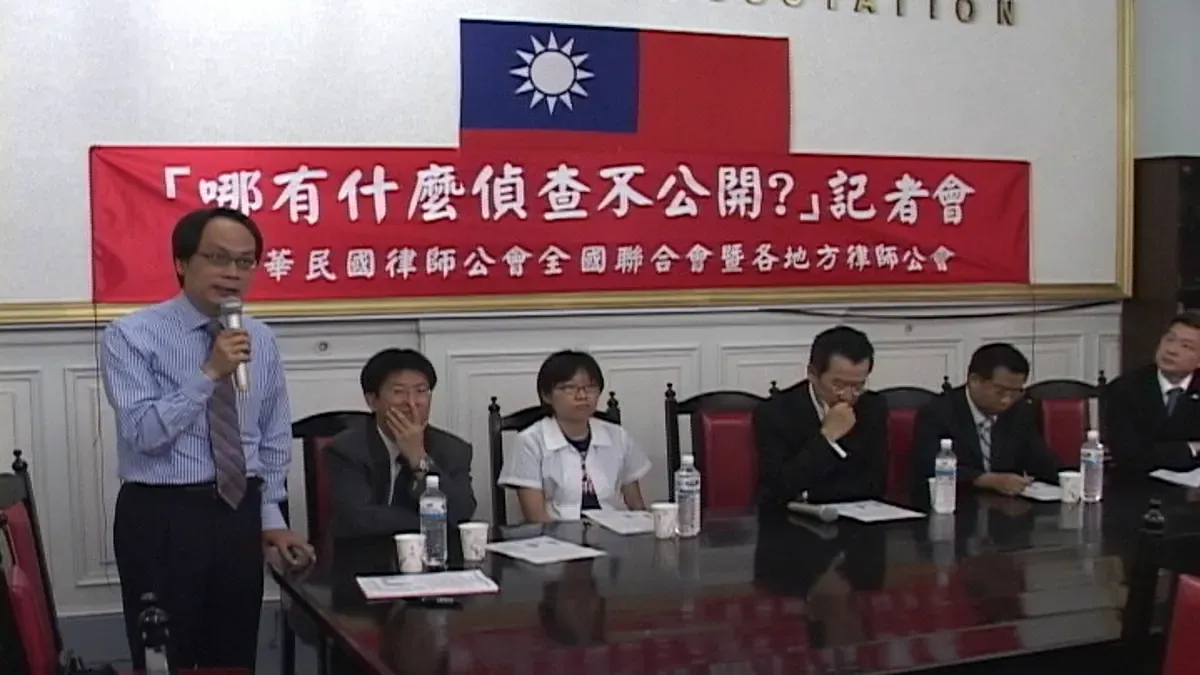
The organizing units of this project—including the Taiwan Bar Association along with various local bar associations, the Judicial Reform Foundation, and the Taiwan Association for Human Rights—held a press conference on June 5 to publish the evidence-gathering results and issue an appeal, hoping that all sectors of society (especially investigative authorities) would take this issue seriously. However, judging from the statistical data for June and July in Figure 1, no responsive change appears to have taken place. Following this, the organizing units also officially dispatched the relevant materials to various agencies in the hope of eliciting further responses.
To date, upon receiving the relevant materials, the Coast Guard Administration established a dedicated task force on July 16 to monitor news reports and pledged to continuously supervise its subordinate units in strictly complying with the principle of non-publicity of investigations. This project team will likewise continue to monitor and visit investigative agencies to see whether conditions have improved. If improvements are observed, they are certainly to be commended; if not, we will proceed to refer the matter to the Control Yuan for investigation and pursue criminal accusations. Our sole objective is to prompt all sectors of society to take this issue seriously and to fully implement the principle of non-publicity of investigations.
Notes:
- Refer to the *Directions for Handling News Coverage of Criminal Investigations by Prosecutor, Police, and Investigation Agencies*, Direction 1: "These Directions are specially formulated to ensure that criminal investigations and news processing are handled prudently in compliance with the principle of non-publicity of investigations under the Code of Criminal Procedure, to prevent inappropriate statements, and to balance the privacy and reputation of defendants, criminal suspects, and related persons while facilitating media interviews."
- For an analysis of the reasons why investigative agencies disclose investigative data to the news media, see Lin Heng-chih, *A Study on the Conflict Between Freedom of News Reporting and the Principle of Non-Publicity of Investigations (Part 2)*, Military Law Journal, Vol. 48, No. 7, p. 36.
- It is worth noting that judges are also members of the viewing public. When a presiding judge (before the case is formally shaped) views such footage, their mental impression may in reality have been prejudiced before ever encountering the suspect. Under such circumstances, emphasizing a fair trial and the presumption of innocence during judicial proceedings is likely a fruitless endeavor akin to "climbing a tree to catch fish."
- Meaning that subtitles have been added to the news footage, such as "Footage provided by XX agency."
This article is an AI-generated translation of the original Chinese text. In the event of any discrepancy, the Chinese version shall prevail.