
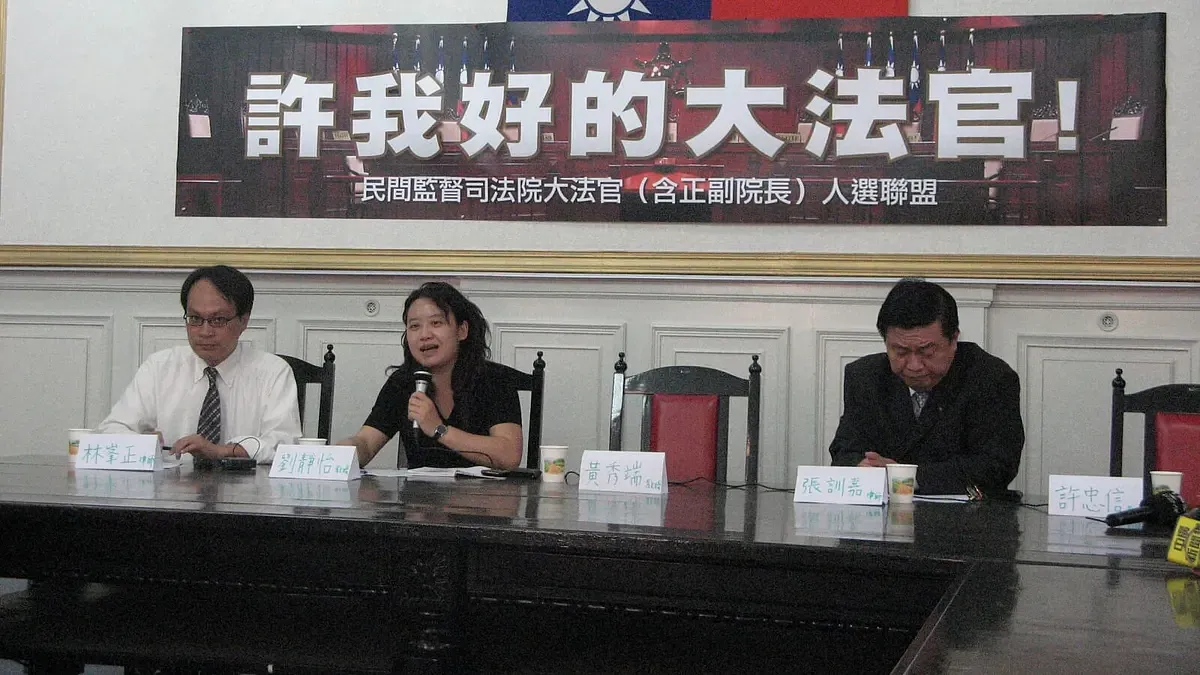
Statement by the Alliance for Civilian Oversight of Candidates for Grand Justices of the Judicial Yuan (including the President and Vice President)
Last edited: 2026-08-23
Observation Period: September 20 to September 26, 2007
I. Statistical Data
The "Alliance for Civilian Oversight of Candidates for Grand Justices of the Judicial Yuan"—composed of groups such as the Taipei Society (Cheng She), Taiwan Association for Human Rights, Taiwan Law Society, Taiwan Bar Association, Taipei Bar Association, and Judicial Reform Foundation—released its evaluation report on the Judicial Yuan Grand Justice nominees on September 17. Since September 20, the Alliance formed an observation delegation for the Legislative Yuan's exercise of the Grand Justice consent power, stationed in the legislature to observe the entire process of lawmakers questioning the nominees. As of 4:00 PM today when the questioning concluded, a total of 212 observation record sheets were collected over the three days. The statistical data on the performance ratings of legislators who questioned the Grand Justice nominees by all observers are presented below.
Table 1: Content of Questions
| Item | Rating | KMT | DPP | PFP | TSU | None |
|---|---|---|---|---|---|---|
| Standard | Very Low | 17.06% | 6.25% | 15.38% | 0.00% | 4.35% |
| Low | 29.86% | 9.38% | 30.77% | 26.67% | 34.78% | |
| Fair | 39.34% | 37.50% | 46.15% | 46.67% | 47.83% | |
| High | 12.32% | 42.19% | 7.69% | 26.67% | 13.04% | |
| Very High | 1.42% | 4.69% | 0.00% | 0.00% | 0.00% | |
| Substance | Very Hollow | 18.75% | 6.56% | 7.41% | 0.00% | 4.55% |
| Hollow | 30.77% | 18.03% | 33.33% | 26.67% | 31.82% | |
| Fair | 28.85% | 11.48% | 29.63% | 20.00% | 22.73% | |
| Substantive | 18.27% | 45.90% | 25.93% | 53.33% | 40.91% | |
| Highly Substantive | 3.37% | 18.03% | 3.70% | 0.00% | 0.00% | |
| Political Undertone | Very Strong | 31.60% | 3.08% | 34.62% | 26.67% | 22.73% |
| Strong | 35.38% | 23.08% | 11.54% | 13.33% | 50.00% | |
| Fair | 18.87% | 29.23% | 19.23% | 53.33% | 22.73% | |
| Faint | 9.91% | 18.46% | 19.23% | 6.67% | 4.55% | |
| None | 4.25% | 26.15% | 15.38% | 0.00% | 0.00% | |
| Ideology | Very Strong | 28.71% | 3.03% | 31.03% | 13.33% | 31.82% |
| Strong | 32.54% | 19.70% | 20.69% | 40.00% | 40.91% | |
| Fair | 24.88% | 28.79% | 13.79% | 26.67% | 18.18% | |
| Weak | 8.61% | 15.15% | 10.34% | 6.67% | 9.09% | |
| None | 5.26% | 33.33% | 24.14% | 13.33% | 0.00% | |
| Personal Attack | Very Strong | 6.70% | 0.00% | 19.23% | 0.00% | 22.73% |
| Strong | 13.40% | 4.62% | 19.23% | 0.00% | 50.00% | |
| Fair | 36.36% | 15.38% | 11.54% | 6.67% | 18.18% | |
| Weak | 11.96% | 15.38% | 11.54% | 33.33% | 4.55% | |
| None | 31.58% | 64.62% | 38.46% | 60.00% | 4.55% | |
| Off-Topic | Completely Off-Topic | 22.77% | 7.81% | 29.63% | 0.00% | 4.55% |
| Somewhat Off-Topic | 36.63% | 15.63% | 18.52% | 26.67% | 50.00% | |
| Fair | 22.28% | 18.75% | 18.52% | 33.33% | 31.82% | |
| On-Topic | 12.38% | 31.25% | 25.93% | 40.00% | 13.64% | |
| Completely On-Topic | 5.94% | 26.56% | 7.41% | 0.00% | 0.00% |
Table 2: Questioning Attitude
| Item | Rating | KMT | DPP | PFP | TSU | None |
|---|---|---|---|---|---|---|
| Rationality | Highly Irrational | 11.00% | 3.23% | 11.54% | 0.00% | 0.00% |
| Irrational | 22.49% | 6.45% | 34.62% | 0.00% | 54.55% | |
| Fair | 36.36% | 20.97% | 15.38% | 28.57% | 36.36% | |
| Rational | 25.36% | 50.00% | 30.77% | 57.14% | 9.09% | |
| Highly Rational | 4.78% | 19.35% | 7.69% | 14.29% | 0.00% | |
| Grandstanding | Very Severe | 16.42% | 6.35% | 18.52% | 0.00% | 27.27% |
| Severe | 22.89% | 4.76% | 29.63% | 7.14% | 36.36% | |
| Fair | 31.34% | 19.05% | 14.81% | 42.86% | 22.73% | |
| Not Severe | 14.43% | 38.10% | 18.52% | 28.57% | 13.64% | |
| None at All | 14.93% | 31.75% | 18.52% | 21.43% | 0.00% | |
| Revilement | Very Severe | 5.34% | 0.00% | 11.54% | 0.00% | 22.73% |
| Severe | 10.19% | 4.76% | 23.08% | 0.00% | 40.91% | |
| Fair | 30.10% | 11.11% | 11.54% | 14.29% | 31.82% | |
| Not Severe | 16.02% | 20.63% | 7.69% | 28.57% | 4.55% | |
| None at All | 38.35% | 63.49% | 46.15% | 57.14% | 0.00% | |
| Humiliation | Very Severe | 4.85% | 0.00% | 15.38% | 0.00% | 13.64% |
| Severe | 13.11% | 3.17% | 19.23% | 0.00% | 54.55% | |
| Fair | 27.18% | 9.52% | 11.54% | 14.29% | 27.27% | |
| Not Severe | 14.08% | 22.22% | 7.69% | 28.57% | 4.55% | |
| None at All | 40.78% | 65.08% | 46.15% | 57.14% | 0.00% |
Table 3: Overall Performance
| Item | Rating | KMT | DPP | PFP | TSU | None |
|---|---|---|---|---|---|---|
| Overall Performance | Excellent | 4.08% | 10.94% | 0.00% | 0.00% | 0.00% |
| Good | 10.20% | 42.19% | 17.39% | 40.00% | 9.09% | |
| Fair | 32.65% | 29.69% | 39.13% | 40.00% | 45.45% | |
| Poor | 34.18% | 9.38% | 17.39% | 20.00% | 31.82% | |
| Terrible | 18.88% | 7.81% | 26.09% | 0.00% | 13.64% |
II. Observation Comments
Because the Legislative Yuan continued to follow the old system for reviewing Grand Justice consent, using a Committee of the Whole House to question nominees on their suitability, and given the critical role Grand Justices play in overall constitutional development, this Alliance met with Legislative Yuan President Wang Jin-pyng on September 6 to argue for sufficient review time for lawmakers' questions. Thanks to President Wang's agreement and a consensus among cross-party legislative caucuses, the questioning period was extended to a total of three days on September 20, 21, and 26. In addition, a 42-question review bank was provided for all legislators to reference when questioning nominees.
However, after three days of questioning, this Alliance believes that—perhaps due to most legislators remaining constrained by the habit of interpellating administrative officials and influenced by individual partisan stances—it is difficult for this process to serve as a meaningful reference for exercising the consent power (i.e., voting) tomorrow. From a civil society perspective, this Alliance specifically puts forward the following observation comments:
- Each legislator was allocated only fifteen minutes, yet had to divide this time among two nominees for President and Vice President or four Grand Justice nominees. This made the questioning rushed, precluding any expectation of meaningful Q&A, or resulting essentially in questions without answers.
- Due to limited time during questioning, most legislators demanded that nominees give brief "yes" or "no" answers. However, many constitutional issues are far too complex to be reduced to conclusions without reasoning. Furthermore, we expect Grand Justice nominees not only to provide appropriate answers to questions, but more importantly, to go through a process of reasoning and argumentation, which constitutes a complete and responsible way of answering. Unfortunately, most legislators were either unwilling to listen to the nominees' reasoning or cut them off mid-explanation when they attempted to elaborate, while a few legislators even outright demanded that nominees "shut up."
- The ideology of Grand Justice nominees is not an impermissible subject for examining their suitability; however, when a few ideological questions occupy the majority of the questioning time, it creates the unfortunate impression of taking the part for the whole. For example, questions such as "Does the Republic of China exist or not?" or "What on earth is the Republic of China?" were repeatedly asked, whereas fundamental attitudes regarding many future issues concerning constitutional development and human rights protection were rarely touched upon.
- Through the public advocacy of this Alliance and joint efforts across party lines, the questioning time for the eight Grand Justice nominees was doubled from a single day (six hours total across morning and afternoon) to two days (twelve hours total across morning and afternoon). However, it was found that some legislators prematurely abandoned their questioning time, causing the review on September 21 to end an hour early and the review on September 26 to end one and a half hours early. In particular, multiple DPP legislators abandoned their questioning, which shows that the seriousness attached to the review of the Grand Justice consent power leaves much to be desired. Whether our honorable legislators have failed the public trust is truly worthy of reflection.
- Before the Legislative Yuan's questioning procedure commenced, this Alliance repeatedly called upon legislators to adopt an attitude of respect toward the office of Grand Justice, conducting necessary and meaningful Q&A in a rational and civilized manner, and provided a question bank as a reference for legislators. However, actual observations reveal that we are still a far cry from the ideal of a civilized and rational parliament.
III. Recommendations
-
Prior to the questioning procedure, the Legislative Yuan should issue a questionnaire for nominees to answer in advance as a reference for review.
During this questioning session, because most legislators overly focused on a few ideology-related questions, it was difficult to give balanced attention to the many focal points of constitutional interpretation that will arise after the new Grand Justices take office. Therefore, this Alliance recommends that prior to future questioning procedures in the Legislative Yuan, each caucus should submit questions to be compiled by the Legislative Yuan into a questionnaire for the nominees, allowing a reasonable amount of time for the nominees to respond. In addition to serving as a practical reference for legislators during actual questioning, this can also be published to the general public to demonstrate openness and transparency, and can serve as a monitoring benchmark for all sectors of society to evaluate the conduct and arguments of Grand Justice nominees after taking office. -
Consideration should be given to using a single nominee as the subject of review, rather than the current practice of questioning multiple nominees simultaneously.
In this questioning session, four nominees were grouped together, and questioning took place over two days. In actual operation, this frequently resulted in a single nominee being asked the majority of questions while the other nominees had little opportunity and time to answer. To remedy this phenomenon, this Alliance recommends using a single nominee as the unit for questioning, with each caucus dispatching representatives to ask questions. For instance, if the questioning time for each nominee is predetermined to be two hours, the order of questioning can be determined by drawing lots and then conducted sequentially. This would not only prevent certain nominees from having scarce opportunities to express their opinions, but also reduce the likelihood of repeatedly asking the same questions by focusing on one individual at a time.
This article is an AI-generated translation of the original Chinese text. In the event of any discrepancy, the Chinese version shall prevail.