
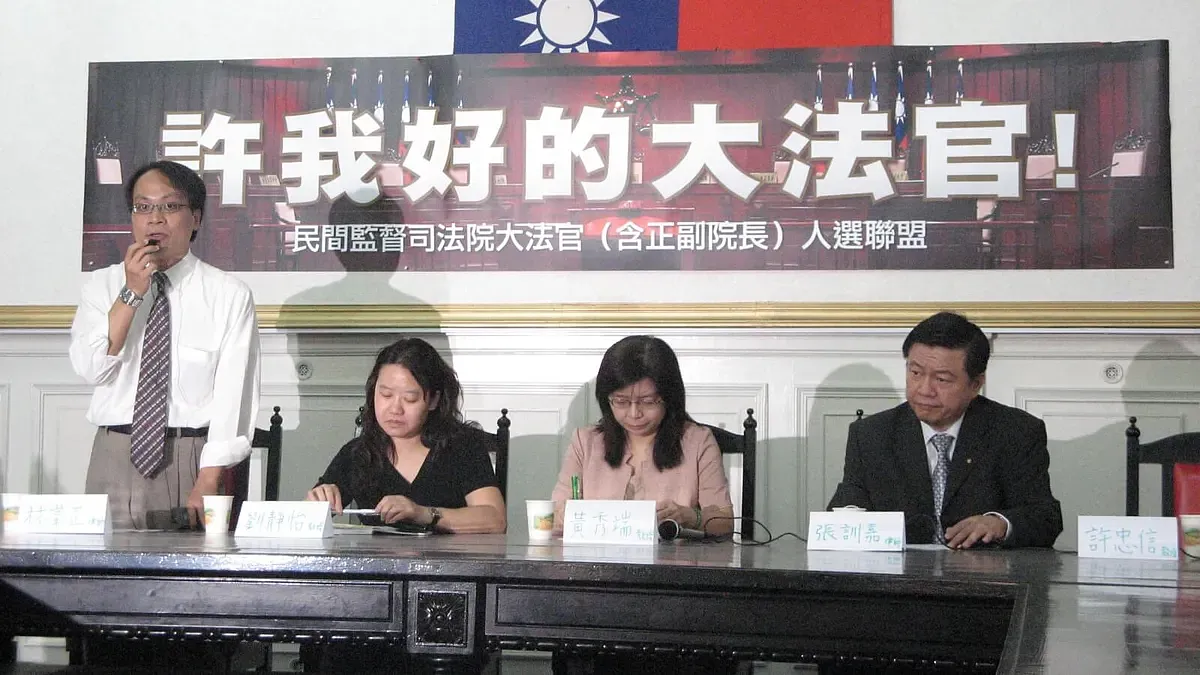
Grand Justices, Give Us an Answer! 42 Questions for the President and Vice-President of the Judicial Yuan and Grand Justice Nominees
Last edited: 2026-08-23
Introduction
On August 31, 2007, President Chen Shui-bian nominated Lai In-jaw as President of the Judicial Yuan. In addition to putting forward three core demands—"1. No bad judges, we want a Judges Act; 2. No delayed justice, we want timely and efficient trials; 3. No botched judgments, we want professional judges with quality"—the Alliance for Civilian Oversight of Candidates for Grand Justices of the Judicial Yuan (including the President and Vice President) also raised 42 questions directed at the nominees for President, Vice-President, and Grand Justices to examine whether their value judgments on current, crucial judicial issues render them qualified for office. Below are the questions published by the Evaluation Committee for Nominees for President and Vice President of the Judicial Yuan and Grand Justices:
Question Bank
I. Question Bank for Nominees for President and Vice-President of the Judicial Yuan:
- When recently assuming office, the newly appointed President of the Supreme Court, Yang Jen-shou, advocated that the unitary single-track system of the Supreme Court currently promoted by the Judicial Yuan should be reconsidered and changed into a dual multi-track system to prevent power from being overly concentrated in the Judicial Yuan. This runs counter to the conclusions of the 1999 National Conference on Judicial Reform. What is your perspective on the direction of organizational reform for the Judicial Yuan?
- Do you support professional law graduate schools? What are your specific views on legal education reform?
- Regarding the public's long-standing low level of trust in the judiciary, how do you think improvements should be made?
- How much longer do you think it will take before we have a Judges Act capable of weeding out bad judges? Can you propose specific measures and make a clear commitment?
- What methods do you have to enable courts to provide the public with timely and efficient trials? How long will it take to achieve such a goal?
- Botched judgments are still heard of from time to time; how much longer must the public endure this? What are your plans for improving such a status quo, and what is the implementation schedule?
- Regarding the reform of criminal procedure, will you still advance in the direction of the principle of a single indictment (charging instrument)? Do you think systems such as detention, restriction of departure, expert witnesses, and reasonable trial periods need to be completely overhauled? Should the sentencing procedure be separated? How can the role and function of defense counsel be further strengthened?
- The Legal Aid System has been implemented for three years. What is your evaluation and view of it?
- How do you think Grand Justices of the Judicial Yuan should strengthen the openness of adjudication proceedings? Regarding constitutional interpretation cases involving important public issues, how should opportunities be strengthened for citizens (or social groups) to participate and express their opinions (such as the "amicus curiae" system in the United States)?
- Outside observers often remark that "the intent of the Judicial Yuan's interpretations of the Grand Justices cannot be understood." Do you think this problem exists? What are the methods to improve this issue?
II. Question Bank for Grand Justice Nominees:
- How do you think the International Covenant on Civil and Political Rights and the International Covenant on Economic, Social and Cultural Rights should be applied in Grand Justice interpretations?
- What flaws do you believe exist in our country's system for protecting people's fundamental rights (including legislative, executive, and judicial)? Compared with the legal systems of advanced democracies (such as the United States, Germany, Japan, etc.) and countries in the third wave of democratization that have made major breakthroughs in constitutional human rights protection systems (such as South Africa, the Czech Republic, etc.), what are the inadequacies?
- How do you think breakthroughs should be made within Grand Justice interpretations before the provisions on people's fundamental rights in the Constitution are amended?
- How do you think the balance between "national security" and "freedom of the press" should be struck?
- Do you support the abolition of the death penalty? Is the death penalty unconstitutional?
- What inadequacies do you think exist in our country regarding the protection of indigenous peoples' rights? Please analyze this from aspects such as culture, language, employment, land, and self-governance.
- Do you think the human rights protection for foreigners in our country should be the same as that for nationals? Does the current legal system have discriminatory phenomena that improperly violate the principle of equality? How should this be improved?
- Do you think the protection of human rights for foreigners and people from mainland China in Taiwan should follow the principle of national treatment?
- Do you think Article 36, Paragraph 2 of the Immigration Act, which permits the indefinite extension of detention for foreigners without a limit on the number of times, is constitutional?
- If a foreign country adopts fingerprinting measures against our citizens, can our country also adopt the same measures against its nationals?
- The application for naturalization and settlement by foreign spouses of nationals appears to be a neutral regulation, yet it results in substantive gender-based differential treatment. That is, although formally it does not distinguish between male or female, in substance those restricted are mostly women, resulting in a more disadvantageous impact on women. Substantive equality theory tends to view such disparate impact as also constituting gender discrimination. However, in practice, those restricted are mostly female new immigrants. Therefore, female new immigrants applying for naturalization and settlement must present proof of financial capacity, which constitutes a harsh burden for lower-income families. Do such measures conflict with "class equality" and "gender equality" under Article 7 of the Constitution?
- What role do you think Grand Justices should play in controversies over the fundamental rights of homosexuals and gender identity rights?
- Do Grand Justices believe that the concept of the right to equality regarding gender should extend to groups with different sexual orientations?
- What are your views on same-sex marriage? Also, what are your views on same-sex married couples adopting children?
- Do you think monogamy is a marriage system that must be absolutely observed? Should non-monogamous marriages adopted by different religious societies be recognized in our country? Can non-monogamous marriages be adopted due to differences in religion or belief?
- What are your views on the definitions of obscenity in Interpretations No. 407 and No. 617?
- What are your views on how Grand Justices protect people's rights to informational privacy and communication privacy?
- What human rights violations might the establishment of a biobank involve? Regarding the controversy over whether Taiwan should establish a biobank, what approach(es) should be adopted to conform to the intent of constitutional human rights protection?
- Do you think it is constitutional to obtain stem cells from surplus embryos of artificial reproduction for research purposes, embryos created via in vitro fertilization, embryos created via somatic cell nuclear transfer, and human-animal chimeric embryos created via somatic cell nuclear transfer, for use in research or disease treatment?
- Where do you think the boundary between judicial power and legislative power lies? Please explain by taking Interpretation No. 530 as an example.
- Do you think the scope of constitutional interpretation by Grand Justices is bound by the scope requested by the petitioner?
- Do you think Grand Justices have the power to require the Legislative Yuan to legislate within a specified time limit? How should Grand Justice Interpretation No. 530 be handled?
- Do you think the relevant provisions of the Enforcement Act for the Suppression of Bandits comply with due process of law?
- Do you think the participation of non-professional judges in trials is constitutional?
- Should there be restrictions on the issues subject to referendums?
- Do you think the establishment of the Referendum Review Committee is unconstitutional?
- Do you think citizen participation or expert participation in trials without judicial qualifications is constitutional?
- Do you think the permit system adopted by the "Assembly and Parade Act" and the "Civil Associations Act" is constitutional?
- Should the application of Article 24 of our Fair Trade Act be restricted based on the protection of economic freedom?
- Does Article 4 of the Labor Union Act, which stipulates that educational personnel shall not form labor unions, comply with the Constitution?
- Article 3 of the Basic Environment Act stipulates that " [I]f economic, technological and social developments have a serious adverse impact on the environment or are likely to be harmful, environmental protection must be given priority." Please explain the relationship between this article in application and other laws involving economic, technological, and social development.
- Article 30 of the Indigenous Peoples Basic Law stipulates that "The government shall respect tribal languages, traditional customs, cultures and values of indigenous peoples in dealing with indigenous affairs, making laws or implementing judicial and administration remedial procedures, notarization, mediation, arbitration or any other similar procedure ...". Please explain how the pluralistic legalism established by this article (where different indigenous peoples have different customary norms) can be implemented in the process of constitutional interpretation.
This article is an AI-generated translation of the original Chinese text. In the event of any discrepancy, the Chinese version shall prevail.