

What is the Judges Act? Moving Toward a Better Judicial Environment
Last edited: 2026-08-23
Why is there an alliance called the "Alliance for the Promotion of the Judges Act"?
The core mission of the alliance is to promote a "Judges Act" capable of weeding out bad judges. But we might ask: what can be achieved if we have a "Judges Act"?
Before explaining this question, let us first understand the role of a "judge."
Judges are public officials and civil servants who receive government salaries (see Article 38, Paragraph 2 of the Judicial Personnel Act: "The remuneration of judicial personnel shall be governed by the Public Functionaries Remuneration Act and shall be provided with professional allowances"). According to Article 80 of the Constitution of the Republic of China (Taiwan): "Judges shall be above partisanship and shall, in accordance with law, hold trials independently, free from any interference." This shows that the work engaged in by judges is "adjudication."
Judges engaged in adjudication are required to adjudicate independently in accordance with the law and free from interference. They therefore differ from ordinary civil servants, who are required to comply with official orders and are subject to a hierarchical relationship of command and obedience with the state. Accordingly, the relationship between judges and the state is one of special appointment.
With respect to the security of tenure and remuneration of judges, the provisions governing civil servants apply, and judges are also entitled to a professional allowance. However, pursuant to Articles 32, 33, and 34 of Judicial Personnel Act:, the provisions governing civil servants do not apply to the dismissal, suspension, or transfer of judges. We must therefore turn back to the relevant provisions of the Constitution.
Article 81 of the Constitution of the Republic of China (Taiwan) provides: “Judges shall hold office for life. No judge shall be removed from office unless he has been found guilty of a criminal offense or subjected to disciplinary measure, or declared to be under interdiction. No judge shall, except in accordance with law, be suspended or transferred or have his salary reduced.”
If a judge fails to meet the requirements of a fair trial, the judge is considered unfit to serve and should therefore be removed from office. Under Article 81 of the Constitution, there are three grounds on which a judge may be removed from office: (1) a final criminal conviction; (2) disciplinary action imposed by the Commission on the Disciplinary Sanctions of Functionaries; or (3) a declaration of interdiction, meaning that the judge is deemed to have a mental impairment. The disciplinary process may be initiated by the Personnel Review Committee of the Judicial Yuan or through an impeachment proceeding brought by the Control Yuan and referred to the Commission on the Disciplinary Sanctions of Functionaries, which then determines whether disciplinary action should be imposed on the judicial officer concerned. In other words, the authorities that initiate disciplinary proceedings are the Personnel Review Committee of the Judicial Yuan or the Control Yuan, while the authority that makes the final determination is the Commission on the Disciplinary Sanctions of Functionaries. The constitutional basis for the Commission on the Disciplinary Sanctions of Functionaries is Article 77 of the Constitution of the Republic of China (Taiwan), which provides: “The Judicial Yuan shall be the highest judicial organ of the State and shall have charge of civil, criminal, and administrative cases, and over cases concerning disciplinary measures against public functionaries.” Accordingly, the Commission on the Disciplinary Sanctions of Functionaries is established under the Judicial Yuan. Like the Personnel Review Committee of the Judicial Yuan, its members are judges. Article 2 of the Public Functionaries Discipline Act provides that disciplinary action may be imposed when a public functionary violates the law, neglects his or her duties, or otherwise engages in misconduct. Consequently, the authority to determine whether a judge should be subject to disciplinary action ultimately rests with individuals within the judicial system itself.
The Alliance for the Promotion of the Judges Act considers reform centered on the people who comprise the judiciary to be an essential component of judicial reform. It therefore hopes that the enactment of the Judges Act will help attract outstanding legal professionals, remove unfit judges from office, ensure fair trials, and improve the quality of judicial decisions. The draft Judges Act covers the recruitment and selection of judges, judicial supervision, judicial evaluation, and judicial discipline.
Judicial supervision is conducted based on the Code of Judicial Ethics. Under the draft Judges Act, the existing Code of Judicial Ethics is to be established by the Judicial Yuan after consulting representatives of judges from courts at all levels nationwide.
The draft Judges Act provides for the establishment of a Judicial Service Tribunal within the Judicial Yuan to adjudicate disciplinary matters involving judges, among other matters. See Chapter 8 of the civil society version of the draft Judges Act for details. The key provisions of the draft are as follows:
Key Provisions of the Judges Act
- The Judges Act expressly abolishes the existing judicial examination system. In the future, judges shall be selected from among prosecutors, attorneys, or legal scholars who have acquired substantial professional experience and qualifications.
- The existing system of official ranks and performance evaluations shall be abolished. Judges’ remuneration shall be increased and placed on a more rational basis, thereby encouraging outstanding judges to remain at the trial-court level.
- A civil society foundation for the evaluation of judges shall be established. Members of the public shall have the right and a clear channel through which to request the evaluation of judges deemed unfit to serve, thereby enabling public oversight of the quality of judicial adjudication.
- A judicial disciplinary mechanism shall be established by law. A Judicial Service Tribunal composed of judges, prosecutors, attorneys, legal scholars, and other impartial members of society shall be responsible for removing judges who are unfit to serve.
If Taiwan had a Judges Act, parties to a case, government agencies, and organizations would have the right to apply for the evaluation of a judge. The grounds for evaluating a judge would include:
- Causing an obvious and serious error in the adjudication of a case through intentional misconduct or gross negligence.
- Seriously violating a duty arising from the judicial office or seriously neglecting to perform such a duty.
- Violating Article 23 (participation in political parties), Article 24 (holding another position or engaging in another occupation or business that may affect judicial independence), or Article 26 (breach of the duty of confidentiality).
- Seriously violating the Code of Judicial Ethics.
The possible outcomes of a judicial evaluation may include the following:
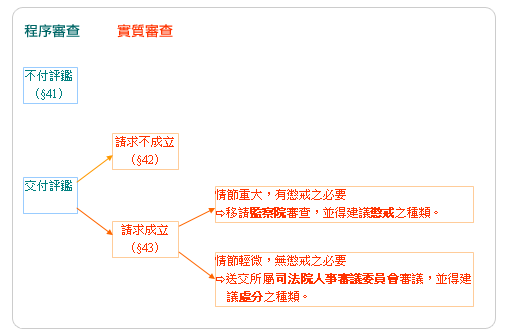
The personnel serving on the judicial evaluation body shall consist of representatives of judges, prosecutors, attorneys, legal scholars, and impartial members of the public (see Paragraph 4 of Article 38 of the civil society version of the draft Judges Act for the number of representatives from each category). This composition is intended to broaden public participation in the oversight of the judiciary, enhance public confidence in the fairness and impartiality of the judicial evaluation mechanism, and ensure that judicial evaluations are not constrained by professional bias.
The Judicial Service Tribunal, which would have broad authority over the disciplinary proceedings against judges, would likewise not be composed exclusively of judges. Pursuant to Article 53 of the civil society version of the draft Judges Act, the composition of the Judicial Service Tribunal would be as follows:
- One Grand Justice.
- Three judges: Selected by the Judges Selection Committee from among judges who have held permanent judicial positions for at least ten years; each shall serve a three-year term.
- Lay adjudicators: Serving on a rotating basis from among four categories of individuals; each shall serve a three-year term.
- One attorney: With at least fifteen years of professional practice.
- One professor: With at least five years of professional experience.
- One prosecutor: With at least five years of experience as a permanent prosecutor.
- One impartial member of the public.
The design of the Judges Act is intended not only to remove judges who are currently unfit to serve, but also to establish an appropriate system for selecting future judges. The most important provisions concerning the qualifications and sources of future judges are found in Chapter 2, “Qualifications for Appointment as a Judge,” and in Paragraph 3 of Article 5, which provides: “Beginning January 1, 2008, examinations for judges shall cease to be administered.” However, due to delays in the legislative process, the Judicial Yuan has announced that the discontinuation of the judicial examination will instead be postponed until 2010.
Diversifying the sources from which judges are recruited is a means of improving the quality of judicial decisions. In the past, judges were recruited primarily through the judicial examination system, which was criticized for producing judges who were too young and lacked sufficient experience of society. Under the Judges Act, in the future, only prosecutors, attorneys, and legal scholars with substantial years of practical legal experience or a strong academic background in law would be eligible to become judges through a selection process.
Attracting outstanding legal professionals to serve as judges and devote themselves to adjudication will enable truly capable judges to earnestly and effectively uphold judicial justice. At the same time, judges who are negligent, shirk their responsibilities, lack awareness of human rights, or are burdened by professional bias should not be allowed to continue wasting judicial resources. In other words, rewarding excellence and removing the unfit are the most important functions of the Judges Act.
This article is an AI-generated translation of the original Chinese text. In the event of any discrepancy, the Chinese version shall prevail.