

How to Help Yourself When Cases Are Delayed? The Judges Act Self-Help Manual: Case Delays
Last edited: 2026-08-23
First, let readers imagine the following scenario: What if an indictment is submitted to the prosecutors' office and then vanishes into thin air? Or what if a judge holds a court session and orders the matter "awaiting official processing," but no further news is ever heard? When unfortunately encountering such issues with case delays, how should the public handle them? This article provides effective self-help methods, and also encourages the public to report incompetent judicial personnel who are lazy and derelict in their duties, in order to resolve the persistent maladies of the current judicial system.
Self-Help Method 1 Regularly Review Case Files, Proofread Transcripts, and Actively Check Case Progress
The best way to prevent case delays is to regularly review case files before court sessions, apply for copies of audio recordings to proofread transcripts after court sessions, and actively check case progress between court dates to understand the actual status of how judges and prosecutors are handling the case. Such actions not only assist with litigation preparation, but also convey a message to judges and prosecutors that one takes their own rights seriously, reminding adjudicators to handle cases promptly and expeditiously.
In response to the internet era, judicial organs have now established online case progress inquiry systems that are convenient and simple. Especially for cases under investigation, other than submitting written urges for prompt action or calling the clerk, checking online is the most effective method to find out case progress, and the public is advised to make good use of it.
Instructions for Using the Online Inquiry System for Cases Under Investigation
- Please link to the "Ministry of Justice Convenient Online Application Services" website.
- Please find the item "Apply for Inquiry into Case Progress" and click "Online Application"
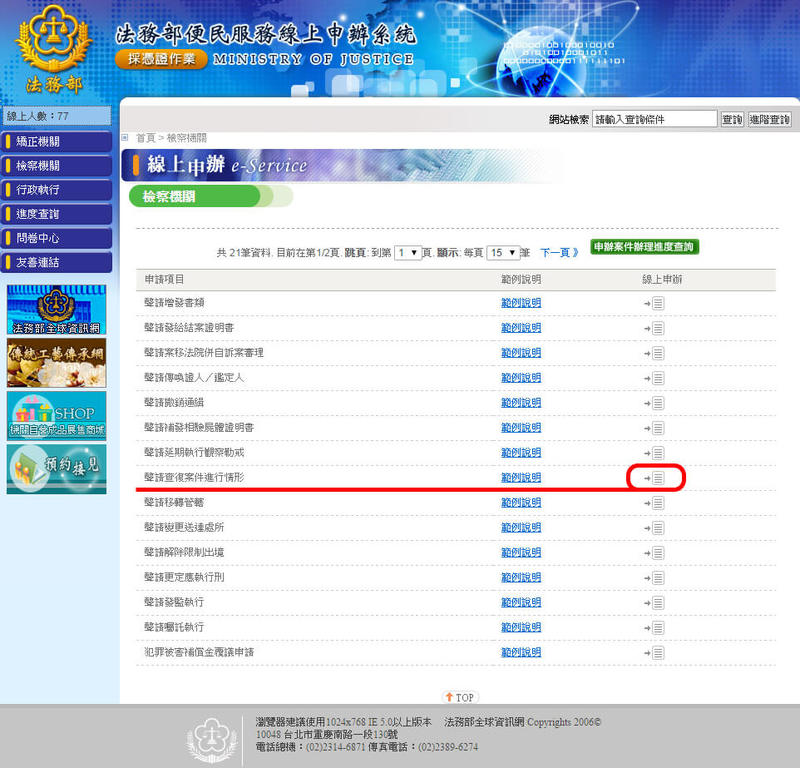
- Clicking "Online Application" will lead to the "My e-Government" webpage. This application requires the use of a "Citizen Digital Certificate". If you have any questions, you may call the "My e-Government" Customer Service Center at (02)2192-7111.
Instructions for Using the Online Inquiry System for Cases Under Adjudication
- Please link to the "Judicial Yuan Case Progress Inquiry System" website.
- Please click the "Application Area for This Service", download the sample form for "Online Application Form for Case Progress Inquiry" or "Indictment", state your E-MAIL account, and submit the application to the court accepting the litigation.
- After receiving the activation notification E-MAIL, the applicant will receive E-MAIL notifications actively sent by the court regarding the latest trial progress, and may also log onto the website at any time to make inquiries. If you still have not received the court's activation notification E-MAIL 5 days after application, please check whether it was moved to the spam folder.
Self-Help Method 2 Review Statutory Case-Handling Time Limits and Demand Prompt and Expeditious Trial by Judges and Prosecutors
Case delay refers to the presiding judge or prosecutor violating "case-handling time limit" or "prompt and expeditious trial" regulations, resulting in cases not being handled as scheduled or in a timely manner. The relevant laws and regulations concerning the time management of judicial trials are summarized below:
-
Check at "Judicial Yuan Regulatory Domain"
- Directives for the Implementation of Case-Handling Time Limits by Courts at All Levels
- Regulations Governing Case-Handling Time Limits for Administrative Courts at All Levels
- Regulations Governing Case-Handling Time Limits for the Intellectual Property Court
- Regulations Governing Adjudication Time Limits for Juvenile and Family Courts
- The Criminal Speedy Trial Act
- Directions for the Application of the Criminal Speedy Trial Act by Courts
-
Check at "Ministry of Justice Regulatory Domain"
- Directives for Case-Handling Time Limits and Prevention of Delays in Prosecutorial Organs
- Table of Time Limits for Prosecutorial Organs at and Below the Taiwan High Prosecutors Office and Their Branch Offices in Handling Applications by the People
Reviewing the aforementioned regulations, if any faults or omissions are found, it proves that the case has been delayed. Parties may urge judges and prosecutors to improve on their own, or request the court or prosecutors office to supervise and investigate ex officio. Due to the complexity of the laws and regulations, this article provides three simple criteria for reference:
-
Whether the Case Has Continuous Court Sessions
For cases under investigation or adjudication, if there are no court sessions for more than 2 months, attention should be paid as there may be an issue of delay. If there are no court sessions for more than 3 months, one should actively understand the reasons; if there is a lack of justifiable cause, it is delayed case handling; if there are no court sessions for more than 6 months, it is a serious delay. -
Whether the Case Has Exceeded the Statutory Time Limit for Investigation or Adjudication
If the case-handling time exceeds the statutory time limit and lacks a justifiable cause, it is a case-handling delay. The statutory time limits concerning cases under investigation or adjudication from the aforementioned regulations are sorted into the following table for self-review and comparison. Case Type
Statutory Time Limit
General Investigation Cases
8 months
Medical Dispute Cases and Fraud, Breach of Trust, and Embezzlement Cases Not Belonging to Economic Crimes
1 year
Major Criminal Cases
4 months
Rexacting (Re-examination) Cases
3 months
Criminal Enforcement Cases
6 months
Civil and Non-contentious Events Participated in by Prosecutors
3 months
Civil and Criminal Summary Procedure First-Instance Adjudication Cases
7 months
Civil and Criminal Ordinary Procedure First-Instance Adjudication Cases and Civil Enforcement Events
1 year
Civil and Criminal Second-Instance Adjudication Cases
1 year and 6 months
Civil and Criminal Third-Instance Adjudication Cases
9 months
Civil and Criminal interlocutory Appeal (Antao) Cases
5 months
Bankruptcy Events and Corporate Reorganization Events
1 year
Traffic Objection Cases
6 months
Traffic interlocutory Appeal (Antao) Cases
5 months
Social Order Maintenance Act Cases
2 months
Interlocutory Appeal Cases in Bankruptcy Events and Corporate Reorganization Events
1 year
Civil Small Claims Procedure First-Instance Adjudication Cases
4 months
Civil Mediation Events
3 months
Civil Ordinary Protection Order Events
4 months
Civil Temporary Protection Order Events
2 months
Labor Dispute Civil Summary Procedure First-Instance Adjudication Cases
5 months
Labor Dispute Civil Ordinary Procedure First-Instance Adjudication Cases
5 months
Election and Recall Litigation Cases for the President, Vice President, and Public Officials at All Instances
5 months
Applications for Debt Restructuring and Liquidation under Consumer Debt Clearance
6 months
Enforcement Events for Debt Restructuring and Liquidation under Consumer Debt Clearance
1 year
Interlocutory Appeal Events under Consumer Debt Clearance
5 months
Intellectual Property Criminal Summary Procedure First-Instance Adjudication Cases
7 months
Intellectual Property Civil and Criminal Ordinary Procedure First-Instance Adjudication Cases and Compulsory Enforcement Events
1 year
Intellectual Property Civil and Criminal Second-Instance Adjudication Cases
1 year and 6 months
Intellectual Property Civil and Criminal Third-Instance Adjudication Cases
9 months
Intellectual Property Civil and Criminal interlocutory Appeal Cases
5 months
Intellectual Property Civil Mediation Events
3 months
Intellectual Property Provisional Status Disposition Events and Their Interlocutory Appeal Events
7 months
Other Applications or Motion Cases
4 months
-
Whether the Case Has Justifiable Causes Deemed Not to Be a Delay
Because judicial cases vary greatly in difficulty, justifiable causes deemed not to be a delay are set within the case-handling time limits, which can legally extend the time limit without constituting a case-handling delay. The public can check whether justifiable causes exist through reviewing files or inquiring about case progress, so as to judge whether there is a case-handling delay. It is specially explained that even if there are justifiable causes, judges and prosecutors must review every 3 months whether the causes have ceased to exist, or seek alternative methods, and may not extend them indefinitely.
Justifiable causes for criminal investigation cases not proceeding according to the time limit:
- The defendant or a key witness has been lawfully summoned but failed to appear in court, and cannot be brought in by a writ of arrest for interrogation.
- The defendant or witness cannot appear for interrogation because they are performing military service, are detained in another case, are serving a sentence, or have been transferred to execute observation and re-education or compulsory treatment dispositions due to violating the Narcotics Hazard Prevention Act.
- The defendant or witness cannot appear for interrogation due to undergoing treatment for a serious illness or severe injury.
- The defendant or witness cannot appear for interrogation due to boarding a vessel for offshore operations.
- The defendant or witness cannot appear for interrogation because they are currently abroad or in mainland China.
- The witness cannot be arrested and brought back because they are wanted in another case.
- An accomplice is wanted or has failed to appear, making it impossible to further verify evidence in this case.
- Evidence has been sent for appraisal, or evidence should be investigated abroad or in mainland China, and the appraisal or investigation results cannot be obtained.
- Whether a crime is established depends on another crime, and that other crime has been indicted but a final judgment has not yet been rendered, making proceedings impossible.
- It is necessary to review the case files of other cases, but they could not be retrieved.
- There are other special reasons approved by the Chief Prosecutor.
Self-Help Method 3 Invoke The Criminal Speedy Trial Act to Safeguard the Right to a Speedy Trial
Criminal cases are specially provided with the Criminal Speedy Trial Act, requiring judges and prosecutors to safeguard the defendant's right to a speedy trial in accordance with the law. The important provisions of this act are in Articles 5, 7, 8, and 9, which please review independently. What this article wishes to specially introduce are the important provisions of the "Points of Attention for Prosecutorial Organs to Promptly and Expeditiously Handle Criminal Cases", which the public is advised to frequently invoke and use:
Points of Attention for Prosecutorial Organs to Promptly and Expeditiously Handle Criminal Cases – Important Provisions
- Where a case has exceeded two years from the date the prosecutor commenced investigation and has yet to be concluded, the Prosecutor-General and the Chief Prosecutor shall understand the reasons, and when necessary, shall personally or assign a senior prosecutor (chief prosecutor) or prosecutor to handle the case jointly, or transfer the case to other prosecutors under their command and supervision for handling. (Point 11)
- Where a case has exceeded two years from the date the prosecutor commenced investigation, and has been ordered by the chief prosecutor of a higher court prosecutors office or the Prosecutor-General to continue investigation three times or more, if the prosecutor renders a non-prosecution disposition or suspension of prosecution disposition again, and upon the complainant's application for re-examination (rexacting), or the prosecutor ex officio directly submits it to the chief prosecutor of a higher court prosecutors office or the Prosecutor-General for re-examination (rexacting), and the chief prosecutor of the higher court prosecutors office or the Prosecutor-General considers that the investigation is still incomplete, they should, pursuant to Article 64 of the Court Organization Act, personally or order a prosecutor of that office to conduct further investigation, and should not order the prosecutor of the original court prosecutors office to continue investigation. In the circumstances of the preceding paragraph, after the investigation is completed, if it is still deemed that the re-examination (rexacting) is well-founded, they shall order the prosecutor of the original court prosecutors office to institute an indictment; if it is deemed groundless, they shall dismiss it. (Point 13)
- Where a public prosecution is instituted or a summary judgment disposition is applied for more than five years after the date the prosecutor commenced investigation, the prosecutor may consider the following matters and request the court to appropriately reduce and mitigate the sentence: (1) The defendant has been subject to detention and the period of detention. (2) The case has long failed to be concluded through no fault of the defendant. (3) The case is legally and factually intricate and complex, resulting in the failure to conclude the investigation promptly. (Point 14)
Self-Help Method 4 Demand Agency Heads to Replace Judges and Prosecutors Who Delay Case Handling
During investigation or adjudication, if one encounters a situation of case delay, and the situation still cannot be improved after using the aforementioned methods, the public may demand the heads of judicial organs to replace the judges and prosecutors who delay case handling in accordance with the following regulations.
-
Paragraph 2, Article 21 of the Judges Act
For the protection of people's rights to litigate and to serve in a public office, the president of a court or branch court at all levels may submit a delayed and undecided case to the Council of Judges and reassign the case to other judge(s) at the same court, or to take other appropriate disposition. -
Items 2 and 4, Paragraph 1, Article 93 of the Judges Act
The following provisions stipulate the administrative supervision scheme of the Prosecutors Office and its branch offices at all levels: 2. The Prosecutor General of the Supreme Prosecutors Office supervises the Supreme Prosecutors Office. 4. The Chief Prosecutor of the Intellectual Property Branch Office, of the High Prosecutors Office, supervises the said branch office.
Self-Help Method 5 Ex Post Facto Punishment of Judges and Prosecutors Who Delay Case Handling
After the conclusion of investigation or adjudication cases, targeting lazy and derelict judges and prosecutors, the public may petition organs and organizations eligible to request individual case evaluations under the Judges Act, such as the Judicial Reform Foundation, to report and punish unfit personnel. The legal basis is as follows:
-
Item 6, Paragraph 2, Article 30 of the Judges Act
The Judge "[u]ndue delay of the case process without proper justification which severely affects the rights and interests of the parties." -
Item 6, Paragraph 4, Article 89 of the Judges Act
A prosecutor "[u]ndue delay of the case process without proper justification which severely affects the rights and interests of the parties."
Omitted Appeal? Typing Too Slowly?
Ms. Wang accused someone of the crime of document forgery. The first-instance court judged the defendant guilty, and the second-instance court judged the defendant not guilty. On August 27, Ms. Wang filed a written motion requesting the prosecutor of the High Prosecutors Office to appeal to the third-instance court, but unexpectedly received a notice of "inability to process" from the High Prosecutors Office on November 29, only to find out that the prosecutor had not appealed to the third-instance court, and the entire case had become final. Ms. Wang suspected that the prosecutor was lazy, derelict in duty, and omitted the appeal, and filed a report.
In response, the handling prosecutor replied with the following reasons for delay:
- To cooperate with policy and respond to trends, handwriting was no longer used to handle cases, and being a beginner at learning computer-generated legal documents, typing was slow.
- Both thumbs and middle fingers suffered from cellulitis and swelling, which was sometimes better and sometimes worse, persisting for over a year, making typing even slower.
- Heavy workload; besides attending court to execute public prosecution every other week, the remaining half of the time still required handling other time-sensitive or preferentially prioritized re-examination (rexacting) cases. Moreover, because many cases required time-consuming, meticulous, and detailed review to strive for correct results, no leave was taken throughout the entire year for many years, and it was also likely the division with the largest case volume.
Half a year later, Ms. Wang received a reply from the Ministry of Justice, explaining that the handling prosecutor had been disciplined with a "formal reprimand once", but the reason was not omitting the appeal, but rather processing the appeal case exceeding the statutory 10-day period and failing to promptly notify the applicant. Upon investigation, that prosecutor was simultaneously given 4 formal reprimands, which is believed to be due to serious delays in other cases as well.
Conclusion: Justice Delayed Is Justice Denied
The operational efficiency of Taiwan's judiciary is poor, and trials drag on for years, leaving the people in untold misery. The reason for delayed judicial justice is bureaucratic mentality—the true examples of "muddling along brings smooth sailing; working hard brings removal and investigation" are frequently seen in the legal profession. In the past, there was a lack of regulations to punish laziness and dereliction, and slacking judges and prosecutors created bad money driving out good, affecting the overall judicial ecosystem. Today, the Judges Act clearly stipulates disciplinary regulations for case-handling delays, and we call on the public to actively help themselves, monitor, report, and eliminate unfit personnel, and rebuild a high-quality and efficient judicial system.
This article is an AI-generated translation of the original Chinese text. In the event of any discrepancy, the Chinese version shall prevail.