
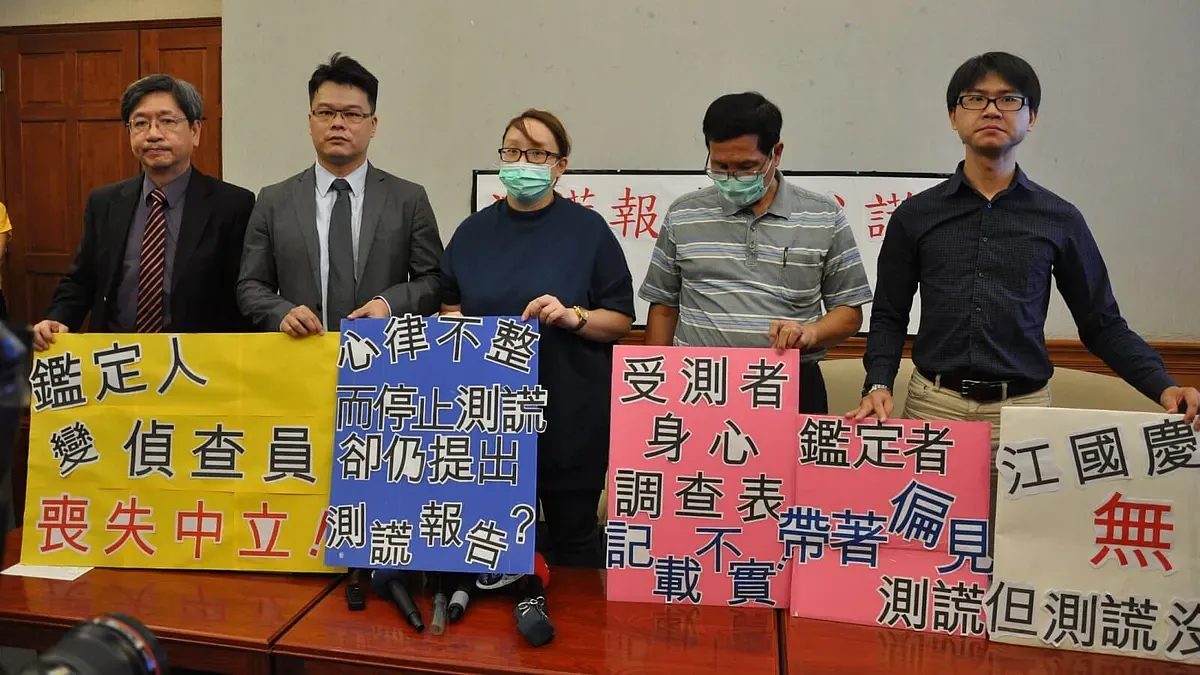
"Lie Detector Reports Can Lie?!" Press Conference
Last edited: 2026-08-24
"Polygraph testing" is often resorted to by judicial practitioners as a form of "divination" when they cannot find sufficient incriminating evidence, yet it remains difficult to judge whether the results reflect truth or nonsense. Lee Fu-kuo of the Ministry of Justice Investigation Bureau once used a polygraph to target Chiang Kuo-ching as the "real culprit" in the rape and murder of a young girl, thereby helping to solve the case. This "feat" was even regarded by him as a representative masterpiece. Over a decade later, after the Chiang case was exonerated, it was discovered that the wrong perpetrator had been identified. Whether the inaccuracy of the polygraph back then was a matter of the test's inherent accuracy or flaws in the testing process remains a question to this day.
To improve the practice of polygraph appraisals, the Judicial Reform Foundation and the Taiwan Innocence Project, in addition to raising the Chiang Kuo-ching case, will also submit three other cases suspected of polygraph flaws to the Control Yuan for petition, in order to comprehensively review the current practical operations of polygraph appraisals.
1. Chiang Kuo-ching Case: Chiang Kuo-ching was innocent, yet failed the polygraph test. The polygraph examiner was Lee Fu-kuo of the Ministry of Justice Investigation Bureau.
In the famous Chiang Kuo-ching wrongful death case, the judgment of the Air Force Operations Command that originally found Chiang Kuo-ching guilty recorded that "according to the appraisal polygraph report made by the Ministry of Justice Investigation Bureau for the defendant, it was discovered that he was heavily implicated and thus targeted." Subsequently, investigators claimed to have broken Chiang Kuo-ching's psychological defense, leading Chiang Kuo-ching to confess. Facts have proven that the liar identified by the polygraph expert of the Ministry of Justice Investigation Bureau was precisely the innocent person who was wrongfully executed. Lee Fu-kuo, the polygraph expert who conducted the test at the time, stated that polygraph testing is a symbol of human rights protection because it can replace torture and screen whether suspects are involved in crimes (1997/01/02 United Evening News). Looking back now, this appears exceptionally ironic.
After the Ministry of National Defense paid out over 100 million NTD in compensation, it turned to seek damages from eight individuals, including the then-Commander of the Air Force Operations Command, the counterintelligence team personnel who investigated the case, and military legal personnel. However, the polygraph personnel who steered the investigation direction toward the innocent Chiang Kuo-ching were never held accountable, and the Investigation Bureau did not conduct any review.
2. Lo Ming-tsun Case: The polygraph examiner was again Lee Fu-kuo of the Ministry of Justice Investigation Bureau.
This case is a corruption case in which the court sentenced Lo Ming-tsun to 13 years of imprisonment. The basic facts of the case are: a witness was subjected to improper interrogation at the Investigation Bureau and identified police officer Lo Ming-tsun as having accepted bribes, but later completely recanted during the trial. However, because Lo Ming-tsun still failed the polygraph test, his defense was not adopted by the court, and his guilty verdict was finalized. The polygraph test in this case had the following flaws:
Flaw
The appraisal report was submitted before the polygraph procedure was completed
Specific Content of the Flaw
Polygraph testing includes pre-test interviews, primary testing, and post-test interviews. While the "pre-test interview" alone requires 30 minutes to 2 hours, the entire polygraph procedure in this case took only 29 minutes. The examiner originally prepared 9 questions, but the test question set shown in the chart* reached a maximum of only 6 questions, failing to ask them all completely. ※Note: A chart is a graph recording the physiological responses of the examinee during a polygraph test, on which the questions actually asked during the test are marked.
Flaw
The polygraph examiner stated "your heartbeat has a problem" yet claimed the polygraph test was failed
Specific Content of the Flaw
During the polygraph process, the examiner told Lo Ming-ts'un, "Your heartbeat has a problem" and "You need to go get it checked," and stopped the polygraph test because they believed Lo Ming-tun had a heart problem, yet still concluded in the polygraph report that Lo Ming-tsun was "lying."
Flaw
The polygraph chart was suspected of being falsified
Specific Content of the Flaw
The order and number of questions on the chart differed from the order and number of questions designed by the examiner. The signature of the principal on the chart was executed by the examiner, not by Lo Ming-tsun.
3. Tsai Lin-yüan Case: The polygraph examiners were Lin Chen-hsing of the Ministry of Justice Investigation Bureau and Hsiao Chih-ping of the National Police Agency.
This case is a sexual autonomy offense case, in which the court sentenced Tsai Lin-yüan to 7 years and 4 months of imprisonment. The basic facts of the case are: a homeless woman A accused Tsai Lin-yüan, a person with moderate intellectual disability, of sexually assaulting her. Another male homeless person who had originally testified that Ts'ai Lin-yüan was involved in the sexual assault later recanted, alleging that woman A's mother had instigated him to commit perjury. The appraisal report showing a failed polygraph test was the only "scientific" evidence in this case. The polygraph test in this case had the following flaws:
Flaw
The qualifications of the examiners were inaccurately recorded
Specific Content of the Flaw
The American Polygraph Association requires members to undergo training to learn the latest polygraph techniques every year in order to maintain membership qualifications. Examiner Lin Chen-hsing obtained American Polygraph Association membership in 1997, but his membership was suspended in 2010. However, in the appraisal report submitted that year, Lin Chen-hsing claimed to be a member of the American Polygraph Association without disclosing that his membership had been suspended. Examiner Hsiao Chih-ping claimed in the appraisal report to have American Polygraph Association membership qualifications, but attached no proof of qualification, and his name cannot be found in the American Polygraph Association membership database.
Flaw
The examinee had a moderate intellectual disability, yet the examiners still forcibly conducted the test
Specific Content of the Flaw
Polygraph experts consider individuals with an IQ below 70 unsuitable for polygraph testing. Tsai Lin-yüan's IQ is only 51, yet he was still subjected to a polygraph test. During the testing process, Tsai Lin-yüan already exhibited obvious comprehension obstacles, but examiner Hsiao Chih-ping instead regarded this as a failure to cooperate with the test and scolded him: "Don't you go messing around here. You need to follow my instructions; don't mess around yourself with the things I ask you. If you mess around, I actually know all about it."
Flaw
The examiner confused the roles of a neutral appraiser and an investigative personnel
Specific Content of the Flaw
Based on the role of a neutral appraiser, the purpose of a "post-test interview" is to confirm with the examinee the true meaning of their chart responses in order to ascertain whether there are other factors affecting the polygraph. However, during the "post-test interview," examiner Hsiao Chih-p'ing said to Ts'ai Lin-yüan, "Why do you want to bully this young girl like this? Speak up" and "If you toy with justice like this, you will definitely receive a heavy sentence." It is evident that he had positioned himself in the role of an investigative personnel to conduct the interrogation.
4. Mr. Hsieh's Case: The polygraph examiner was again Lin Chen-hsing of the Ministry of Justice Investigation Bureau.
This case is a violation of the Public Officials Election and Voted Act, and was remanded and改判 (changed to) not guilty in the fourth retrial. The basic facts of the case are: Mr. Hsieh was reported by an informant for allegedly involving in vote-buying, with no other clear evidence. However, four witnesses who testified that he did not engage in bribery had their testimonies dismissed because they failed the polygraph test. It was not until the fourth retrial that severe flaws in the polygraph were discovered, and the entire case was reversed to a not guilty verdict. The polygraph test in this case had the following flaws:
Flaw
Inadequate pre-test interview
Specific Content of the Flaw
Pre-test interviews must include introducing polygraph principles, understanding the examinee's background, analyzing case issues, and discussing polygraph questions, but the examiner did none of these.
Flaw
False and inaccurate records on the examinee's physical and mental questionnaire
Specific Content of the Flaw
The examinee stated that he had only slept for 2 hours the day before the polygraph and that his sleep condition was not very good, but the examiner filled in the sleep duration as "6 hours" and sleep condition as "fairly good."
Flaw
Displaying bias during the polygraph process
Specific Content of the Flaw
When conducting a polygraph on a witness, the witness stated that they had not received bribe money, and the examiner unexpectedly said, "This seems to be an open secret."
Flaw
Employing the "Modified General Question Test (MGQT)" for polygraph testing without following the prescribed MGQT format
Specific Content of the Flaw
The "Modified General Question Test (MGQT)" requires asking the examinee 10 to 11 questions, which must include 2 control questions, and testing 3 to 4 times. However, the examiner in this case formulated only 6 questions, included only 1 control question, and tested only 2 times. The 6 questions modified by the polygraph examiner were not validated for validity.
A substantive examination of the testing processes of these self-proclaimed qualified polygraph examiners is chilling. Therefore, we raise the following three demands:
- We petition the Control Yuan to conduct an in-depth investigation into the polygraph flaws in the Chiang Kuo-ching case, Lo Ming-tsun case, Tsai Lin-yüan case, and Mr. Hsieh's case, and to propose impeachments against unqualified polygraph personnel based on the degree of culpability, or request their affiliated agencies to suspend them from duties and provide retraining.
- We petition the Control Yuan to require polygraph units to establish rigorous standard operating procedures for various polygraph methods, providing polygraph personnel with clearer standards to follow and subjecting them to more meticulous scrutiny.
- Under circumstances where current practical polygraph testing processes are fraught with problems yet difficult to subject to substantive examination, we petition the courts to use polygraph testing with caution as evidence of guilt.
Principal Parties
Family of Ts'ai Lin-yüan, Eldest daughter of Lo Ming-ts'un
Attendees
Chairman of the Judicial Reform Foundation / Attorney Lin Yung-sung
CEO of the Taiwan Innocence Project / Attorney Lo Shih-hsiang
Standing Executive Committee Member of the Judicial Reform Foundation / Attorney Lin Chun-hung
Deputy CEO of the Judicial Reform Foundation / Attorney Chen Yu-fan
Press Contact
Executive Secretary of the Judicial Reform Foundation, Lin Wei-ting 02-25231178#21
This article is an AI-generated translation of the original Chinese text. In the event of any discrepancy, the Chinese version shall prevail.