
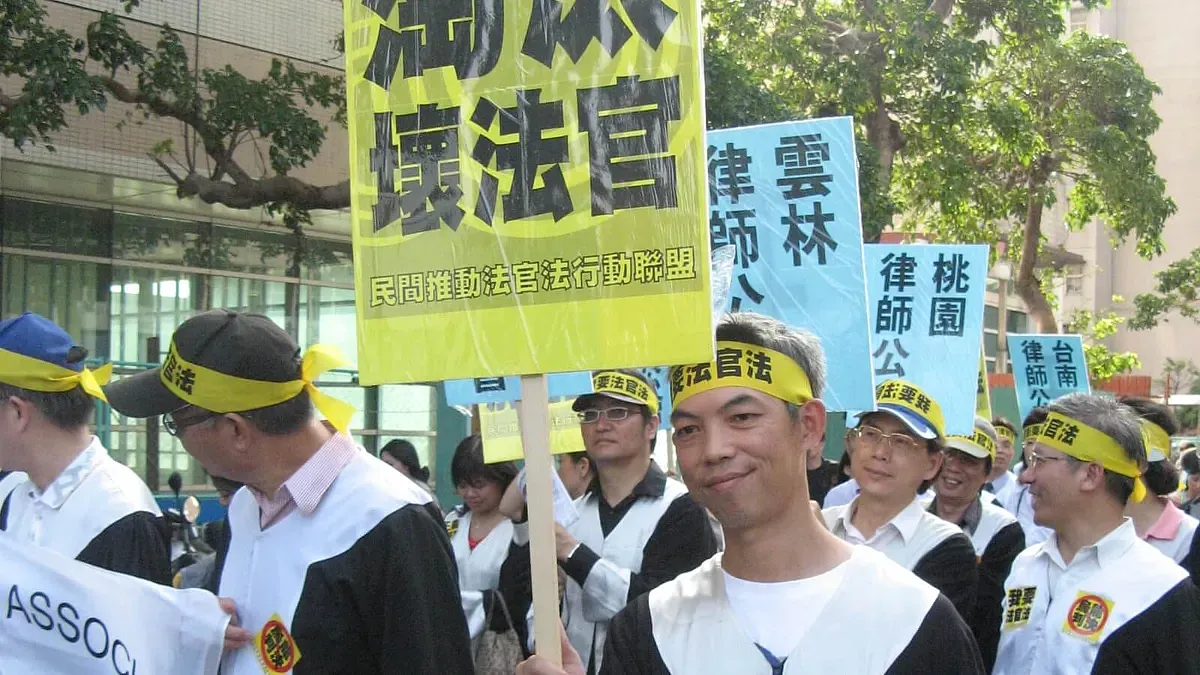
Mr. Ma! Judicial Reform Is Not Just Talk!
Last edited: 2026-08-24
On December 21, 2007, Legislative Yuan President Wang concluded the final plenary session of the current parliamentary term. Due to the rule of parliamentary continuity, all bills that failed to pass the third reading by the deadline were completely voided and had to be restarted in the next session without exception. Among them, the draft Judges Act, strongly promoted by judicial reform groups, ultimately fell short because the Kuomintang (KMT) caucus and the Non-Partisan Solidarity Union refused to sign the negotiation conclusions.
At 10:00 a.m. on December 28, 2007, the highly anticipated second-instance verdict was handed down in the special-expense case involving Mr. Ma Ying-jeou, the KMT presidential candidate, arising from his tenure as Mayor of Taipei. Former Mayor Ma was acquitted, and many of his supporters welcomed the verdict as restoring his good name. However, in a subsequent press conference, former Mayor Ma publicly stated that after nearly 10 months of litigation, he had experienced the feelings of ordinary citizens facing interrogation and trial. Believing that any unjust grievances imposed on him could also be inflicted upon anyone else, he promised that "upon being elected," he would establish a judicial system trusted by the people.
On January 3, 2008, Mr. Ma Ying-jeou commissioned lawyers to file a complaint with the Taipei District Prosecutors Office against Special Investigation Division prosecutor Hou K'uan-jen for allegedly falsifying records, and reported three prosecutors—Shen Ming-lun, Chou Shih-yu, and Hou Kuan-jen—accusing them of abuse of power and failure to prosecute Chen Yue-hsin, former director of the Taipei Office of the Kaohsiung City Government, who was alleged to have written off expenses using false receipts while investigating the special-expense case of former Kaohsiung Mayor Frank Hsieh.
These three events, each separated by a week, are all coincidentally related to judicial reform and contain strong implications that may determine the advance or retreat of Taiwan's judicial reform.
During the trial of Mr. Ma Ying-jeou's special-expense case at the Taipei District Court, his appointed lawyers exposed inaccuracies in the witness testimony recorded by prosecutor Hou Kuan-jen, leading the Taipei District Court to reject that witness testimony. Seven days after the second-instance court once again found Mr. Ma Ying-jeou not guilty, Mr. Ma took the unprecedented and drastic step of formally filing a complaint against prosecutor Hou Kuan-jen with the Taipei District Prosecutors Office in an attempt to vindicate his individual case.
Regarding whether there were flaws in the witness records compiled by prosecutor Hou, we do not oppose Mr. Ma Ying-jeou using formal legal action to uncover the truth, and we even express affirmation of Attorney C.V. Chen statement that arbitrary and autocratic actions by a minority of prosecutors destroy public trust in prosecutors.
However, an even more serious reality regarding the abuse of power and illegality by prosecutors, as we perceive it, is that in the handling of thousands of cases involving ordinary citizens every day, the human rights violations "actually" caused by prosecutors clearly do not fall under the unfair treatment by prosecutors that Mr. Ma Ying-jeou "claims" to have endured. Mr. Ma Ying-jeou, a presidential candidate in all his majesty, can file a lawsuit, but what about ordinary people?
The judicial system trusted by the people that Mr. Ma Ying-jeou promised to build "after being elected," as expressed after his acquittal in the second instance on December 28 of last year, was preceded by hands-on, immediate action "before being elected" to strive for the redress of his own individual case. This is certainly worth pondering and analyzing.
We hope that Mr. Ma Ying-jeou, who is competing for the presidency, will not only care about case-specific justice and take drastic action by suing a prosecutor, but also refrain from keeping systemic reforms at the level of mere wishes. His concrete approach is simple and easy: demand that the KMT legislative caucus support the passage of the draft Judges Act—which can weed out bad judges (and applies to prosecutors as well)—so that the general public can clearly see that Mr. Ma Ying-jeou's commitment to judicial reform is truly more than just talk. Of course, if the Legislative Yuan could be convened for an extraordinary session after the legislative elections before the current term expires at the end of January to pass the Judges Act sooner, it would be a tremendous boost to Mr. Ma's electoral campaign!
※ This article was published on Page A15 of the Liberty Times Free Plaza on January 5, 2008. This is the complete original text.
This article is an AI-generated translation of the original Chinese text. In the event of any discrepancy, the Chinese version shall prevail.