
Sower of Legal Education: Press Conference on the Allocation and Use of Kingston's Donation
Last edited: 2026-08-24
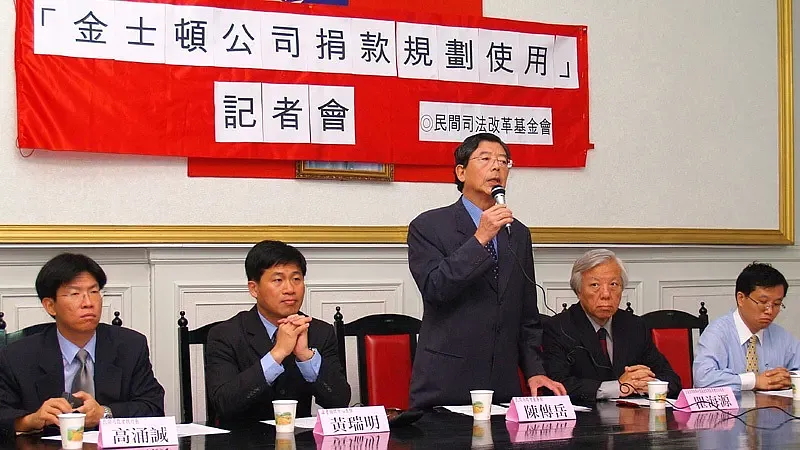
On April 13, 2006, the Judicial Reform Foundation held a press conference at the National Federation of Bar Associations meeting room to officially announce the usage plan for the remaining funds donated by Kingston Technology after subsidizing the recount costs, in accordance with the contract. The joint press conference was attended by JRF Chairperson Chen Chuan-yue, Prof. Chiu Hei-yuan of the Academia Sinica's Institute of Sociology, Attorney Remington Huang, Attorney Huang Hsu-tien, and JRF CEO Attorney Kao Yong-cheng.
Following the 2004 presidential election, Mr. David Sun of Kingston Technology in the U.S. observed social turbulence arising from election disputes and the heavy financial burden of recount procedures. Wishing for Taiwanese society to uphold the ideals of ethnic integration and loving Taiwan, and to resolve related disputes rationally through judicial procedures, he pledged a donation of NT$100 million. He entrusted the Judicial Reform Foundation to distribute these funds, after the conclusion of the election lawsuits, to the parties responsible for paying the recount costs. On April 16, 2004, the JRF publicly signed an agreement with Kingston Technology representatives and established the "Love Taiwan Ethnic Integration Special Account" to handle matters concerning the subsidization of election lawsuit inspection (recount) expenses.
Description of Donation Utilization
Following the judicial ruling on the presidential election lawsuit, the JRF distributed NT$17,222,626 on August 17, 2005, from the Kingston donation to cover the recount expenses incurred by Mr. Lien Chan and Mr. James Soong. The remaining donation of NT$82,777,374, coupled with an additional NT$2.63 million collectively donated by enterprises such as Hsieh Sen Company, brought the total balance of this special account—including accrued interest—to NT$85,691,381 as of March 20, 2006.
According to the aforementioned contract, any remaining funds must be used to promote ethnic integration, human rights education, legal education, and judicial reform. To this end, in accordance with the contract, the Foundation allocated 50% of the remaining funds, totaling NT$42,845,691, to establish the "Ethnic Harmony Public Welfare Trust Fund" to promote initiatives and activities fostering ethnic harmony. In addition, NT$21,422,845 was allocated to establish the "Roots-Down Legal Education Center" to promote education related to human rights and the rule of law; and NT$24,122,845 was allocated to establish the "Legal Ethics Center" to advance research and promotion on legal ethics, aspiring for Taiwan to become a society that values human rights, justice, democracy, the rule of law, and rational discourse.
Introduction to the Ethnic Harmony Public Welfare Trust Fund
In December 2005, the JRF signed the "Ethnic Harmony Public Welfare Trust Fund Domestic Public Welfare Trust Contract" with the Central Trust of China. Pursuant to this contract, the Foundation appointed the following individuals as fund advisory committee members: Mr. Hsu Cheng-chi (Kingston Technology's Taiwan representative), Prof. Chiu Hei-yuan, Attorney Chen Chuan-yue, Convenor Chien Hsi-chieh of the Pan-Purple Coalition, Prof. Hsiao Hsin-huang, Prof. Chang Mao-kui, Prof. Hsia Hsiao-chuan, Prof. Wu Chi-kwang, Father Peter Nguyen Van Hung (from Vietnam), indigenous Attorney Pawan Yumin, Prof. Ku Chung-hwa, Prof. Huang Chang-ling, Attorney Remington Huang, Prof. Chen Yi-chien, and Prof. Wang Fu-chang. From the advisory committee, Chiu Hei-yuan , Chen Chuan-yue, Chang Mao-kui, Hsia Hsiao-chuan, and Chien Hsi-chieh were elected as executive advisory committee members, with Chiu Hei-yuan serving as the chairperson. The committee also passed the "Regulations for Application and Review of Subsidies from the Ethnic Harmony Public Welfare Trust Fund."
Recently, the first executive advisory committee actively prepared and promoted two proposals. The first proposal is to publicly solicit teams to plan multicultural teaching plans for schools at all levels based on their respective educational objectives and curricula, incorporating key concepts and domestic and international experiences regarding ethnic harmony and multiculturalism. The second proposal involves planning human rights investigations for disadvantaged groups, conducting post-incident monitoring and review of ethnic conflict or discrimination events, and incorporating these into investigative reports. In principle, these will be presented in the form of annual reports, with investigative reports on individual cases published separately when necessary. The reports may include lists and recommendations regarding violations of the human rights of disadvantaged groups, as well as annual records of ethnic issues and analyses/reviews of ethnic relations. The executive advisory committee is also actively planning public forums on ethnic harmony and mainstream social education programs.
Starting immediately, the fund will accept proposals and activities promoting ethnic harmony, and civil organizations and individuals are welcome to apply. The fund accepts applications at the end of January, April, July, and October, and reviews will be conducted in March, June, September, and December to determine whether to grant subsidies. The full text of the "Regulations for Application and Review of Subsidies from the Ethnic Harmony Public Welfare Trust Fund" and related information about the fund can be found on the JRF website.
Introduction to the Roots-Down Legal Education Center
As early as 2003, the JRF cooperated with the Chinese Rotary Education Foundation and the Taipei Bar Association to establish the "Special Committee for Roots-Down Legal Education." The Taipei Bar Association signed a licensing contract with the Center for Civic Education in the U.S. to translate and promote its published series in Taiwan, titled Foundations of Democracy: Authority, Privacy, Responsibility, Justice. After nearly three years of implementation, teaching has been introduced into elementary school campuses across multiple locations, and the series received recognition by winning an award for human rights publications in 2005 from the National Institute for Compilation and Translation.
Sensing that as the translation and publication of textbooks suited for all age groups gradually reach completion, the scope of implementation is expanding, the Chung Hwa Rotary Educational Foundation—which led the committee's operations—felt it might soon lack the capacity to single-handedly sustain this execution work. It hoped that upon the completion of its three-year tenure leading the execution work at the end of June 2006, the baton could be handed over to the JRF to continue the next phase of legal education promotion.
Deeply aware that after more than a decade of striving for judicial reform, our society and citizens still lack sufficient understanding of various concepts and foundations related to human rights and the rule of law, the JRF felt it should not shy away from taking over the implementation of "Roots-Down Legal Education." Consequently, the JRF resolved to take over the mission of the former Chinese Rotary Education Foundation's "Special Committee for Roots-Down Legal Education," restructuring and transforming it into the "Roots-Down Legal Education Center" established under our organization. Utilizing the aforementioned donation funds intended by Kingston Technology for human rights and rule-of-law education promotion, the Center will continue to extensively promote the teaching materials from the Foundations of DFoundations of Democracy: Authority, Privacy, Responsibility, Justice, translated and adapted under authorization from the Center for Civic Education in the United States.. This will provide our society and the next generation with more opportunities to learn how to resolve many conflicts and tricky problems encountered in daily life through rational thinking, enabling them to make effective and better judgments and decisions.
Introduction to the Legal Ethics Center
Legal ethics education is a crucial subject in advanced rule-of-law countries, yet Taiwan's legal education has long neglected it, lacking foundational and comprehensive research and discourse. The Legal Ethics Center aspires to play the role of a "sower." Professional ethics and proper moral norms for legal professionals share commonalities across different countries. Therefore, foundational research on legal ethics in Taiwan should begin with the experience of "learning from other stones." The Center will initially collect important treatises on legal ethics from advanced rule-of-law countries and conduct translation work, hoping to establish a complete body of legal ethics discourse within five years to lay the foundation for indigenous research on legal ethics.
This article is an AI-generated translation of the original Chinese text. In the event of any discrepancy, the Chinese version shall prevail.