
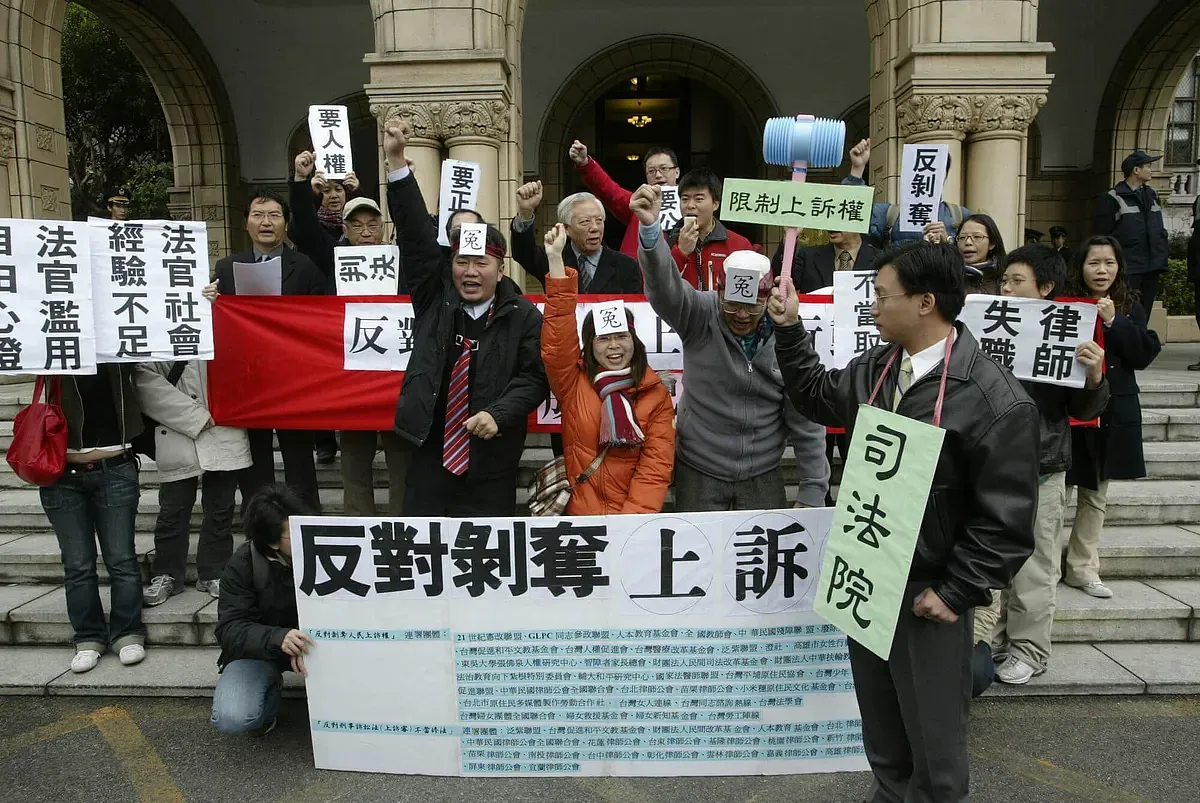
Press Release on the Establishment of the "Alliance Against the Deprivation of People's Right of Appeal"
Last edited: 2026-08-30
The "Alliance Against the Deprivation of People's Right of Appeal," composed of dozens of groups including the Taipei Society, Taiwan Association for Human Rights, Peacetime Foundation for Taiwan, Alliance of Fairness and Justice, Chang Fo-quan Centre for Human Rights, Soochow University, and the Judicial Reform Foundation, was officially established today.
As the Judicial Yuan is about to propose amendments to the Code of Criminal Procedure in the next legislative session to restrict people's right to appeal to the second and third instances, civil society groups believe that the current quality of court trials remains poor and has yet to gain the full trust of the public. Rushing through these amendments would be a disaster, prompting them to form this alliance to voice their opposition to the current legislative amendments to the Judicial Yuan.
The Alliance opposes the Judicial Yuan's current legislative approach of restricting the people's litigation rights for the following reasons:
1. The new criminal procedure system has only been implemented for a little over two years, and judges, prosecutors, and attorneys are still in the adaptation period with insufficient experience, leaving much room for improvement. Furthermore, according to the " Questionnaire Survey on the One-Year Implementation of the New Criminal Procedure System" conducted by the JRF targeting judges, prosecutors, and attorneys, 76.2% of respondents believed that judges failed to truly implement the presumption of innocence. This shows that there is still significant room for improvement in the new criminal procedure system. The authorities should concentrate their reform efforts on the police, prosecutors, investigators, and the court of first instance, rather than amending the law by restricting people's right to appeal at this stage.
2. In the past, many wrongful criminal convictions occurred because police used improper methods to obtain evidence during the investigation stage. However, these deficiencies in the rule of law and violations of human rights still exist today. The police and prosecutorial investigation stage is the uppermost stream of the criminal litigation procedure; if more active reforms are not invested, wrongful convictions will continue to occur. If the conditions for appeal are further restricted or closed off at this time, the consequences are truly unimaginable.
3. According to relevant international human rights conventions, defendants in criminal cases enjoy the right to adequate legal representation and defense. However, in our country, related systems remain highly incomplete. Not only do defendants lack the right to confidential consultations with attorneys, but appointed attorneys also lack sufficient rights to help their clients investigate evidence and conduct an adequate defense. It is not too late to discuss the pyramid-shaped restructuring of the criminal litigation system only after supporting measures for human rights protection are fully implemented.
4. Regarding personnel quality, the mechanisms for selecting competent judges and removing incompetent ones have yet to be established, making it difficult to expect guaranteed trial quality. Moreover, the reform of the attorney system is also incomplete; in an environment where the quality of attorneys varies, people often do not know how to select competent attorneys to defend them. How can wrongful convictions be avoided under such circumstances?
5. The Judicial Yuan should logically prioritize and actively promote the completion of "higher-level norms" legislation such as the "Judicial Yuan Organization Act" (organizational pyramid) and the "Judges Act" (personnel pyramid). Instead, it is now attempting to advance the legislation of the "lower-level norm" draft amendments to the Code of Criminal Procedure, which is clearly putting the cart before the horse!
6. The appellate structure and provisions proposed by the Judicial Yuan this time lack care and improvement from the high ground of human rights (including both defendants and victims). The scope of the amendments is limited to appellate trials, and whether this is appropriate has already drawn widespread questioning from academic and practical circles. There is a genuine necessity to rethink the construction principles and direction of appellate trials holistically from the perspective of human rights protection and the litigation system, and to repeatedly study and refine a complete solution.
The Alliance calls on the Judicial Yuan to first:
- Improve the quality of case handling by police, prosecutors, and investigators.
- Eliminate incompetent judges.
- Strengthen the right to defense.
- Build public trust in the trial quality of the court of first instance.
- Actively promote other related supporting measures.
The Alliance is convoked by Professor Chiu Hei-yuan of Academia Sinica, with former National Policy Advisor Mr. Huang Wen-hsiung serving as deputy convener, attorney Lo Ping-cheng, chairperson of the Criminal Law Committee of Taiwan Bar Association, serving as chief executive officer, and Wu Hao-jen, president of the Taiwan Association for Human Rights, serving as spokesperson.
Organizations Endorsing the "Alliance Against the Deprivation of People's Right of Appeal"
21st Century Constitutional Reform Alliance, Gay and Lesbian Political Caucu, The Humanistic Education Foundation, Millet Foundation, Promotion of Women's Rights, National Teacher's Association, Taiwan Confederation of Trade Unions, League of Welfare Organizations for the Disabled, Taiwan Association for Victims of Occupational Injuries, Taiwan Bar Association, Peacetime Foundation for Taiwan, Taiwan Association for Human Rights, Taiwan Health Reform Foundation, Pingpu Plains Aborigines Association of Taiwan, Taiwan Labor Front, Taiwan Tongzhi Hotline Association, Taiwan Law Society, National Alliance of Taiwan Women’s Associations, League of Taiwan Women, Taipei Bar Association, Alliance of Fairness and Justice, Miaoli Bar Association, Taipei Women’s Rescue Foundation, The Awakening Foundation, Taipei Society, Kaohsiung Women's Action Association, Chang Fo-quan Centre for Human Rights, Soochow University, Parents Association for Persons with Intellectual Disability, Gender/Sexuality Rights Association in Taiwan, Judicial Reform Foundation, Rule of Law Education Special Committee of the ROC Rotary Education Foundation, Fu Jen Catholic University Institute for Research into Dialogue for Peace, National Association of Medical Examiners, Taiwan Alliance to End the Death Penalty
Organizations Endorsing "Opposition to Improper Amendments to the Code of Criminal Procedure (Appellate Procedure)"
Alliance of Fairness and Justice, Peacetime Foundation for Taiwan, Judicial Reform Foundation, The Humanistic Education Foundation, Taiwan Bar Association, Taipei Bar Association, Keelung Bar Association, Taoyuan Bar Association, Hsinchu Bar Association, Miaoli Bar Association, Nantou Bar Association, Taichung Bar Association, Changhua Bar Association, Yunlin Bar Association, Chiayi Bar Association, Kaohsiung Bar Association, Pingtung Bar Association, Yilan Bar Association, Hualien Bar Association, Taitung Bar Association
This article is an AI-generated translation of the original Chinese text. In the event of any discrepancy, the Chinese version shall prevail.