
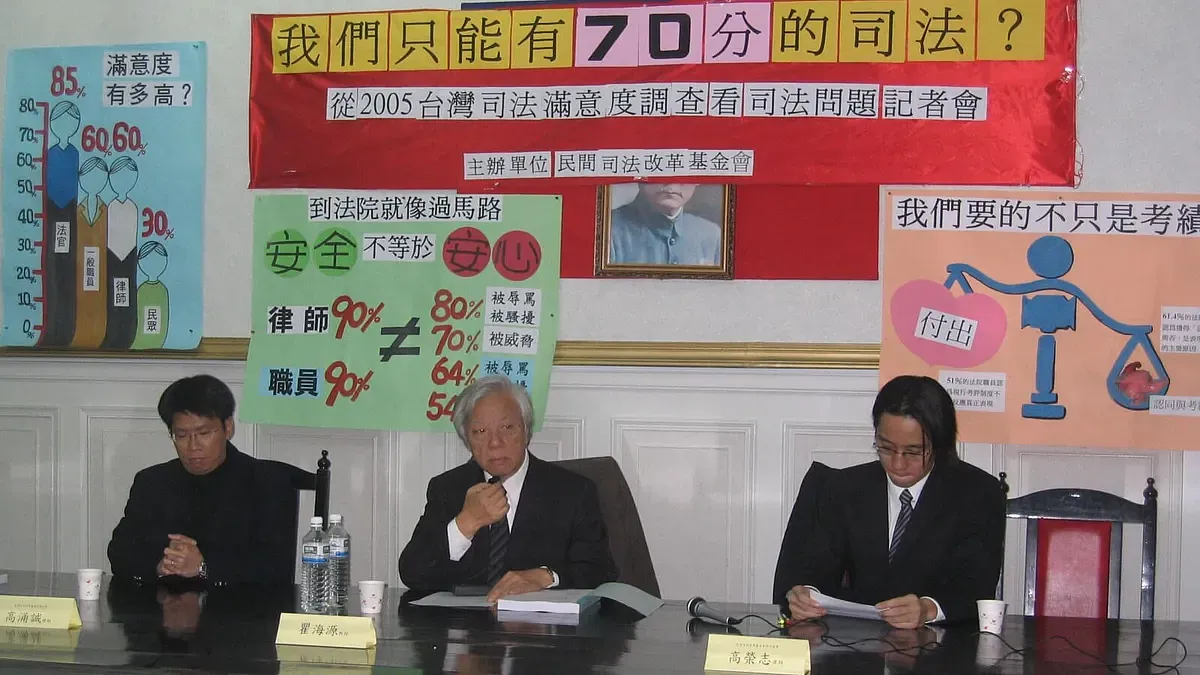
Can We Only Have a 70-Point Judiciary? Press Conference on Judicial Problems Based on the 2005 Taiwan Judicial Satisfaction Survey
Last edited: 2026-08-30
This year (2005), the Judicial Reform Foundation introduced the Trial Court Performance Standards & Measurement System from the National Center for State Courts (NCSC) in the United States, and implemented Area 5: Public Trust and Confidence.
In addition to surveying various court users such as lawyers, the general public, the media, and representatives of the judicial system, the survey for the first time included internal personnel such as court staff and court spokespersons within the scope of court users.
The Judicial Reform Foundation presents the following data to illustrate its observations:
1. Prompt, Fair, and Reliable Courts: Can We Only Have a 70-Point Judiciary?
Regarding general impressions of court performance, this survey obtained the following data:
- 66.8% of court staff believe the court performs well. Broken down by duties, 85% of judges believe the court performs well, while only 60% of other general staff share this view.
- 60% of lawyers believe the court performs well;
- Only 30% of the general public believe the court performs well (more than 80% of whom had never interacted with a court).
If basic integrity and immunity from political interference constitute a passing score of 60; then court workers who treat their job (especially adjudication) as a "calling" rather than merely a "job to make a living," and who are serious and passionate, deserve an 80; and judicial personnel who also possess humanistic literacy, empathy, and constitutional awareness truly merit a 90 rating. Should this be complemented by a sound judicial system and faithful, accurate media reporting, the resulting judicial image might possibly achieve a perfect score.
According to the survey results for court staff, 66.8% of staff have a favorable impression of the court's performance. Based on this data, one might say that court staff believe Taiwan's judiciary is currently at around a 70-point level. However, the general public's view of the court in telephone interviews yielded only a 30% favorable rating. Of course, it must be emphasized that 80% of the interviewed citizens had never been in contact with a court; considering the factor of usage frequency, perhaps referring further to lawyers' evaluations of the court can bring us closer to the true situation. Meanwhile, lawyers' satisfaction with the court reached 60%, showing complete consistency with general staff working at the court (excluding judges).
The Judicial Reform Foundation believes that the above data shows that for the court to improve from 70 points upward, the key lies in the principle that "justice must not only be done, but must also be seen to be done." The court should use various evaluation mechanisms to improve its performance; furthermore, it is precisely because of impartial evaluations that such improvements can win the public's trust.
The gap between the actual situation of the court and public perception, as well as the gap between judges' self-evaluations of their favorable performance (85%) and external perceptions (lawyers, general staff), all demonstrate that if the judiciary is to win the public's recognition—beyond demanding integrity, diligence, constitutional awareness, and humanistic literacy from court staff—it must also be matched by evaluation systems such as the "Judges Act." This will prevent the attrition of talented personnel, eliminate reverse selection, and make judicial improvements openly and transparently visible to the public to win their trust, thereby making it possible to further elevate the public's satisfaction with the judiciary.
2. Convenience, Safety, Court Courtesy, and Hardware: Safety Does Not Equal Peace of Mind!
Overall, the courts' convenience for the public received the highest affirmation from the general public and is generally recognized as having made significant progress compared to the past. Aspects such as staff courtesy, hardware environment, and the convenience of conducting business within the court all showed favorable satisfaction ratings. However, now that reform has reached its tenth year and convenience measures have mostly been improved, this survey wishes to especially emphasize the concept of "refined judicial convenience for the public."
The survey results on safety show that, generally speaking, citizens (61.7%), lawyers (over 80%), and court staff (over 80%) all believe that the courts are fundamentally "safe."
At the same time, however, over 80% of lawyers believe there is a possibility of being "verbal abused or harassed" in court, and 70% of lawyers believe there is a possibility of being "threatened." Court staff reflected similar opinions (64% for the former, 54% for the latter). This indicates that "safety" does not equal "peace of mind"; providing merely "personal safety" where one "won't be hacked or killed" inside a court is far from sufficient. It must also be able to give people a "sense of security and peace of mind."
Whether in terms of equipment, security checks, environmental design, bailiff training, or alertness, the court must become a more refined and advanced "safe space." Even before citizens step into the court to "seek justice," they should be able to "feel secure and reassured" that "justice" is waiting at the other end of the court. Citizens will then be more willing to utilize the court, which is naturally also a manifestation of the court's people-friendly and convenient approach.
3. Accountability and Independence: What We (Court Staff) Want Is More Than Just Performance Evaluations!
Finally, and most concerning to the public, is the issue of "fairness and justice" in the courts. The survey found that both citizens and lawyers expressed negative opinions regarding the court's potential for bias (61% among citizens), particularly toward those with higher socio-economic status (57.9% among lawyers), while lawyers' reactions to criminal judges favoring prosecutors (77.4%) were even stronger. These are phenomena that a court symbolizing fairness and justice should not take lightly.
Here, this survey also intends to present the perspectives of internal court personnel, because the courts should not only serve external users, but also have a responsibility to improve for internal users, ensuring that the court fulfills its role as a place of "fairness and justice" both internally and externally.
The survey results concretely demonstrate that court staff strongly disagree with the current court performance evaluation system (51% negative evaluation), believing it "fails to reflect" the true performance of court staff. Comparing this with responses to questions regarding "compensation," it can be seen that compared to salary, promotion, and benefits, court staff indicated that receiving "recognition" is the primary reason for good or bad job performance (61.4%). This perhaps shatters the myths of bureaucratic hierarchy; promotions and salaries are not the sole reasons prompting internal improvement, but rather indirectly illustrate that—especially in a court that emphasizes "fairness and justice"—the presence or absence of a "sense of honor" is what court staff care about most!
Here we return to the issue of "winning external trust"; establishing a fair evaluation mechanism is clearly a necessary way to promote satisfaction levels, both inside and outside the court. Although a 70-point judiciary has already passed, it remains far from the ideal score. Reform measures must be refined, and fair evaluations must be established, before the judiciary has any possibility of moving toward 80 or 90 points!
Attendees
Professor Chiu Hei-yuan (瞿海源)
Attorney Kao Yong-cheng (高涌誠) (CEO, Judicial Reform Foundation)
Attorney Kao Jung-chih (高榮志) (Executive Committee Member, Judicial Reform Foundation; Convener of the Judicial Satisfaction Survey)
This article is an AI-generated translation of the original Chinese text. In the event of any discrepancy, the Chinese version shall prevail.
