
Who Supports Corruption and Fears Reform?
Last edited: 2026-08-30
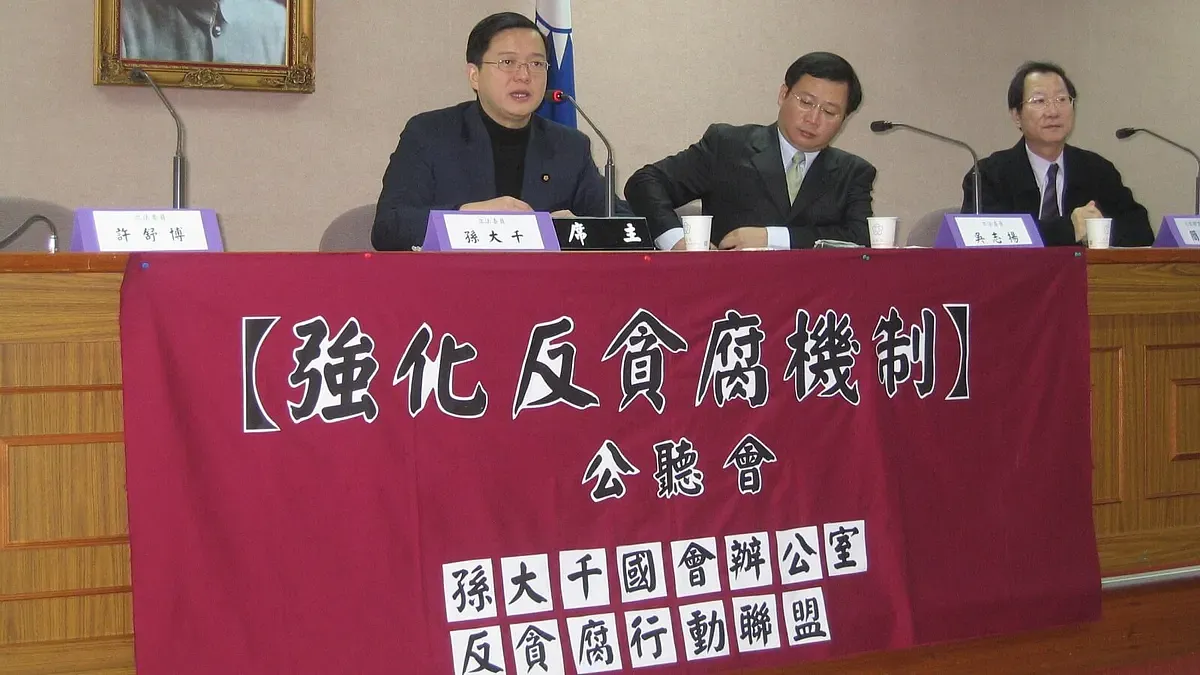
On December 13, the Alliance had hoped that the negotiations among the political parties on the Court Organization Act would result in an agreement, based on the version proposed by the Judicial Reform Foundation, concerning the appointment and term of office of the Prosecutor General and the establishment of a Central Special Investigation Division. Unexpectedly, the Democratic Progressive Party’s representatives in the negotiations obstructed the talks by repeatedly saying, “Oppose! Oppose! Oppose…” without stating any reasons, causing the negotiations to break down and bringing the matter back to square one. The Alliance deeply regrets this outcome.
At a time when the public is increasingly disgusted by government corruption and eager to establish, as soon as possible, a prosecutorial system that is impartial and free from political interference and can effectively prevent and combat corruption, the Legislative Yuan should respond to public sentiment and complete the amendments to this bill, which has been pending in the Legislative Yuan for more than three years, during the current legislative session.
The bill has entered the stage of inter-party negotiations prior to its second and third readings. As long as the ruling and opposition parties work together, the amendments can certainly be completed during the current legislative session. Accordingly, the Alliance will not only intensify its communication with the various party caucuses, but will also closely monitor the entire process. If the bill is deliberately obstructed through procedural tactics under any pretext and the amendments fail to be completed during the current legislative session, the Alliance will publicly identify the parties and individual legislators responsible, issue strong condemnation, and place them on the “Accomplices to Corruption List,” allowing voters to remove them from the political arena through their ballots.
With regard to reform of the prosecutorial system, the Alliance advocates the following:
1. The Appointment of the Prosecutor General Should Include a Sunrise Clause
The version proposed by the Prosecutors Association lacks a sunrise clause concerning the appointment of the Prosecutor General, which is a significant shortcoming.
The version proposed by the Judicial Reform Foundation contains the following sunrise clause: “The Prosecutor General shall be appointed by the President with the approval of the Legislative Yuan. In addition to a fixed four year term of office, within one month after the amendments take effect, the President shall nominate a candidate for Prosecutor General, who shall be appointed upon obtaining the approval of the Legislative Yuan.”
The principal consideration behind this provision is that, under the new system, the Prosecutor General would have full authority to direct and supervise prosecutorial administration, exercise substantive criminal investigative powers through the Central Special Investigation Division, and have representation on the Prosecutor Review Committee, thereby possessing a significant degree of personnel authority. Given the extensive powers vested in the Prosecutor General, the existing prosecutorial system and its institutional culture need to undergo change. The legitimacy of the entire personnel system should therefore be established through appointments made under the new system.
2. The Term of Office of the Prosecutor General Should Not Exceed Four Years
The Prosecutor General under the new system would wield substantial authority and operate in a high pressure environment marked by political and social conflicts. This would require the prosecutorial system to have a strong defensive mechanism, with a Prosecutor General willing to take on responsibilities. A relatively short term of office would also promote vitality and creativity within the prosecutorial system through rapid personnel turnover. The Prosecutor General's term of office should therefore not be too long.
South Korea's prosecutorial system has undergone vigorous reforms in recent years, with Prosecutors General often being replaced after only one or two years, and the most recent Prosecutor General serving for only six months. This high turnover and rapid personnel rotation have been key to maintaining the vitality and strength of its prosecutorial system.
We therefore maintain that the term of office of the Prosecutor General should not exceed four years. The six year term proposed by the Prosecutors Association would risk making the office bureaucratic and causing it to lose its vitality.
3. The Central Special Investigation Division Should Be Established within the Supreme Prosecutors Office
The reason for establishing the Central Special Investigation Division within the Supreme Prosecutors Office is that the caseload at the first instance level is too heavy. Special investigation prosecutors would otherwise be overwhelmed by the sheer volume of cases, leaving them little time to proactively uncover major cases or conduct independent investigations. They could easily end up serving merely as rubber stamps for the police and investigative authorities.
Successfully investigating major cases requires not only excellent investigative skills and the ability to coordinate and integrate investigative efforts, but, more importantly, strong integrity and the ability to withstand pressure. These qualities involve not only adherence to principle, but also the transmission of experience from one generation to the next.
Generally speaking, prosecutors at the second and third instances have greater experience. Because of their higher ranks, career advancement, and greater job stability, they are generally better able to withstand pressure. They also face fewer internal and external obstacles in handling cases and are therefore naturally better positioned to investigate major criminal cases in a manner that meets the expectations of the public.
If the Special Investigation Division is not placed under the Supreme Prosecutors Office, the Prosecutor General would have neither the personnel nor the institutional means to act effectively. How, then, could the Prosecutor General be held responsible for carrying out the major policy of eradicating political corruption and illicit financial influence?
South Korea's recent efforts to crack down on major political corruption and illicit financial networks, which have been credited with contributing to its economic transformation, have often been praised by the Taiwanese public. The reason lies in the fact that, under the Supreme Prosecutors Office led by the Prosecutor General, South Korea established a Central Investigation Department that has repeatedly investigated corruption and other wrongdoing involving former presidents and their associates, thereby renewing the Korean public's confidence in the country's efforts to combat corruption.
This article is an AI-generated translation of the original Chinese text. In the event of any discrepancy, the Chinese version shall prevail.