
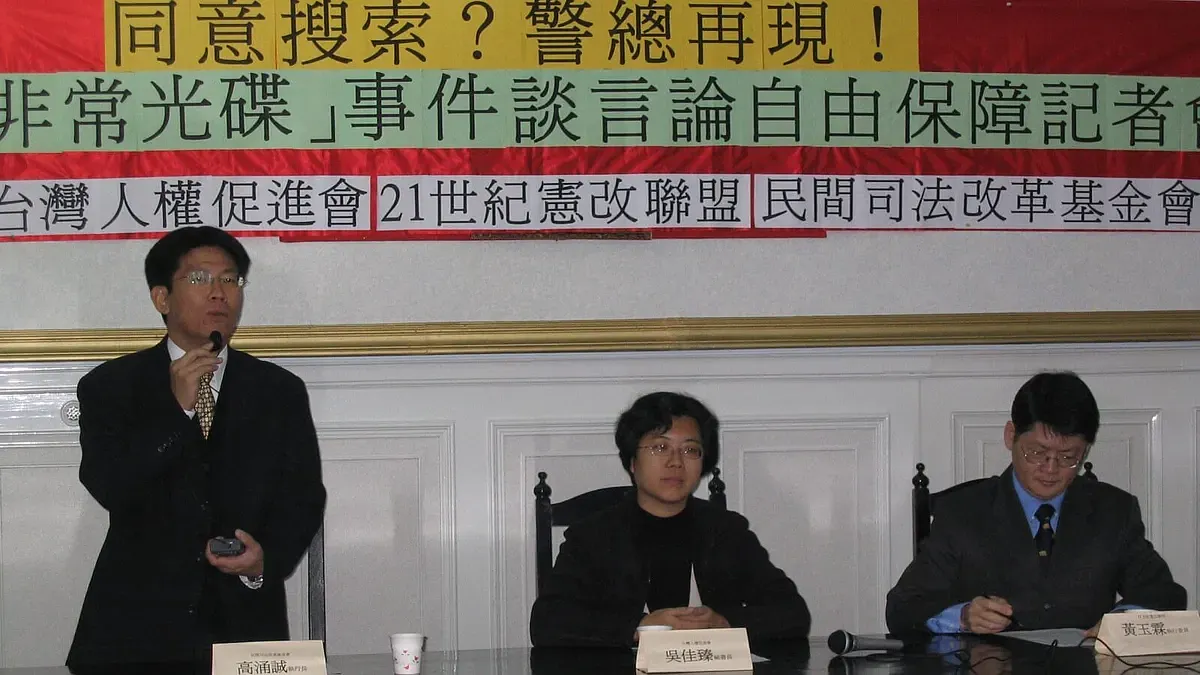
"Consent to Search? The Garrison Command is Back!" ~ Safeguarding Freedom of Speech Through the Lens of the "Extraordinary CD" Incident
Last edited: 2026-08-30
On November 12, the Taoyuan County Police Bureau executed a search and seized the master tapes of the "Extraordinary CD" at Chung Hsiao East Road and Pa Te Road in Taipei City without obtaining a search warrant, sparking a massive controversy regarding the CD.
Civil society groups held a press conference after the elections—ensuring no interference with the electoral process—to harshly criticize the absurd performance of prosecutors and police in this incident. They also did not rule out pushing for amendments to the Code of Criminal Procedure, hoping all sectors of society will examine police and prosecutorial actions to urge their improvement.
"Freedom of speech" is the foundation of a democratic society's operation and a vital fundamental right of the people. Unless there is a clear and present danger, the content of speech cannot be subject to "prior restraint" or "prior censorship" and thereby prohibited from publication. Therefore, even if the content of speech is inappropriate, the principle of subsequent liability is generally adopted, allowing for strict punishment after the fact, whereas prohibiting the publication of speech beforehand is impermissible under the Constitution.
In other words, freedom of speech protected by the Constitution means that the speaker has the freedom to arbitrarily express their opinions, and the state must not impose prior restraints upon them. If the content of such speech involves crimes such as defamation, liability can naturally be pursued afterwards. Therefore, whether it is the crime of defamation under the Criminal Code or the crime of defamation with intent to cause a candidate to be elected or not elected under Article 92 of the Public officials Election And Recall Act, "dissemination" is an essential element of the act. If dissemination is not reached, not only are preparatory or conspiratorial acts unpunishable, but even attempted acts are not punished. This is the "system of subsequent punishment." This is not only the fundamental spirit of constitutional protection of freedom of speech, but also the ABCs of criminal law.
However, whenever elections reach a white-hot stage, politicians spew rhetoric targeting the judiciary. When investigation authorities uncover problems in the opposing camp, they immediately enlist the judiciary to endorse them and praise investigators as brilliant; yet when problems are found within their own camp, they invariably cry foul and accuse the judiciary of unfairness. The credibility of the judiciary is eroded bit by bit amidst such toxic electoral practices.
Article 92 of the Public Officials Election and Recall Act and the crime of defamation under Article 310 of the Criminal Code frequently become weapons utilized by candidates to attack opponents through the police and prosecutors. Tragically, the inadequacy of police and prosecutorial training and the lack of rule-of-law concepts often make them tools of exploitation, whether intentional or not. Taking this "Extraordinary CD" incident as an example, before any dissemination had occurred and before any crime had been committed, the Taoyuan County Police Bureau proceeded to search and seize. This was a blatantly unlawful abuse of power and an act of "prior restraint" prohibited by the Constitution. The reappearance of the "Garrison Command" in the 21st century is truly bewildering.
We believe that negative campaigning by producing CDs or propaganda materials containing untruthful content to attack opponents certainly does not deserve encouragement. However, substantive justice must be preceded by procedural justice. Regardless of how illegal or inappropriate the content of speech may be, one must wait until it has been published before demanding according to law that the speaker bear responsibility for their speech. Therefore, the content of speech and the freedom to publish speech are genuinely two separate matters; the latter must be fully safeguarded. Civil society groups deem it necessary to clarify this to the public. Taoyuan police and prosecutors possess a fuzzy understanding of this and truly need to relearn the Constitution and the Criminal Code so as not to trample upon human rights.
Furthermore, it was reported that a captain surnamed Yen of the Taoyuan County Police Bureau Criminal Investigation Corps claimed that, based on the consent of the person searched, conducting a search without a search warrant suffered from no legal flaws. Civil society groups maintain that compulsory measures under the Code of Criminal Procedure operate on the principle of warrant issuance, with warrantlesness as the exception. Yet police officers frequently use intimidation or enticement to coerce citizens into consenting to searches, turning the exception into the rule. Not only have the police failed to reflect upon this, but they are even smugly self-satisfied—a stance civil society groups deeply disapprove of. We also do not rule out proposing an amendment to the Code of Criminal Procedure to require that police clearly inform individuals of their rights under Article 95 of the Code of Criminal Procedure prior to obtaining their consent to a search.
In fact, apart from the more high-profile Extraordinary CD incident, it was frequently heard during this election that police and prosecutors rushed into printing plants to confiscate "black letters" (smear pamphlets) prior to their dissemination. Such investigative actions are entirely unlawful, and the rule-of-law standards of the police and prosecutors are deeply disappointing. Additionally, this election witnessed multiple instances of politicians threatening the judiciary or even directing prosecutors on how to handle cases. Civil society groups call upon police and prosecutors to enrich their legal literacy, stand firm in their positions, and avoid being swayed by politics in order to earn the public's trust.
Organizers
Ms. Wu Jia-zhen (吳佳臻), Secretary-General, Taiwan Association for Human Rights
Professor Huang Yu-lin (黃玉霖), Executive Member and Spokesperson, 21st Century Constitutional Reform Alliance
Attorney Kao Yong-cheng (高涌誠), Executive Director, Judicial Reform Foundation
This article is an AI-generated translation of the original Chinese text. In the event of any discrepancy, the Chinese version shall prevail.