
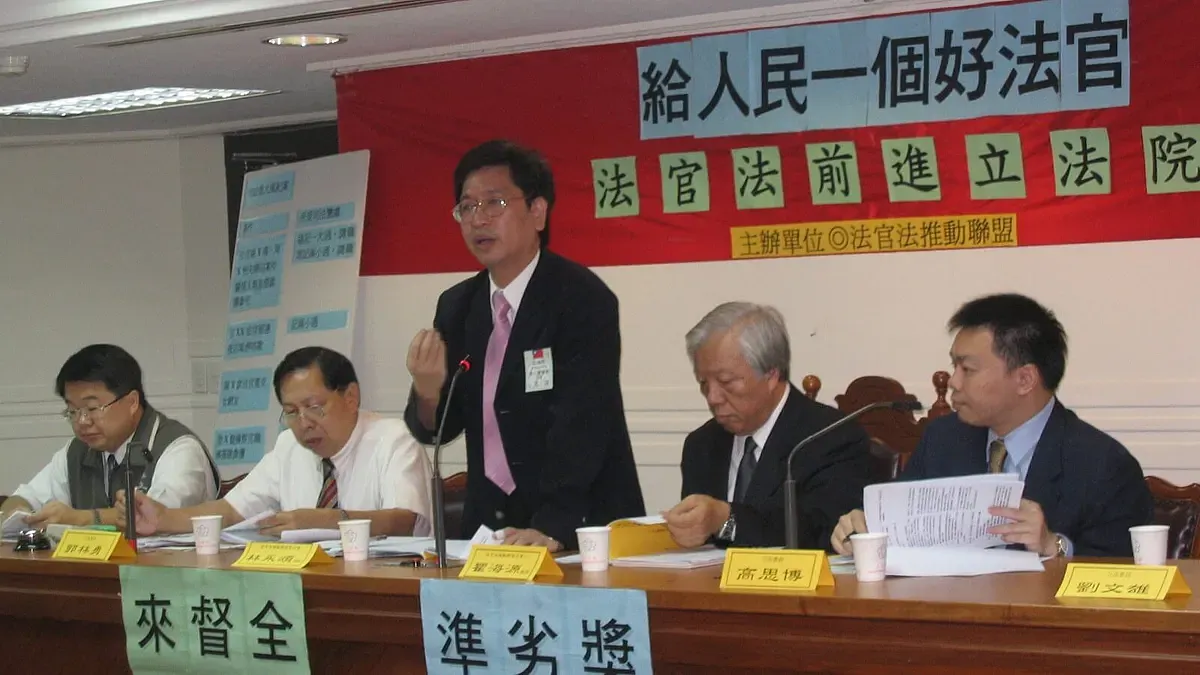
Giving the People a Good Judge: Judges Act Advanced to the Legislative Yuan Press Conference
Last edited: 2026-08-28
The judiciary is the last line of defense for maintaining justice, and judges are undoubtedly the ones who concretely guard this line. Judges are expected by the people to engage in trials independently, impartially, and objectively, and to be trusted by the public. Therefore, the appointment, elimination, and status protection of judges should be specially regulated and should not be equated with ordinary civil servants who follow orders from superiors.
However, it is regrettable that current regulations concerning the judicial system are still scattered across more than a dozen civil service laws, and the current legislative design still treats judges the same as ordinary civil servants. Not only does this run counter to the spirit of the Constitution protecting judicial independence, but it also goes against public expectations, posing a major obstacle to building a "judiciary trusted by the people."
In fact, only with quality judges can there be a quality judiciary. Therefore, enacting a "Judges Act" that conforms to constitutional spirits and the trends of the times has always been the core of judicial reform.
More than a decade ago, the Judicial Yuan already realized the importance of the "Judges Act" and began drafting one. By 1990, the Department of Judicial Administration had prepared the "Preliminary Draft of the Judges Act." After countless revisions by the Judicial Yuan's "Judicial System Research and Revision Committee," the official version of the draft "Judges Act" was proposed in 1995. In 1998, the Judicial Reform Foundation, the Taiwan Law Association, and the Taipei Bar Association jointly drafted a nongovernmental version of the "Judges Act" draft, which was proposed and co-signed by fifty legislators including Hsieh Chi-ta, Tsai Ming-hsien, and Huang Kuo-chung, bringing the nongovernmental draft of the "Judges Act" into the Legislative Yuan for the first time. Subsequently, in 2002, Legislator Chiu Tai-san and others proposed and co-signed it again, bringing the new nongovernmental draft of the "Judges Act" into the Legislative Yuan for the second time. Unfortunately, multiple proposals failed to complete the legislative process. In 2003, civil society organizations established the "Three Judicial Reform Laws Promotion Alliance" to actively lobby the Judicial Yuan, the Executive Yuan, and the Examination Yuan to enact the Judges Act.
However, the introduction of the nongovernmental draft of the "Judges Act" also exerted considerable pressure on the Judicial Yuan, which realized that the people need good judges and unqualifed judges must be eliminated. Consequently, the Judicial Yuan and civil society began lengthy negotiations, hoping that the Judges Act would smoothly pass in the Legislative Yuan. Following the passage of the Legal Aid Act, the Three Judicial Reform Laws Promotion Alliance was reorganized into the Judges Act Promotion Alliance. After multiple rounds of contention and negotiation, the nongovernmental draft of the "Judges Act" was finally finalized in 2005. A high degree of consensus was reached with the Judicial Yuan on most provisions, while retaining some opinions insisted upon by civil society, resulting in the following characteristics:
- Explicitly declaring the abolition of the judicial examination, and stipulating that future judges shall be selected from prosecutors, lawyers, or scholars with at least six years of experience.
- Establishing a Judicial Evaluation Foundation to conduct external oversight and evaluation of judges.
- Clearly stipulating a judicial disciplinary mechanism, wherein a Disciplinary Court composed of Grand Justices, judges, and lay judges serving as impartial individuals from outside the judiciary is formed to eliminate unqualified judges.
- Strengthening the functions of judges' meetings to implement the spirit of judicial self-governance.
- To ensure that prosecutorial system reform does not lag behind, stipulating that before the revision of the Prosecutors Act is completed, prosecutors may mutatis mutandis apply relevant provisions of the Judges Act.
Recently, integrity scandals have occurred successively within the judicial circle, and the calls for unqualified judicial personnel to be eliminated are growing louder. The Judges Act Promotion Alliance deeply understands the public's sentiments and has accelerated the completion of the nongovernmental draft of the "Judges Act," hoping that through this legislation, the meritorious can be rewarded and the unqualified eliminated, protecting excellent judges and eliminating unqualified ones, comprehensively elevating the quality of adjudication, and establishing a judiciary truly trusted by the people.
In short, the reform of "people" is definitely an extremely important part of judicial reform! The draft Judges Act is designed to foster a high-quality judicial environment, attract outstanding talent, eliminate unqualified judges, and protect the independent judicial duties of judges. It is truly the key to ensuring fair trials and improving adjudication quality. We hope the entire public and the Legislative Yuan will work together to complete this legislation!
Participating Members of the Judges Act Promotion Alliance
Taipei Society, Judicial Reform Foundation, Taipei Bar Association, Taiwan Law Society, Taiwan Association for Human Rights, Prosecutor Reform Association, Taiwan Law Society, Gender/Sexuality Rights Association, Taiwan Tongzhi Hotline Association, The Taiwan Confederation of Trade Unions, Parent’s Association for the Mentally Handicapped Persons, League of Welfare Organizations for the Disabled, National Federation of Banking Employees' Unions, HuHualien Teachers' Association, National Teacher's Association
Annex
2005 Nongovernmental Draft of the Judges Act
Post-Meeting Press Release
Today, the Judges Act Promotion Alliance held a press conference to announce the nongovernmental version of the draft Judges Act, officially commissioning legislators to submit the draft to the Legislative Yuan for deliberation. Attendees included Professor Chiu Hei-yuan, Convenor of the Judges Act Promotion Alliance; Attorney Joseph Lin, CEO of the Alliance; Attorney Chen Chuan-yue, Chairperson of the Judicial Reform Foundation; Prosecutor Hou Kuan-jen, representative of the Prosecutor Reform Association; multiple representatives of alliance members; and Legislators Kao Su-po, Kuo Lin-yung, Wu Ping-jui, Lu Tien-lin, among others.
Professor Chiu Hei-yuan, Convenor of the Judges Act Promotion Alliance, stated that this is the third time civil society has submitted the nongovernmental draft of the Judges Act to the Legislative Yuan, and he hopes that through the proposals and co-signatures of legislators concerned about this case, the nongovernmental draft of the Judges Act can pass legislation during this session. Furthermore, Attorney Lin Yung-sung, CEO of the Judges Act Promotion Alliance, stated that this nongovernmental draft of the Judges Act holds very important significance for judicial reform, featuring the following 5 characteristics:
- Explicitly declaring the abolition of the judicial examination, and stipulating that future judges shall be selected from prosecutors, lawyers, or scholars with at least 6 years of experience.
- Establishing a Judicial Evaluation Foundation to conduct external oversight and evaluation of judges.
- Clearly stipulating a judicial disciplinary mechanism, wherein a Disciplinary Court composed of Grand Justices, judges, and lay judges serving as impartial individuals from outside the judiciary is formed to eliminate unqualified judges.
- Strengthening the functions of judges' meetings to implement the spirit of judicial self-governance.
- To ensure that prosecutorial system reform does not lag behind, stipulating that before the revision of the Prosecutors Act is completed, prosecutors may mutatis mutandis apply relevant provisions of the Judges Act.
Legislator Kao Su-po, Convenor of the Judiciary and Organic Laws and Statutes Committee of the Legislative Yuan, stated that he will do his utmost to enable the Judges Act to pass legislation during this session. Legislator Kuo Lin-yung, Convenor of the Organic Laws and Statutes Committee, stated that when he previously served as a lawyer, he was already very concerned about the legislation of the Judges Act, and since the Judges Act requires co-signing by the Judiciary Committee and the Organic Laws and Statutes Committee, his attendance at today's press conference announcing the nongovernmental draft of the Judges Act signifies that he will set aside all party conflicts and have the Judges Act pass legislation as soon as possible. Legislator Wu Ping-jui of the Organic Laws and Statutes Committee further stated that having previously served as a judge, he affirms the importance of the existence of the Judges Act and will undoubtedly do everything in his power to ensure the Judges Act passes legislation.
Finally, Professor Chiu Hei-yuan, Convenor of the Judges Act Promotion Alliance, expressed profound gratitude for the support from all sectors. This will be a supra-partisan, rational, and professional bill that also meets the public's expectations. He expressed hope that the Judiciary Committee and the Organic Laws and Statutes Committee will uphold a rational and professional attitude to pass the Judges Act as soon as possible, giving the public a refreshing new perspective on the Legislative Yuan.
This article is an AI-generated translation of the original Chinese text. In the event of any discrepancy, the Chinese version shall prevail.