
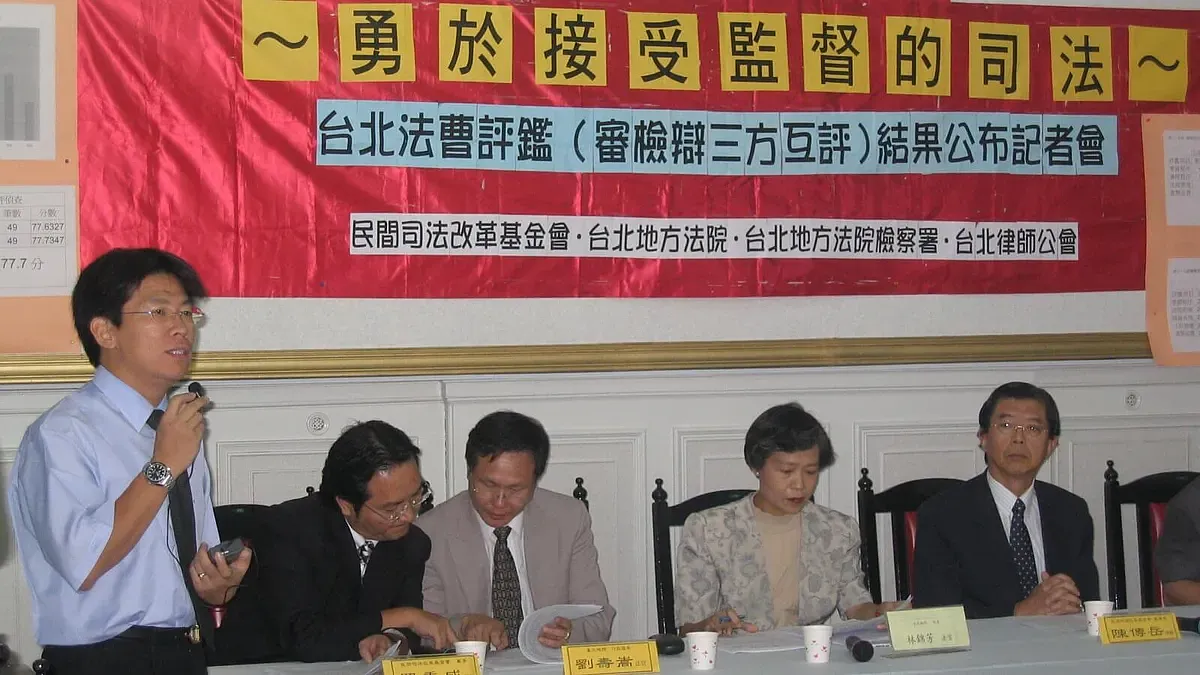
A Judiciary Courageous in Accepting Oversight: Press Conference on the Results of the Taipei Jurist Association (Mutual Evaluation Among Judges, Prosecutors, and Defense Attorneys)
Last edited: 2026-08-30
For the first time in history, the results of the "Three-Way Legal Professionals Evaluation," jointly participated in and mutually evaluated by judges, prosecutors, and attorneys, have finally been released!
As early as 1992 (ROC Year 81), the late Lin Min-sheng (林敏生), former chairperson of the Taipei Bar Association, pioneered legal professional evaluation by having association member attorneys evaluate all judges of the Taipei District Court and the Taiwan High Court. The Judicial Reform Foundation has also conducted judge evaluations since 1996 (ROC Year 85), prosecutor evaluations in 1999 (ROC Year 88), and attorney evaluations in the Hsinchu area in 2003 (ROC Year 92). The evaluation methodology has evolved from early approaches where attorneys evaluated judges based on subjective impressions to having attorneys evaluate specific judges they encountered in handled cases. This continuous refinement aims to ensure the objectivity of the evaluations.
In line with the evolution of evaluation methods and to meet widespread demands for refined evaluations, the Judicial Reform Foundation, Taipei District Court, Taipei District Prosecutors Office, and Taipei Bar Association finally announced on January 30 of last year (2004/ROC Year 93) the launch of the Taipei Three-Way Legal Professionals Evaluation. The methodology and content of this evaluation were highly complex, spanning one year and divided into two evaluation periods: the first phase from February 1, 2004, to July 31, 2004, and the second phase from August 1, 2004, to January 31, 2005. The scope covered criminal cases under ordinary procedures pending before the Taipei District Court and cases under investigation by the Taipei District Prosecutors Office during this period, allowing judges, public prosecutors, investigative prosecutors, and attorneys involved in specific cases to evaluate one another. The evaluation criteria included general professional performance such as courtroom demeanor, quality of legal documents, preparatory proceedings, trial proceedings, cross-examination performance, and argument performance. In addition, specific inquiries were made regarding unjustified case backlogs, professional ethics and integrity, and suitability for office. Consequently, this evaluation utilized up to 10 types of questionnaires, reaching a level of complexity unmatched by previous evaluation methods, which is why the release of the results was eagerly anticipated.
The results of this evaluation objectively present several phenomena:
- Two years into the implementation of the new criminal procedure system, the three parties—judges, prosecutors, and defense attorneys—have gradually come to understand their self-roles. Due to the reinforcement of the judge's role as a neutral adjudicator, judges' performances were generally affirmed by prosecutors and attorneys, with average scores higher than those given in the evaluation conducted by the Judicial Reform Foundation in 2002. Although scores for attorneys and prosecutors varied slightly, their overall performances scored above 78 points, reaching standard levels. Furthermore, the mutual evaluation scores between prosecutors and defense attorneys demonstrated an adversarial model of debate based on rational opposition. We believe that the correct system allows respective roles to function properly, and the achievements of judicial reform in the criminal procedure sector are worthy of affirmation.
- Public prosecutors performed best among the four roles, which aligns with general external impressions. Public prosecutors are stationed in courtrooms long-term to carry out burden of proof and argumentation. Whether due to the comprehensive training provided by the prosecutorial system or the rapid accumulation of experience through long-term immersion in courtroom activities, the overall professional performance of public prosecutors clearly surpasses that of attorneys, prompting the legal profession to reflect on the necessity and desirability of specialization.
- Attorneys' performance still ranked last among all roles. Aside from lacking the massive administrative resources available to the courts and prosecutors' offices—which leaves attorneys fighting isolated battles without institutional support—problems inherent to the attorney system itself are becoming increasingly severe. These include a lack of adequate in-service training, the absence of specialized divisions, and the ineffective enforcement of ethical codes. All of this indicates that reform for attorneys is evidently urgent. On the other hand, the right to defense should also be strengthened; actively planning complementary systems such as investigative powers to genuinely achieve equality of arms between defense attorneys and prosecutors is a direction that should be actively pursued.
- Investigative prosecutors received lower average scores than public prosecutors and judges, and the scores given to investigative prosecutors by judges were significantly lower than those given to public prosecutors (a difference of nearly 10 points). This indicates that the case-handling and document quality of investigative prosecutors need improvement. Additionally, due to the confidentiality of the investigation chambers, investigative prosecutors have low visibility and their performance lacks transparent oversight, which may be a reason for their lower performance scores. Furthermore, neither non-prosecution nor non-prosecution dispositions are made public, preventing more effective oversight of the handling and indictment quality of investigative prosecutors. The prosecutorial system must contemplate reforms in this area.
- Regrettably, due to an insufficient number of evaluation entries in this round, neither trust in professional integrity nor the suitability of various legal professionals reached the originally anticipated evaluation targets. However, this outcome also provides another perspective: acknowledging the limited functionality of evaluations. Because professional integrity has low visibility, it is difficult to uncover issues through general evaluations. Moving forward, other methods should be devised, and foundational education and training should be strengthened to ensure legal professionals are not tempted improperly and do not commit integrity breaches.
As the first collaborative effort among judges, prosecutors, and defense attorneys, this evaluation may have imperfections, but it holds immense reference value and further demonstrates that our judiciary still has many issues in need of reform. We look forward to expanding similar sophisticated evaluations nationwide in the future; after all, evaluations reveal problems, allowing us to chart the course for reform.
Attachments
Statistical Analysis of the Three-Way Legal Professionals Evaluation
This article is an AI-generated translation of the original Chinese text. In the event of any discrepancy, the Chinese version shall prevail.
