
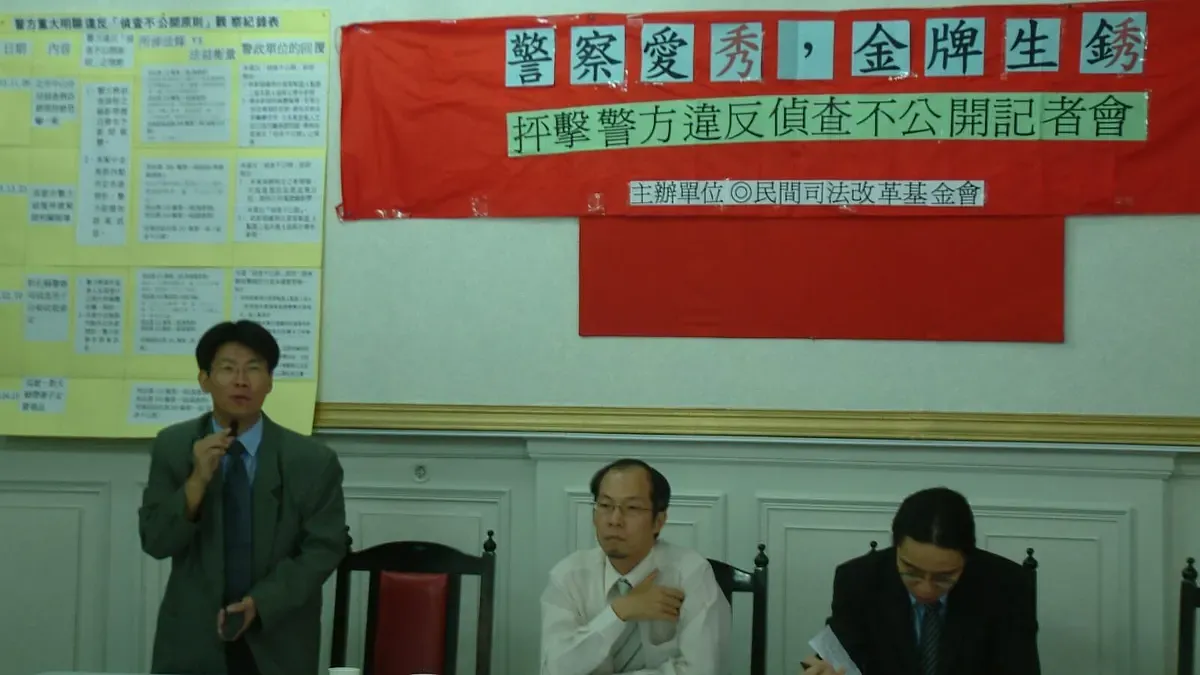
Police Love the Spotlight, Gold Medals Rust! ~ Press Conference Criticizing the Police for Violating the Principle of Non-Publicity of Investigations
Last edited: 2026-07-27
Police officers are supposed to be the guardians of the people; when investigating criminal cases, in addition to maintaining public order, they should pay even greater attention to "protecting human rights"!
Article 245, Paragraph 1 of our Code of Criminal Procedure stipulates that "Investigations shall not be public." In 2002, the Ministry of Justice promulgated the Directions for Handling Press Releases on Criminal Investigations by Prosecutorial, Police, and Investigation Agencies, which explicitly requires that press handling of criminal investigations must comply with the principle of non-publicity of investigations and protect the privacy and reputation of defendants, suspects, and related persons. Furthermore, the Human Rights Advisory Committee of the Office of the President held a hearing on the non-publicity of investigations and human rights protection in October of last year (2004), specifically demanding that the Ministry of Justice and police authorities ensure the implementation of the presumption of innocence and the principle of non-publicity of investigations.
However, television reports regarding criminal suspect cases frequently feature footage simultaneously recorded by the police during searches, raids, and other investigative procedures. Such investigative footage, which ought to be considered internal police data and forms part of the investigative case records that by law shall not be made public, is blatantly provided by the police for media broadcast. Such conduct violates the aforementioned laws and regulations.
To rectify the police's disregard for regulations and slighting of human rights by violating the principle of non-publicity of investigations, the Judicial Reform Foundation (JRF), starting late last year, specifically gathered concrete evidence regarding major and obvious violations of the principle of non-publicity of investigations by the police, and issued official letters demanding that police authorities review and reform their practices.
For example, on December 22 of last year (2004), the Kaohsiung County Police Bureau cracked a gambling ring at a certain shrine and subsequently provided the investigative footage to the media for broadcast. However, the maximum principal punishment for the offense of ordinary gambling under the Criminal Code is merely a fine of under one thousand NT dollars; conversely, if the police misjudge and damage someone's reputation, the maximum principal punishment for defamation is imprisonment for up to one year. In other words, protecting the reputation of citizens should take precedence over cracking down on ordinary gambling. The police providing footage for media broadcast has no educational social significance whatsoever, and the legal interests protected are clearly disproportionate. Regarding this incident, the JRF issued an official letter demanding that the National Police Agency investigate and handle the matter, but the relevant units merely responded as usual by claiming they did not violate the "principle of non-publicity of investigations."
Unexpectedly, there was recently another incident where Olympic gold medalist Chu Mu-yen's (朱木炎) dialogue recordings—provided to the police to entrap suspects in a fraud investigation—were leaked, circulated, and disseminated. This once again fully exposes the police's casual attitude toward the protection of privacy and reputation of the parties involved.
In fact, the police's leakage of investigative footage and other acts violating the principle of non-publicity of investigations constitute the crime of divulging confidential information under Article 132, Paragraph 1 of the Criminal Code. Therefore, the JRF will compile the relevant evidence and submit an official letter to the Taiwan High Prosecutors Office for investigation, hoping to correct the police's long-standing practices of trampling on human rights and breaking the law, so that they may truly become the guardians of the people.
Post-Meeting Press Release
Police officers are supposed to be the guardians of the people; when investigating criminal cases, in addition to maintaining public order, they should pay even greater attention to "protecting human rights"!
Article 245, Paragraph 1 of our Code of Criminal Procedure stipulates that "Investigations shall not be public." The Ministry of Justice promulgated the Directions for Handling Press Releases on Criminal Investigations by Prosecutorial, Police, and Investigation Agencies, requiring that press handling of criminal investigations must comply with the principle of non-publicity of investigations and protect the privacy and reputation of defendants, suspects, and related persons. Furthermore, the hearing on the non-publicity of investigations and human rights protection held by the Human Rights Advisory Committee of the Office of the President also specifically demanded that the Ministry of Justice and police authorities ensure the implementation of the presumption of innocence and the principle of non-publicity of investigations.
However, television reports regarding criminal suspect cases frequently feature footage simultaneously recorded by the police during searches, raids, and other investigative procedures. The incident where Olympic gold medalist Chu Mu-yen's (朱木炎) dialogue recordings—provided to the police to entrap suspects in a fraud investigation—were leaked, circulated, and disseminated further fully exposes the police's casual attitude toward the protection of privacy and reputation of the parties involved. Consequently, the JRF decided to hold a press conference to strongly criticize this conduct by the police that violates the principle of non-publicity of investigations, disregards regulations, and slights human rights protection.
Kao Yung-ch'eng (高涌誠), attorney and executive director of the JRF, stated that taking the gambling case as an example, the police provided investigative footage to the media for broadcast; however, the maximum principal punishment for the offense of ordinary gambling under the Criminal Code is merely a fine of under one thousand NT dollars, whereas if the police misjudge and damage someone's reputation, the maximum principal punishment for defamation is imprisonment for up to one year. In other words, protecting the reputation of citizens should take precedence over cracking down on ordinary gambling. The police providing footage for media broadcast has no educational social significance whatsoever, and the legal interests protected are clearly disproportionate. Furthermore, the police's leakage of investigative footage and other acts violating the principle of non-publicity of investigations actually constitute the crime of divulging confidential information under Article 132, Paragraph 1 of the Criminal Code, and also risk violating the crime of defamation under Article 310, Paragraph 1 of the Criminal Code.
In fact, since the end of last year, the JRF has begun gathering concrete evidence regarding major and obvious violations of the principle of non-publicity of investigations by the police, and issued official letters demanding that police authorities review and reform their practices. However, the relevant units merely responded as usual by claiming they did not violate the "principle of non-publicity of investigations." For this reason, the JRF will compile the relevant evidence and submit an official letter to the Taiwan High Prosecutors Office for investigation, hoping to correct the police's long-standing practices of trampling on human rights and breaking the law.
Ma Tsai-ch'in (馬在勤), attorney and executive board member of the JRF as well as executive director of the Taiwan Police Reform Alliance, stated that the police's claim that releasing news for media reporting is for the purpose of promoting crime prevention is untenable, because none of these cases belong to major social security cases, possessing no practical benefit for advocacy while causing actual harm to human rights. Moreover, certain contents of the "Directions for Handling Press Releases on Criminal Investigations by Prosecutorial, Police, and Investigation Agencies" risk violating the "principle of presumption of innocence," such as Item 1 of Point 4, "where the criminal facts have been clearly ascertained and verified," and Item 4, "where there is no obstruction to the investigation." Herein, we urge the competent authorities to note and amend these provisions. The JRF does not rule out proactively filing a complaint with prosecutorial authorities, and is also willing to assist victims affected hereby in applying for state compensation from the police, so that law enforcement officers who violate the law and abuse their power bear the responsibilities they ought to shoulder.
Kao Jung-chih (高榮志), attorney and working committee member of the JRF, stated that "non-publicity of investigations" is a "principle" under the Code of Criminal Procedure. As every principle has exceptions, how to determine "what constitutes an exception" is precisely the key. Regarding matters that infringe upon human rights, they must be strictly defined and handled with caution. Arresting suspects cannot be equated with upholding the public interest, and the legal interests involved in a suspect's case must be balanced against the privacy and reputation involved in publicizing the matter. Point 4 of the aforementioned directions explicitly sets forth five major requirements for press handling: safeguarding public interest, protecting legitimate rights and interests, necessity, handling by a spokesperson, and appropriate content of the released news. In addition, it details seven specific situations, yet the police either turn a blind eye or arbitrarily interpret them broadly.
The JRF sternly calls upon the police to face human rights protection squarely, strictly abide by the law, and truly become the guardians of the people.
This article is an AI-generated translation of the original Chinese text. In the event of any discrepancy, the Chinese version shall prevail.