
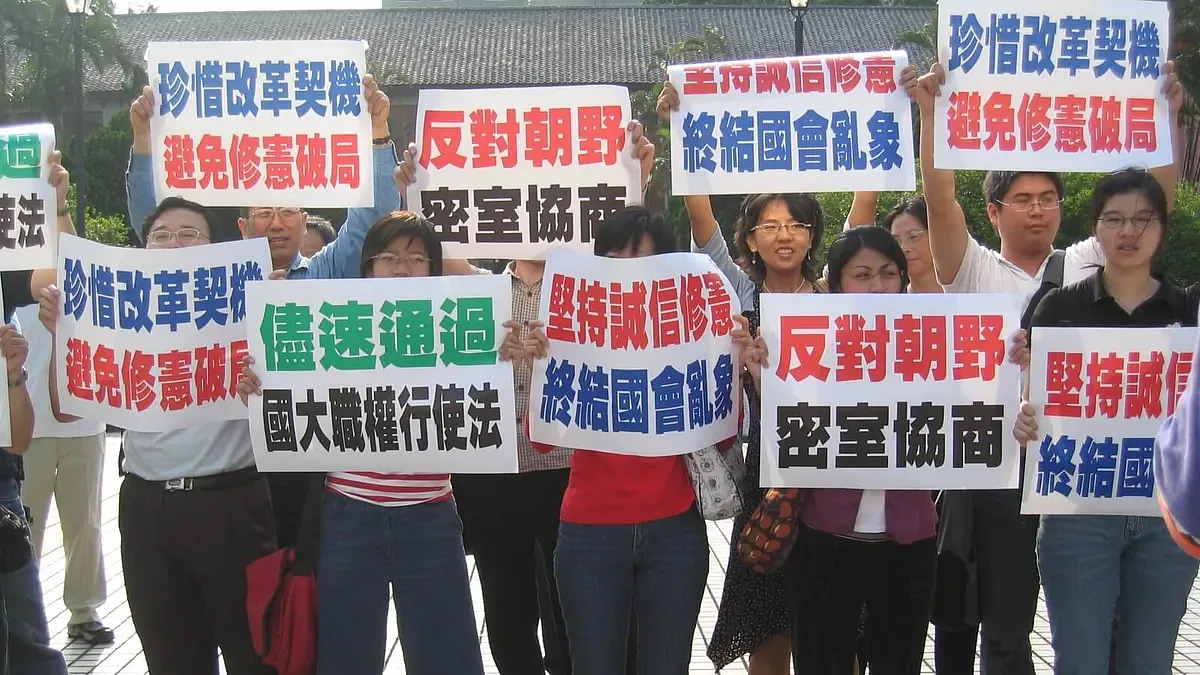
Press Conference by the "Alliance for Integrity and Constitutional Reform Monitoring"
Last edited: 2026-07-27
The "Alliance for Integrity and Constitutional Reform Monitoring" puts forward the following assertions:
- Ad-hoc National Assembly delegates should be entrusted representatives without personal will, responsible solely for the "referendum (review)" of the Legislative Yuan's constitutional amendment proposals, and shall not conduct any substantive discussions or amendments. There is a vast difference between the "referendum procedure" and the "deliberative procedure"; only the "deliberative procedure" can encompass substantive discussions and amendment motions. To fulfill the spirit of the referendum, the referendum procedure for ad-hoc National Assembly delegates should be simplified as much as possible. The outcome of the referendum is actually determined when the election of ad-hoc National Assembly delegates concludes and the results are announced; subsequent assemblies of delegates hold only formal significance, and the referendum procedure must not be complicated to avoid unnecessary trouble. Since the referendum procedure holds only formal significance, a three-day assembly is sufficient to referendum the constitutional amendment proposals.
Regarding the relevant contents of the draft "Law on the Exercise of Power by the National Assembly" proposed by various political parties:
- Lü Hsueh-chang's version: Article 9 ... Constitutional amendment proposals, ... shall not be discussed or subjected to further amendment motions.
- People First Party's version: Article 6 Constitutional amendment proposals ... without discussion, shall immediately exercise the referendum ...
- Ch'en Chieh's (Kuomintang) version: Article 7 Constitutional amendment proposals ... without discussion, shall immediately exercise the referendum ...
- Democratic Progressive Party's version: Article 7 Constitutional amendment proposals ... without discussion, shall immediately exercise the referendum ...
- Non-Partisan Solidarity Union's version: Article 7 Constitutional amendment proposals ... without discussion, shall immediately exercise the referendum ...
The draft versions of all political parties agree that ad-hoc National Assembly delegates should be entrusted representatives, responsible solely for the "referendum" of the Legislative Yuan's constitutional amendment proposals, and cannot engage in any substantive discussions or amendments. We hope that under this consensus, the referendum procedure will be simplified as much as possible to avoid unnecessary complications and waste of public funds.
- Regarding the threshold for passage, in accordance with the spirit of a referendum, more than one-half of the National Assembly delegates should suffice. Otherwise, would not the consensus reached by the Legislative Yuan with a high threshold of three-fourths become a fragile consensus? If the threshold for the constitutional amendment referendum is set at three-fourths, the high-threshold consensus reached by the Legislative Yuan could easily be overturned during the referendum. Moreover, the National Assembly cannot discuss or amend the proposals during the referendum on constitutional amendments; a high threshold truly violates the referendum spirit prescribed by the Constitution.
The People First Party's version, Lü Hsueh-chang's version, and the Non-Partisan Solidarity Union's version advocate setting the constitutional amendment referendum threshold at three-fourths, while Ch'en Chieh's (Kuomintang) version and the Democratic Progressive Party's version advocate a threshold of one-half. We hope that the Kuomintang and the Democratic Progressive Party will persist in their advocacy for a one-half referendum threshold. Minor parties may worry that "halving the number of legislators" and the "single-member district two-vote system" will help form a two-party system, which is disadvantageous to minor parties. Taiwan's electoral culture does not necessarily trend this way; minor parties need not oppose this congressional reform amendment out of fear that "halving the number of legislators" and the "single-member district two-vote system" will disadvantage them. The "single-member district two-vote system" will indeed transform elections previously centered on individuals into elections centered on political parties. Such a transformation will enhance the importance of policy platforms and political ideals in influencing voters, while reducing the weight of candidates' personal charisma or private interests. Therefore, the single-member district two-vote system will indeed strengthen party politics, but whether it will inevitably trend toward a two-party system remains to be seen. We believe that any actions driven by partisan self-interest will not gain voter approval. Public opinion detests the Legislative Yuan and desires congressional reform. Any political party opposing congressional reform will inevitably be repudiated by voters. The Alliance for Integrity and Constitutional Reform Monitoring will certainly fulfill its duty to provide voters with information and strongly condemn anti-reform political parties.
- The provisions contained in the constitutional amendment proposal are all interconnected and should be subjected to a whole-case referendum rather than being handled separately. Since the National Assembly has no right to introduce amendment motions, and constitutional amendment proposals are systematic and complete, conducting item-by-item referendums while being unable to propose amendments for rejected parts will create application difficulties.
Only the Non-Partisan Solidarity Union's version advocates that "constitutional amendment proposals ... shall adopt item-by-item referendums..."; all other versions advocate whole-case referendums.
This constitutional amendment represents a long-awaited opportunity for congressional reform in society. Should it fail, we will return to legislative chaos. Only by taking this step can subsequent congressional remodeling efforts—such as constituency delimitation, committee reform, revising internal rules to expand the disciplinary committee's powers and penalties, professionalizing and full-time legislators, and prohibiting concurrent jobs for legislators—be rolled out. The "Alliance for Integrity and Constitutional Reform Monitoring" urges all political parties not to hinder congressional reform for the sake of partisan self-interest. "Halving the number of legislators" and the "single-member district two-vote system" are the eager expectations of all citizens. We call upon both the ruling and opposition parties to honor their commitment to reforming the legislature and to enact a sound "Law on the Exercise of Power by the National Assembly" to ensure the success of this congressional reform, which would be a great fortune for the nation!
This article is an AI-generated translation of the original Chinese text. In the event of any discrepancy, the Chinese version shall prevail.
