
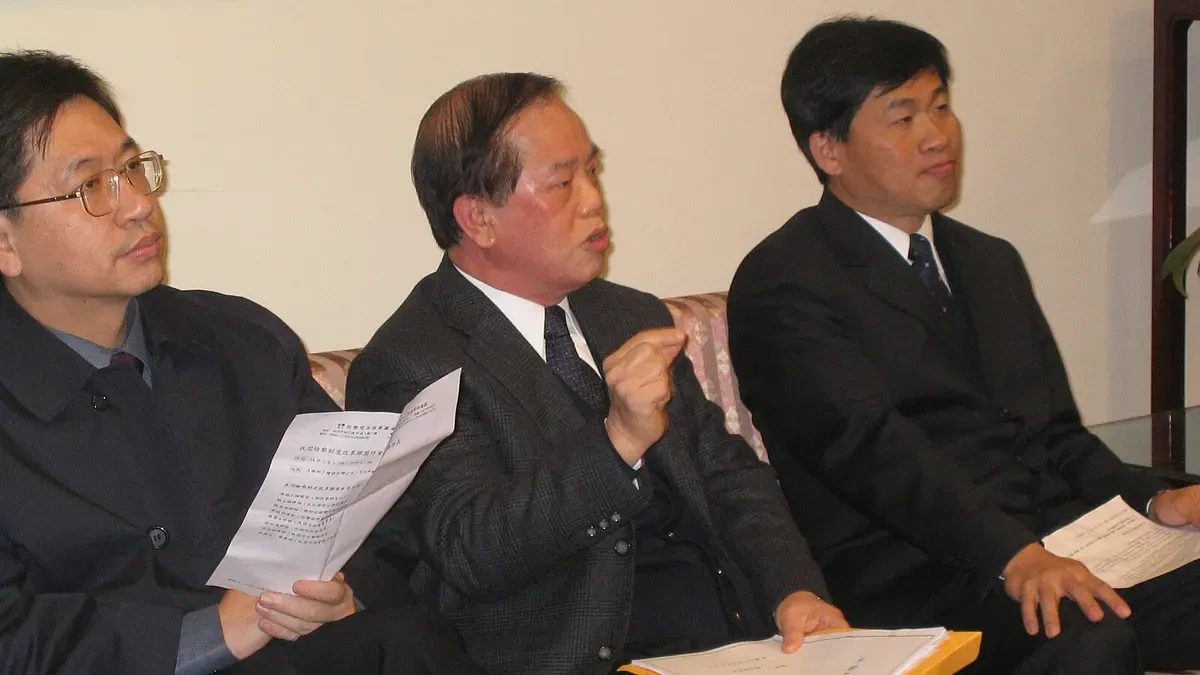
Civilian Prosecutor System Reform Alliance Visits Minister of Justice
Last edited: 2026-11-03
Representatives of the "Civilian Prosecutor System Reform Alliance" visited Minister of Justice Shih Mao-lin at 5:00 PM today (March 3, 2005), demanding that the Ministry of Justice propose concrete implementation plans and a timeline for prosecutorial system reform.
The Civilian Prosecutor System Reform Alliance (hereinafter referred to as the Prosecutor Reform Alliance) stated that it is a coalition jointly initiated by multiple civic legal professional groups, human rights organizations, and social movement groups, with a mission to promote the independence of the Prosecutor-General, reform of the prosecutorial system, and the renewal of prosecutorial culture. Following the inauguration of the new Minister of Justice, Shih Mao-lin, this was the Prosecutor Reform Alliance's first visit. In addition to putting forward concrete recommendations on issues of concern to the alliance, it hoped that Minister Shih would respond favorably to jointly promote judicial reform and safeguard the rights and interests of the people.
The Prosecutor Reform Alliance stated its hope that after taking office, Minister Shih will not only continue to fulfill the judicial reform commitments that former Minister Ch'en Ting-nan was unable to complete during his tenure, but also devote substantial effort to the reform of the overall prosecutor system, while referring to recommendations made by relevant civic judicial reform groups to achieve a cultural renewal of the prosecutor system. (1) The method for selecting the Prosecutor-General should be reformed through legislation and granted independent powers. (2) The "Prosecutor Personnel Review Committee," the "Antitrust and Anti-Corruption Center (the Anti-Black Gold Center)," and various special investigation units should be legalized through legislation as soon as possible. (3) When appointing important personnel, such as chief prosecutors and personnel stationed at the Financial Supervisory Commission, their integrity and qualifications should be rigorously evaluated. (4) Concrete actions should be taken to incentivize grassroots prosecutors to proactively investigate public-interest cases and establish a new atmosphere within the prosecutor system, rather than relying solely on evaluation systems to judge performance. (5) Regarding the issue of how to establish the boundaries between prosecutorial unity and prosecutorial independence, the Minister should widely solicit opinions from all sectors and seek the system best suited to our national conditions.
Furthermore, legal affairs work encompasses not only the administration of the prosecutor system but also other grassroots legal management such as prison administration, corrections, juvenile protection, parole, the Attorney Regulation Act, the Medical Examiners Act, legal education, and the abolition of the death penalty. The Prosecutor Reform Alliance expects Minister Shih to pay attention to comprehensive reforms. In addition, it hopes that Minister Shih will practice former Minister Ch'en Ting-nan's commitment to the gradual abolition of the death penalty, and outline a timeline and complementary measures for the gradual abolition of the death penalty, with the aims of aligning with international ideals and effectively safeguarding human rights.
Minister of Justice Shih Mao-lin responded to the demands raised by the Prosecutor Reform Alliance one by one: (1) Regarding the tenure system for the Prosecutor-General, the Ministry of Justice agrees to plan in this direction, but the appointment of the Prosecutor-General falls under the President's prerogative and requires broader discussion. (2) The legal institutionalization of the Prosecutor Personnel Review Committee and the Anti-Black Gold Center is naturally supported by the Ministry of Justice. (3) For important personnel such as chief prosecutors, he will communicate with relevant chief prosecutors and grassroots prosecutors, and will definitely take integrity and qualifications into consideration for appointments. (4) Prosecutors are representatives of the public interest, and the Ministry of Justice will encourage prosecutors to proactively investigate public-interest cases. As for the evaluation system, it still has a necessary existence, but it must not become an obstacle to reform; the Ministry of Justice will carefully review it. (5) Regarding the issue of prosecutorial unity and prosecutorial independence, the internal prosecutor system should coordinate to seek consensus.
Minister Shih further stated that the Medical Examiners Act has already passed the Executive Yuan meeting and been submitted to the Legislative Yuan for deliberation. The Ministry of Justice welcomes voices from all sectors to fully discuss it during public hearings convened by the Legislative Yuan. Regarding public prosecution issues following the implementation of the new criminal procedure system, the Ministry of Justice will require that public prosecution in the first instance must be solid. Although the second instance is constrained by a shortage of manpower, it will also require active and proactive court attendance by second-instance prosecutors for key cases—such as cases repeatedly remanded for retrial, cases where the facts remain unclear, or cases where first-instance public prosecution was not solidly implemented. As for parts requiring cooperation from the courts, the prosecution, defense, and judiciary should also make concerted efforts or communicate with the Judicial Yuan.
Regarding the issue raised by the Prosecutor Reform Alliance that prosecutors frequently and indiscriminately file appeals using template drafts, leading to a waste of judicial resources and widespread public grievances, Minister Shih agreed to request at the meeting of chief prosecutors that appeals must be handled prudently, opinions from public prosecution prosecutors should be heard, and reasons should be concretely stated rather than appealing with template drafts. Furthermore, once public prosecution is solidly implemented, it is even possible to consider making it a principle for prosecutors not to appeal cases where the court has delivered a not-guilty verdict.
Minister Shih also stated that the Ministry of Justice is willing to conduct statistical surveys and design standards for prosecutors' sentencing recommendations and plea bargaining. Regarding the abolition of the death penalty, the Ministry of Justice will continue former Minister Ch'en's commitments, continuing to promote and plan complementary measures. Regarding other related issues such as the Arbitration Act, the Attorney Regulation Act, legal education, and coordination with legal aid, the Ministry of Justice is willing to listen to civic voices and fully cooperate or actively study the establishment of better systems.
The visit by the Prosecutor Reform Alliance lasted for an hour and a half and concluded at approximately 6:30. Attendees from the Prosecutor Reform Alliance included: Attorney Ch'en Ch'uan-yueh (Chairman, Judicial Reform Foundation), Attorney Huang Jui-ming (Chairman, Taiwan Law Society), Attorney Ku Li-hsiung (Chairman, Taipei Bar Association), Attorney Su Yu-ch'en (Secretary-General, Taiwan Bar Association), Attorney Lin Yung-sung (Board Director, Judicial Reform Foundation), Prosecutor Ch'en Jui-jen (Spokesperson, Prosecutor Reform Alliance), and Attorney Kao Yung-ch'eng (CEO, Judicial Reform Foundation).
This article is an AI-generated translation of the original Chinese text. In the event of any discrepancy, the Chinese version shall prevail.