
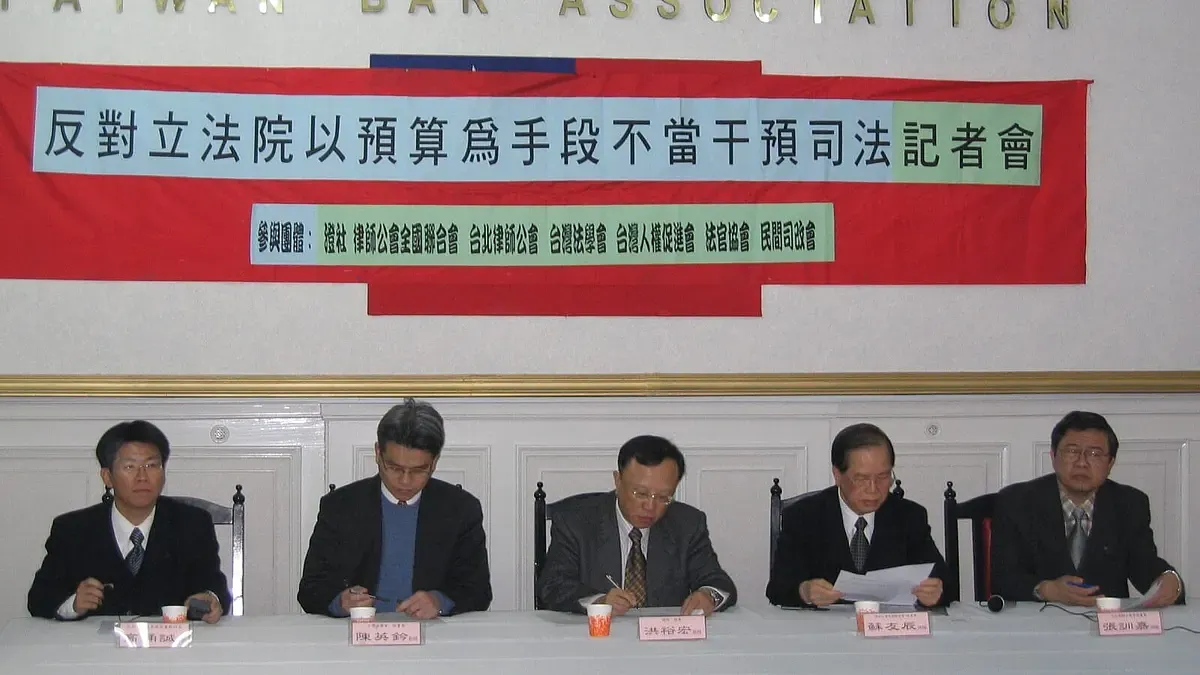
Opposing the Legislative Yuan's Inappropriate Interference with the Judiciary Through the Use of the Budget!
Last edited: 2026-11-03
According to news reports, during the cross-caucus consultations on the Judicial Yuan's budget for fiscal year 2005, the Kuomintang and People First Party caucuses substantially slashed the judicial budget—even eliminating the "judicial personnel professional allowance" for the President and Vice President of the Judicial Yuan, the Secretary-General, and the Grand Justices—due to their dissatisfaction with the perceived biased stances of the Judicial Yuan and Grand Justices in the presidential election litigation and the Truth and Reconciliation Commission constitutional interpretation. Civil society organizations express severe condemnation of such an unprofessional act of "retroactive settling of accounts" and "attempting to improperly interfere with the judiciary through the budget.
While the Legislative Yuan representing public opinion to oversee the government and review the budget ought to be a sacred and professional task, it frequently engages in "backroom politics" under the guise of "cross-caucus consultations," prioritizing political stances over right and wrong. If something does not align with its wishes, it haphazardly and arbitrarily slashes the budget. This legislative style has long been criticized by the public. Unexpectedly, because the Kuomintang and People First Party caucuses were dissatisfied with the constitutional interpretation rendered by the Council of Grand Justices regarding the Truth and Reconciliation Commission and the judges' rulings on the presidential election litigation, they advocated for cutting the "judicial personnel professional allowance" of the Grand Justices, which has been in place for years. Such naked interference in the judiciary fills the people with anger.
The power of the Grand Justices to interpret the Constitution is clearly stipulated in the Constitution, and their judicial interpretations possess "the function of state adjudication" (refer to Judicial Yuan Interpretation No. 392). Furthermore, "judicial organs" referred to in the Constitution, in the narrow sense, mean the Judicial Yuan and courts (including tribunals), and personnel exercising this judicial power include Grand Justices and judges (refer to Judicial Yuan Interpretation No. 396). Moreover, within the judicial personnel system, Grand Justices hold the highest rank, with many having transitioned from senior judges of the Supreme Court. Furthermore, interpretations rendered by the Council of Grand Justices carry the same legal force as the Constitution and must be observed by all courts. Therefore, since 1952, Grand Justices have drawn the "judicial personnel professional allowance." For decades, the Legislative Yuan raised no objections. Cutting the "judicial personnel professional allowance" of the Grand Justices now due to a political dispute over the election controversy not only violates the protection of legitimate expectations regarding incumbent Grand Justices, but such irrational legislative behavior also fails to win public approval.
Furthermore, pursuant to Article 5, Paragraph 4 of the Judicial Yuan Organization Act, Grand Justices whose terms have expired and who are not reappointed shall be deemed as judges who have ceased handling cases, and pursuant to Article 40, Paragraph 3 of the Judicial Personnel Appointment Act, they may still draw judicial remuneration. Since Grand Justices who are not reappointed are entitled to judicial remuneration (including the "judicial personnel professional allowance"), incumbent Grand Justices naturally have every reason to receive it. Additionally, the President and Vice President of the Judicial Yuan also hold the status of Grand Justices and are naturally entitled to draw the "judicial personnel professional allowance." As for the Secretary-General, if appointed from among judges and responsible for executing judicial administrative affairs, the importance of their position is no less than that of judges engaged in trial work. Pursuant to Article 39 of the Judicial Personnel Appointment Act, they likewise have the right to draw the "judicial personnel professional allowance." Therefore, the Kuomintang and People First Party caucuses' advocacy for abolishing the "judicial personnel professional allowance" for the aforementioned personnel clearly violates the provisions of these respective laws.
In fact, while civil society organizations advocate that the budget of the Judicial Yuan should be subject to oversight, they firmly oppose unlawful and irrational budget cuts—especially targeting the allowances of Grand Justices that are protected by legitimate expectations. Not only must we consider avoiding a "chilling effect" on Grand Justices resulting therefrom, but we must also refrain from using the budget to improperly interfere with the judiciary and thereby demand that the judiciary serve specific interests. The absolute independence of the Grand Justices is what the nation's judicial credibility hinges upon. We must safeguard Grand Justices from any form of interference and hope that the Legislative Yuan will listen to the voices of the people, rationally oversee the judicial budget, and make every effort to uphold judicial independence.
Issuing Organizations
Hsien-fa Review (The Cheng She)
Taiwan Bar Association
Taipei Bar Association
Taiwan Law Society
Taiwan Association for Human Rights
Judges Association of the Republic of China
Judicial Reform Foundation
This article is an AI-generated translation of the original Chinese text. In the event of any discrepancy, the Chinese version shall prevail.
