
Formally United, Spiritually Divided: Results of the Questionnaire Survey on the First Anniversary of the Implementation of the New Criminal Procedure System
Last edited: 2026-07-27
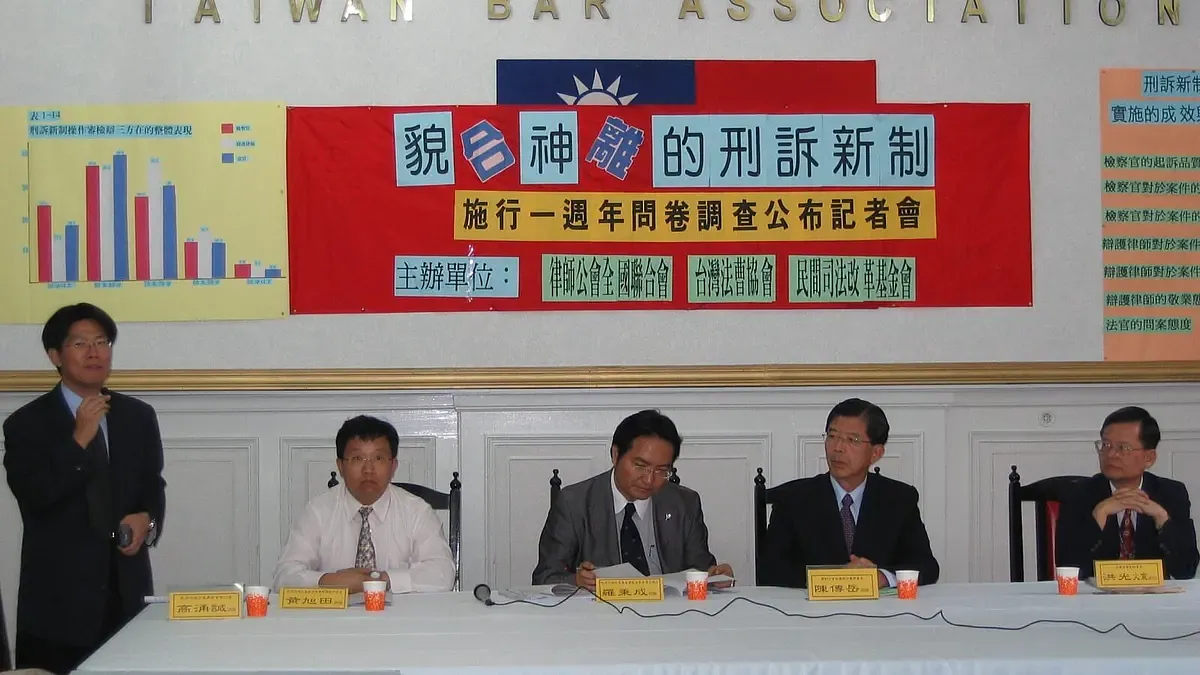
On September 1, the Judicial Reform Foundation, the Taiwan Bar Association, and the Taiwan Law Association held a press conference to release the results of a questionnaire survey marking the first anniversary of the new criminal procedure system, reviewing its implementation effectiveness over the past year.
The new criminal procedure system has been in effect for exactly one year since its implementation on September 1 of last year (2003). It is necessary to review how effective its implementation has been over the past year and what areas require improvement. To this end, the JRF, the Taiwan Law Association, and the Taiwan Bar Association launched an unprecedented large-scale questionnaire survey starting July 20, targeting lawyers, first-instance prosecutors, and judges who actually participated in the implementation of the new system.
The JRF issued a total of 6,662 questionnaires: 1,335 to judges, with 100 returned; 886 to prosecutors, with 175 returned; and 4,441 to lawyers, with 414 returned. Because the questionnaires were sent out without distinguishing between civil and criminal judges or lawyers handling civil versus criminal cases, the returned questionnaires should possess a considerable degree of representativeness.
Analysis of the survey results reveals that, apart from judges' litigation management and judgment quality, all respondents considered the overall performance of prosecutors and lawyers, as well as judges' questioning attitudes, to be improved compared to the old system (please refer to Tables 1-11, 1-12, and 1-13). Furthermore, the passing rates for the average scores of judges, prosecutors, and defense attorneys in operating the new system all exceeded ninety percent (please refer to Table 1-14). This indicates that all three branches of the legal profession have gradually accepted the reality of the new system's implementation. Moreover, more than half of the respondents stated that the new system's implementation has been beneficial in areas such as judicial neutrality, the quality of police and investigative handling of cases, and centralized trials (please refer to Table 1-15). Overall, respondents largely held a positive attitude toward the effectiveness of the new system's implementation.
However, regarding the final overall evaluation of the new system, exactly fifty percent of respondents affirmed that the new system is better than the old one (please refer to Table 1-15). In other words, better implementation effectiveness does not mean respondents like the new system; thus, fifty percent of respondents emotionally do not feel the new system is superior. Cross-analysis of the questionnaire results helps clarify where the problem lies.
First, while respondents highly affirmed whether prosecutors attended court throughout the proceedings, the proportion of prosecutors who actually fulfilled the function of public prosecution to bear the burden of proof after attending court dropped to 36.5% (please refer to Table 1-8). Regarding observations on judges realizing the presumption of innocence, adhering to the modified adversarial system, and following evidence investigation and evidentiary rules—the most crucial essence of the new system—the scores were also lower than those for implementing the collegiate panel system and following cross-examination regulations (please refer to Table 1-10).
Reflected in the most critical aspect of judgment quality, 58.6% of respondents believed that the new system failed to achieve any improvement (please refer to Table 1-13). This result demonstrates that after one year of the new system's implementation, both the bench and the prosecution showed better formal performance than the realization of its internal spirit. We do not believe the new system is merely "superficial," but we must admit it is somewhat "formally united yet spiritually divided."
Similarly, we also found that prosecutors performed better under the new system than lawyers did (please refer to Tables 2-19 and 2-20), but only 25.9% of prosecutors affirmed the new system (please refer to Table 2-26). Therefore, prosecutors' reactions indeed align with the description of being formally united yet spiritually divided.
Additionally, according to the survey results, the implementation of the new system has also highlighted the disparity in judicial resources between urban and rural areas, particularly concerning legal resources (please refer to Tables 2-13, 2-14, and 2-15).
Therefore, we believe that the successful implementation of the new system must be reviewed from three aspects. First is the renewal of legal professionals' mindset; that is, the judge, prosecutor, and defense attorney must thoroughly eradicate their old mentalities in accordance with the spirit of the new system for it to function as intended. Second, in reviewing supporting systems, whether to substitute the single-charge indictment system (charging instrument only) for the transfer of case files and evidence to prevent judicial prejudgment affecting the system's efficacy should be a topic of study for the next stage. Finally, regarding resource allocation, how to properly integrate and utilize resources—including how to improve shortages in human and material resources in non-urban areas or second-instance courts—truly impacts the success or failure of the new system.
Following today's press conference, the JRF will submit the survey results and analytical research to the Judicial Yuan for reference and improvement, and will continue to observe and supervise the implementation of the new criminal procedure system in the future, hoping to achieve the goals of the new system at an early date.
Attachments
- Investigation Report on the First Anniversary of the New Criminal Procedure System
- Annotation Summary of the Questionnaire Survey on the First Anniversary of the Implementation of the New Criminal Procedure System
- Questionnaire of the Survey on the First Anniversary of the Implementation of the New Criminal Procedure System
Attendees
Ch'en Ch'uan-yueh, Esq. (President, Taiwan Bar Association)
Lo Ping-cheng, Esq. (Convener of the Supervisory Committee, Judicial Reform Foundation)
Huang Hsu-t'ien, Esq. (Standing Executive Director, Judicial Reform Foundation / Secretary-General, Taiwan Bar Association)
Hung Kuang-huo, Deputy Director (Deputy Secretary-General, Taiwan Law Association)
Kao Yung-cheng, Esq. (Executive Director, Judicial Reform Foundation)
This article is an AI-generated translation of the original Chinese text. In the event of any discrepancy, the Chinese version shall prevail.