
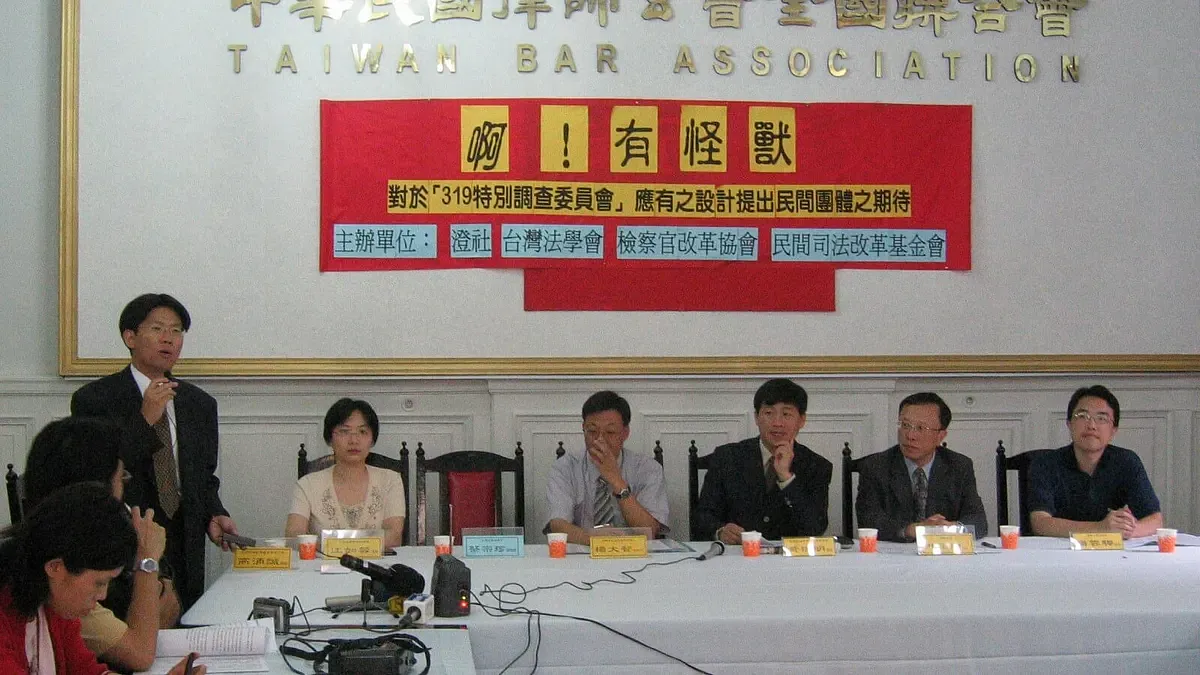
There is a Monster! Press Conference on the Special Investigation Committee for the March 19 Shooting of the President and Vice President
Last edited: 2026-07-27
Last Friday (August 13), negotiations between the ruling and opposition caucuses in the Legislative Yuan's provisional session broke down regarding the draft "Special Investigation Committee for the March 19 Shooting of the President and Vice President Act," setting the stage for a showdown vote. However, upon reviewing the version proposed by the opposition parties for negotiation, one cannot help but be appalled. As a civil society organization concerned with the operation of Taiwan's judicial power, we must voice our perspective before the ruling and opposition parties enter this voting showdown, in order to prevent the birth of a monstrous agency that undermines the judiciary.
First, the constitutional positioning of the Special Investigation Committee for the March 19 Shooting of the President and Vice President (hereinafter referred to as the SIC) suffers from a common flaw in both the ruling and opposition party versions. According to the ruling party's version, the power of the SIC derives from the control power (of the Control Yuan). However, the purpose of the control power is to impeach and censure executive agencies for illegal or derelict conduct. If the establishment of the SIC aims to investigate the faults of the Office of the President and the National Security Bureau, or the inadequate investigation by existing prosecutors, police, and investigative agencies, there would be no problem. Yet, the ruling party's version is designed to directly investigate the truth of a crime, thereby confusing the distinction between the control power and judicial investigative power.
As for Articles 11 and 12 of the opposition party's version, they appear to combine the investigative powers of the Legislative Yuan and the Control Yuan into a mixed operation. This is precisely the situation that the Constitution's adoption of the separation of five powers sought to avoid; therefore, prior to a constitutional amendment, the opposition party's version is also suspected of being unconstitutional. Not only that, according to Article 9 of the opposition party's version, the SIC may second or direct prosecutors. This is tantamount to disrupting the normal prosecutor operating mechanism, turning the SIC into a great monster possessing legislative, control, and judicial powers. The potential consequences of this are simply unimaginable!
Secondly, according to Article 8, Paragraph 1 of the opposition party's version, the "investigative power" of the SIC includes "inspecting and examining places where relevant evidence and documents are concealed," "interrogating... relevant personnel," "verifying or appraising," "ordering relevant personnel to undergo physical examinations and polygraph tests," and so on. Therefore, this so-called "investigative power" actually exceeds the design of investigative powers under Chapter 5 of the Control Act and possesses the nature of judicial power, which is equivalent to the SIC exercising powers of search, seizure, and interrogation outside of the courts. However, according to Article 8 of the Constitution, in fact only judicial agencies possess this authority. Thus, the powers conferred upon the SIC by the opposition party's version are not only blatantly unconstitutional but also risk infringing upon human rights.
Furthermore, according to Article 8, Paragraph 7 of the opposition party's version, the SIC may prohibit the person under investigation and related personnel from leaving the country. In other words, the SIC may arbitrarily interfere with the freedom of movement guaranteed to the people by the Constitution, free from judicial review. Calling it a monster is entirely justified!
In fact, in order to let the public understand the truth of the March 19 incident, civil society organizations can understand the expectation of establishing a special institution to conduct an investigation. However, civil society organizations believe that the spirit of democracy and the rule of law cannot be sacrificed for a specific case. To establish such an institution and confer investigative powers upon it, it must still comply with the constitutional requirements regarding the separation of powers, without confusion or concentration of power in a single body. Therefore, if the purpose demanded by the Legislative Yuan is to conduct a criminal investigation into the March 19 incident, it should establish an exclusive judicial investigative power over the March 19 incident akin to an independent prosecutor. Moreover, this "independent prosecutor" must possess a legal background, understand investigative practices, and be equipped with a oversight mechanism to prevent the abuse of power, while the exercise of its power must also comply with due process requirements such as the Code of Criminal Procedure. Conversely, if the Legislative Yuan's purpose is to pursue administrative responsibility, legislation must be formulated strictly under the concept of control power, and this special agency must not be allowed to have criminal investigative powers.
It is rumored that the Legislative Yuan will hold a voting showdown within days. However, the SIC Act versions of the various parties are not only unconstitutional, but will also interfere with the operation of the current judicial power and carry the risk of infringing upon human rights. As a force for civil judicial oversight, even if we might tolerate exceptional, case-specific legislation out of deference to the broad expectations of the people, we can never sit idly by in the face of legislative actions that violate the principle of the separation of powers under the Constitution. To this end, civil society organizations have specially issued this statement, calling on our fellow citizens to join together in stopping the birth of this monster, and hoping that all caucuses in the Legislative Yuan will think twice and design a truth-finding body that is constitutional and lawful in accordance with the spirit of the Constitution.
This article is an AI-generated translation of the original Chinese text. In the event of any discrepancy, the Chinese version shall prevail.
