
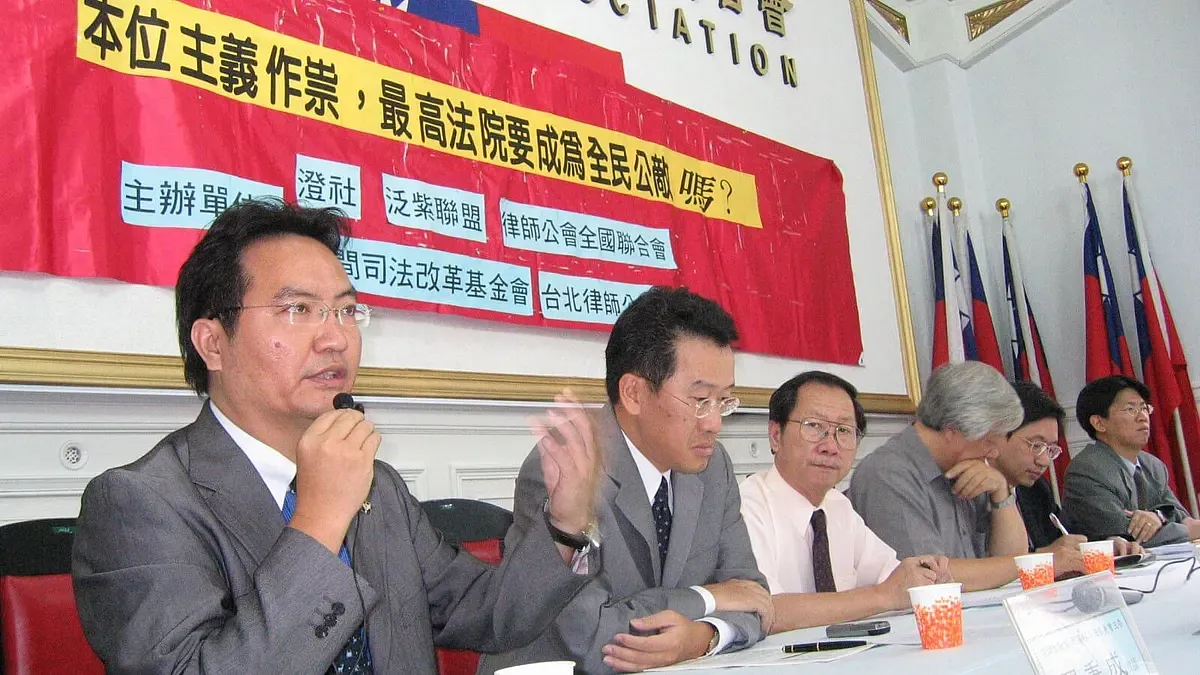
Driven by Parochialism: Is the Supreme Court Becoming a 'Public Enemy'?
Last edited: 2026-11-03
On July 23, the Council of Grand Justices of the Judicial Yuan rendered Judicial Yuan Interpretation No. 582, declaring that parts of Supreme Court Precedents Shang-Tzu No. 2423 of the 31st Year of the Republic, Tai-Shang-Tzu No. 419 of the 46th Year, and other similar precedents—specifically those regarding the exclusion of the statutory investigation procedures for human witnesses concerning "statements by co-defendants" and the improper deprivation of a defendant's right to cross-examination—shall no longer be applied. On the afternoon of the same day, the Supreme Court took the rare step of issuing a statement in the name of its President, expressing regret over the Interpretation and calling for "judging to be returned to judging!", which seemingly portended an imminent conflict between the two institutions.
True to form, the Supreme Court convened a criminal division meeting on July 27, specifically establishing an impact response team for Interpretation No. 582, announcing that it would petition for a supplementary interpretation, and stating that it would not rule out suspending the adjudication of similar cases pending a supplementary interpretation by the Council of Grand Justices. Consequently, more than 4,000 cases would be affected, and the public's right to access justice would suffer severe harm. Furthermore, the spokesperson for the Supreme Court Criminal Division held a press conference yesterday (the 28th) morning, stating that the Court would continue to apply the precedents declared unconstitutional, thereby openly defying the Grand Justices' Interpretation. Such law-breaking behavior by the Supreme Court, which should know the law, compels civil society groups to speak out.
First of all, Judicial Yuan Interpretation No. 582 is by no means, as the Supreme Court claimed, tailor-made for death row inmate Hsu Tzu-chiang (徐自強), nor does it raise the question of whether Paragraph 2, Article 156 of the current Code of Criminal Procedure is likewise unconstitutional. The Supreme Court's backlash is clearly driven by parochialism. Legally speaking, the Supreme Court's arguments are unconvincing.
Moreover, the Supreme Court's use of "suspending trials" as a retaliatory threat is tantamount to a farce and sacrifices the public's right to seek judicial remedies. Civil society organizations believe that if the Supreme Court truly adopts this approach, it will inevitably become a public enemy and will be utterly unforgivable. In addition, regardless of the appropriateness of the Council of Grand Justices' Interpretations, they carry the same hierarchical status as the Constitution. When the Supreme Court encounters difficulties in application, it should follow the institutional framework to petition for a supplementary interpretation, rather than openly defy the Grand Justices' Interpretation and continue applying unconstitutional precedents. As the guardian of the law, the Supreme Court taking the lead in breaking the law it is sworn to uphold is not only regrettable but also sets the worst possible example for the public.
In fact, comparing today's Interpretation No. 582 with Interpretation No. 263 rendered by the 5th-term Grand Justices fourteen years ago regarding the Ma Hsiao-pin (馬曉濱) case, one can clearly see the trajectory of human rights progress. This demonstrates that the torrent of the times cannot be blocked by anyone; the fundamental human rights proclaimed and protected by the Constitution are absolute universal values, and the Supreme Court cannot逆勢 (reverse the trend).
Here, we call upon the Supreme Court to abandon its parochial confrontation and refrain from becoming a public enemy. It should earnestly contemplate the issue of safeguarding defendants' right of defense as revealed in Interpretation No. 582, rather than falling into emotional backlash. In response, the Judicial Reform Foundation will arrange relevant seminars, inviting criminal procedure scholars and experts to study Interpretation No. 582, and welcomes Supreme Court judges to participate and communicate together in an attempt to resolve the practical adjudication problems perceived by the Supreme Court. After all, emotional backlash is of no help in solving problems; rational communication and pooling collective wisdom is the best course of action.
In addition, the institutional conflict between the Supreme Court and the Grand Justices also demonstrates that the amendment of the Judicial Yuan Organization Act is indeed imminent. Through the amendment of the Judicial Yuan Organization Act, the problem of the so-called "fourth instance" can naturally be resolved. The general public can use this incident to urge the Legislative Yuan to swiftly pass the amendments to the Judicial Yuan Organization Act to fulfill human rights protections.
This article is an AI-generated translation of the original Chinese text. In the event of any discrepancy, the Chinese version shall prevail.