
Press Release on the Results of the Questionnaire Survey on Prosecutors from the Taiwan High Prosecutor's Office Attending Court to Execute Public Prosecution
Last edited: 2026-07-27
Grading the New Criminal Procedure System Six Months After Implementation
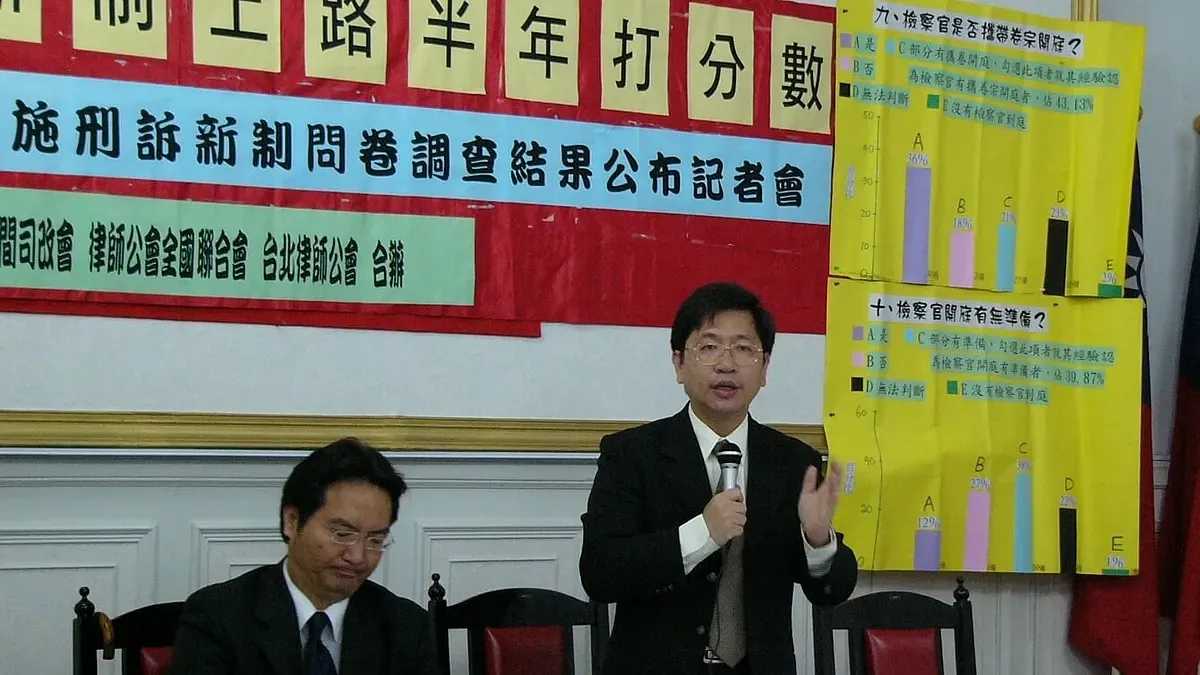
The Judicial Reform Foundation (hereinafter referred to as JRF), the National Bar Association of the Republic of China (hereinafter referred to as NBA), and the Taipei Bar Association held a press conference today (the 8th) to release the results of a questionnaire survey regarding prosecutors from the Taiwan High Prosecutor's Office attending court to execute public prosecutions, grading the new criminal procedure system six months after its implementation.
The JRF stated that the new Code of Criminal Procedure system featuring "cross-examination" has been in effect for half a year, from September 1 of last year (2003) to February 29 of this year (2004). During this period, as many lawyers reported to the Foundation that prosecutors from the Taiwan High Prosecutor's Office had the least satisfactory cooperation record, the JRF, with the assistance of the NBA and the Taipei Bar Association, launched a one-month questionnaire survey targeting lawyers nationwide in early February [see Attachment 1].
According to the JRF, by the end of March this year, the Foundation had recovered 126 valid questionnaires, with male and female lawyers accounting for 70% and 30% respectively. Furthermore, the responding lawyers possessed extensive practical experience, with an average practice duration of 11.32 years. It is generally expected that these responses faithfully reflect criminal defense lawyers' practical evaluation of the implementation of the new criminal procedure system by prosecutors from the Taiwan High Prosecutor's Office.
As synthesized from the questionnaire results, the implementation of the new criminal procedure system by prosecutors from the Taiwan High Prosecutor's Office over the past six months has been less than satisfactory. The most prominent flaws include: First, prosecutors from the Taiwan High Prosecutor's Office failed to consistently attend court throughout the proceedings: As shown in Tables 1 and 2, only 54% of prosecutors attended the entire "preparation proceedings," and during "trial proceedings," as many as 2% of prosecutors failed to attend at all. Second, prosecutors from the Taiwan High Prosecutor's Office failed to break away from old trial patterns: Up to 70% of prosecutors, when stating the gist of their appeal (indictment), merely made the perfunctory statement: "As stated in the appeal (indictment) brief," which appears to be a mere formality (refer to Table 3 and Figure 3). Third, prosecutors from the Taiwan High Prosecutor's Office failed to fulfill their duty to present evidence: As shown in Tables 4, 5, and 6, as many as 72%, 79%, and 85% of prosecutors respectively failed to submit an "evidence list," an "application for evidence investigation," or a "closing argument brief," raising doubts as to whether prosecutors have faithfully fulfilled their burden of proof. Fourth, prosecution representatives at hearings were inconsistent: According to the survey, in 37% of cases, hearings were not consistently attended by the same group of prosecutors to execute public prosecutions (refer to Table 7 and Figure 7). Under such circumstances, one must question whether prosecutors can effectively grasp case facts and successfully prosecute crimes. Fifth, prosecutors from the Taiwan High Prosecutor's Office were inadequately prepared for hearings: As shown in Table 9, nearly 20% of prosecutors did not bring case files to the hearings at all, and naturally, fewer than 28% of lawyers considered prosecutors to have "fully" or "partially" prepared for hearings (refer to Table 10 and Figure 10) [see Attachments 2 and 3]. It is evident that the scorecard of prosecutors from the Taiwan High Prosecutor's Office over the past six months of implementing the new criminal procedure system is far from "impressive." The three organizations stated that if improvements are not made in the future, the chief prosecutors of the Taiwan High Prosecutor's Office or its branch offices should consider resigning!
In addition to releasing the above questionnaire results, the JRF also announced that upon the one-year anniversary of the implementation of the new criminal procedure system, it will launch a large-scale questionnaire survey targeting judges, prosecutors, and lawyers in criminal divisions of courts of first and second instance nationwide, to gain a deeper understanding of the actual implementation status and shortcomings of the "cross-examination" system under the Code of Criminal Procedure across the country.
Attachments
- Questionnaire on the New Criminal Procedure System
- Statistical Tables for the New Criminal Procedure System Questionnaire
- Statistical Figures for the New Criminal Procedure System Questionnaire
Attendees
Attorney Lo Ping-ch'eng, Chairperson, Criminal Procedure Law Committee, National Bar Association
Attorney Ku Li-hsiung, President, Taipei Bar Association
Attorney Lin Yung-sung, Board Director, Judicial Reform Foundation
Attorney Lin Ching-p'ing, Executive Director, Judicial Reform Foundation
This article is an AI-generated translation of the original Chinese text. In the event of any discrepancy, the Chinese version shall prevail.