
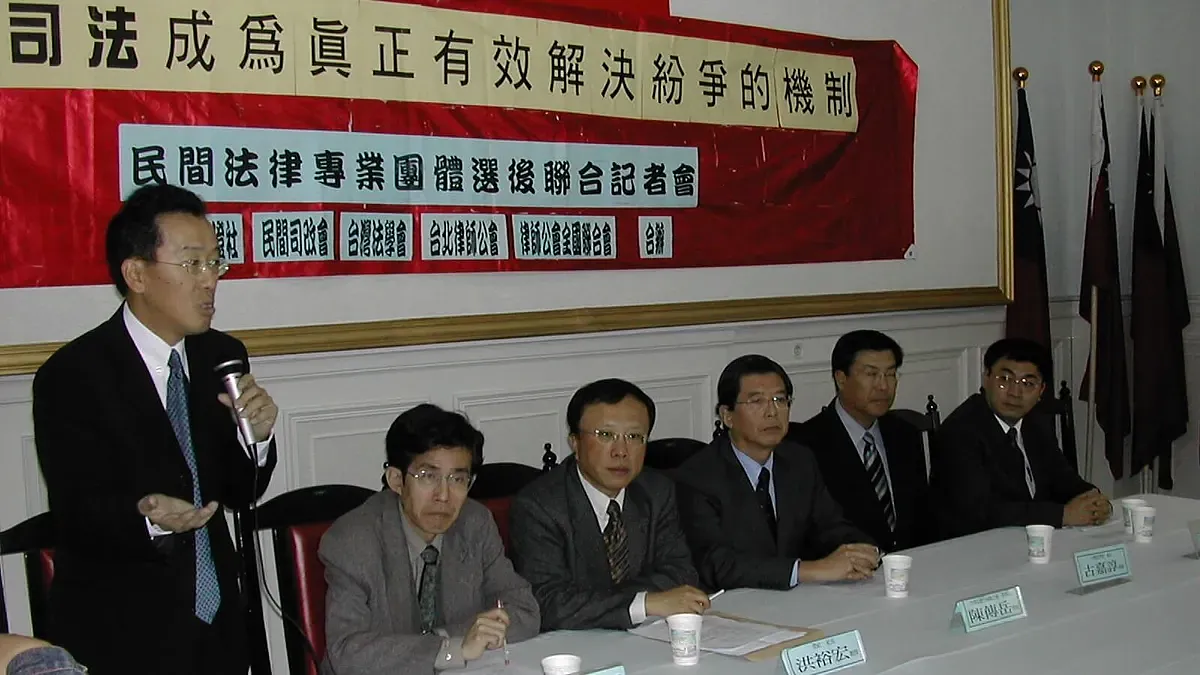
Making the Judiciary a Truly Effective Mechanism for Resolving Disputes
Last edited: 2026-07-27
In response to the March 20 presidential election seemingly entering "overtime," with electoral fervor and social fractures failing to heal, the Judicial Reform Foundation (hereinafter JRF) issues the following statement today (the 23rd):
I. Judicial independence is the lifeblood of the judiciary and must not be interfered with by any person through external forces in any form:
Article 80 of the Constitution stipulates: "Judges shall be beyond partisanship, conduct trials independently in accordance with the law, and be free from any interference." This explicitly proclaims that judicial independence is a vital principle of the separation of powers and checks and balances within a free and democratic constitutional order. In conducting trials, judges are bound solely by the law (including the Constitution) and their conscience, free from any other form of interference. Such interference includes not only intervention from other branches of government (such as the executive or legislative power), but also efforts by parties with a specific stake in a case to exert pressure on the court by organizing crowd protests or manufacturing public opinion.
Recently, Kuomintang and People First Party presidential and vice-presidential candidates Lien Chan and James Soong, dissatisfied with the election results, commissioned lawyers to apply to the court for evidence preservation (sealing all ballot boxes nationwide) and filed lawsuits for the nullification of the election and of the election results (hereinafter this case). This constitutes a litigation right guaranteed by Article 16 of the Constitution, which the people of our nation naturally should respect. However, while Messrs. Lien and Soong participated in the election following our democratic constitutional system and sought legal remedies through judicial procedures upon the announcement of the election results, they simultaneously incited supporters to gather in front of the Presidential Office for days and nights on end, demanding that the President and the Executive Yuan "immediately recount the ballots" and "recount all ballots." This action not only contradicts their stated purpose of respecting the judiciary and seeking resolution within the institutional framework, but also undermines the constitutional order, constituting improper conduct intended to interfere with the judiciary through external forces.
Regarding election litigation, whether the court should conduct a recount, how to conduct it, and the scope of the recount all fall within the scope of its independent adjudication. They are certainly matters upon which the President or the Executive Yuan cannot opine, nor should they be subjected to external interference by any person in any form. Following political democratization, the foundations of constitutional governance and judicial independence—progressively realized through more than a decade of reform efforts by all sectors of society—must even less be arbitrarily undermined by politicians. Based on the principle that judicial independence is the lifeblood of the judiciary and the objective of safeguarding our nation's democratic constitutional order, the JRF hereby solemnly appeals:
- Politicians must not use crowds to coerce the executive branch into demanding interference with judicial operations.
- Politicians should not incite crowds with the intent of influencing judges' adjudication and rulings on cases.
- The resolution of political issues must not be made a sacrifice to judicial independence.
- At this critical juncture when judicial independence either rises or sinks, judges and prosecutors must stand firm and refuse to bow to any form of pressure.
- The entire citizenry should loudly condemn any behavior tantamount to hijacking the judiciary, and should particularly spurn politicians who harm the judiciary.
II. This case is a benchmark case that will establish or destroy judicial credibility; adjudicators must not treat it lightly:
While defending judicial independence, we must reiterate that the trial procedures and ruling outcomes of this case will inevitably attract high levels of attention domestically and internationally. Judicial authorities and the presiding judges alike must realize that this case is sufficient to establish or destroy judicial credibility, and they must not fail the trust and mandate placed in them by the litigants and the entire citizenry! Therefore, we solemnly urge the presiding judges in this case, when facing the first-ever lawsuits for the nullification of a presidential and vice-presidential election in our nation's electoral history, to handle this case with the principles of prudence, fairness, openness, transparency, and promptness, lest judicial credibility be buried alongside societal fractures that have yet to heal.
Herein, the JRF believes that our nation's judicial mechanism possesses sufficient capacity to handle such litigation cases, yet also puts forward two concrete suggestions as follows:
- Trial procedures should strive for openness and transparency. Where necessary, audio and video recordings should be maintained throughout, or even broadcast live, to demonstrate public credibility.
- Trial duration should strive to be concentrated and intensive, bringing election litigation to a swift conclusion so as to avoid national anxiety and difficulties in government administration.
III. Citizens should remain rational, respect the judiciary, and afford the judiciary a pristine trial space and reasonable review time:
As stated above, while "promptly trying this case" is a shared expectation, tolerating to a certain extent the time costs necessary for the judiciary to balance procedural and substantive justice as well as ruling accuracy is equally important! Therefore, we also call upon our citizens to remain rational, exercise patience, respect the judiciary, and grant the presiding judges a pristine trial space and reasonable review time, rather than attempting to influence or oppress the judiciary through mass movements or street protests. Otherwise, this not only violates the spirit of democratic rule of law, but is also likely to cause their demands to lose legitimacy.
Joint Press Release
Civic legal professional groups including the Chai-society, Taiwan Law Association, Judicial Reform Foundation (hereinafter JRF), Taiwan Bar Association (hereinafter Bar Association R.O.C.), and Taipei Bar Association held a joint press conference this morning (the 23rd) regarding the ongoing electoral fervor and societal fractures following the March 20 presidential election, issuing appeals to the judiciary, ruling and opposition parties, and the general public.
The speaking order at today's press conference was as follows: Lawyer Huang Hsu-t'ien (Standing Executive Committee Member of the JRF), Professor Hung Yu-hung (President of Chai-society), Professor Cheng Tai-an (Member of Chai-society), Lawyer Ku Chia-chun (President of the Taiwan Law Association), Professor Chen Tzu-yang (Director of the Constitutional and Administrative Law Committee of the Taiwan Law Association), Lawyer Chen Ch'uan-yueh (Chairman of the Board of Bar Association R.O.C.), and Lawyer Koo Li-hsiung (Chairman of the Board of Taipei Bar Association). However, right after the remarks delivered by the representatives attending from the JRF and Chai-society [their respective statements are attached in the appendix], the organizers learned through media reports (Eastern Broadcasting Co.) that the ruling and opposition parties were considering amending the Presidential and Vice-Presidential Election and Recall Act and submitting it directly to second reading to satisfy the demands of the KMT and PFP and their supporters for "immediate recounts" and "full recounts." Although this news could not be verified at the time, subsequent speakers still more or less expressed their opinions on this latest development.
Among them, Professor Chen Tzu-yang, Director of the Constitutional and Administrative Law Committee of the Taiwan Law Association (Professor of Constitutional Law at National Taipei University), stated that even if the Legislative Yuan were to amend the Election and Recall Act to include provisions for "administrative recounts," such provisions should apply only to future elections and future procedures. Since Lien and Soong's election litigation cases have already entered the judicial jurisdiction, from the perspective of constitutional law, legislators should no longer intervene; otherwise, it would violate the constitutional principle of the separation of powers.
Subsequently, Lawyer Chen Ch'uan-yueh, Chairman of the Board of Bar Association R.O.C., stated that ordinarily people find it difficult to understand what is truly meant by "the judiciary is the last line of defense for social justice." Yet today's situation truly allows us to deeply comprehend the meaning of this phrase, demonstrating just how heavy the responsibilities borne by the judiciary are! At the same time, however, Chen Ch'uan-yueh also raised a question: even if the Election and Recall Act is amended to include the procedure of "administrative recount," would people truly believe the results of an administrative recount? Moreover, if someone were dissatisfied with the results of the administrative recount, would they not also file an election lawsuit and return to today's predicament? Therefore, he appealed to the ruling and opposition parties and the general public to place greater trust in a fair and transcendent "judicial recount."
Finally, Lawyer Koo Li-hsiung, Chairman of the Board of Taipei Bar Association, stated that as seen from recent developments, compared to other branches of state power (executive, legislative...), the judiciary is indeed the most fragile and vulnerable link. Today's predicament arises simply because crowds have coerced parties into making private political deals that harm judicial dignity. Should the citizenry not reflect on this or feel a shred of alarm? Why do people not trust the judiciary? Why, even after Messrs. Lien and Soong have filed lawsuits, do they still not trust the judiciary? Furthermore, Koo Li-hsiung expressed with a sense of emotion that "democratic politics" consists of more than just casting ballots in elections; it also includes respect for the principle of the separation of powers and respect for the judiciary as the ultimate adjudicator. If the ruling and opposition parties truly intend to use statutory amendments with retroactive effect to allow an "administrative recount" of the ballots from this presidential election, that would be trampling upon the judiciary with executive and legislative power, which is entirely unacceptable.
This article is an AI-generated translation of the original Chinese text. In the event of any discrepancy, the Chinese version shall prevail.