
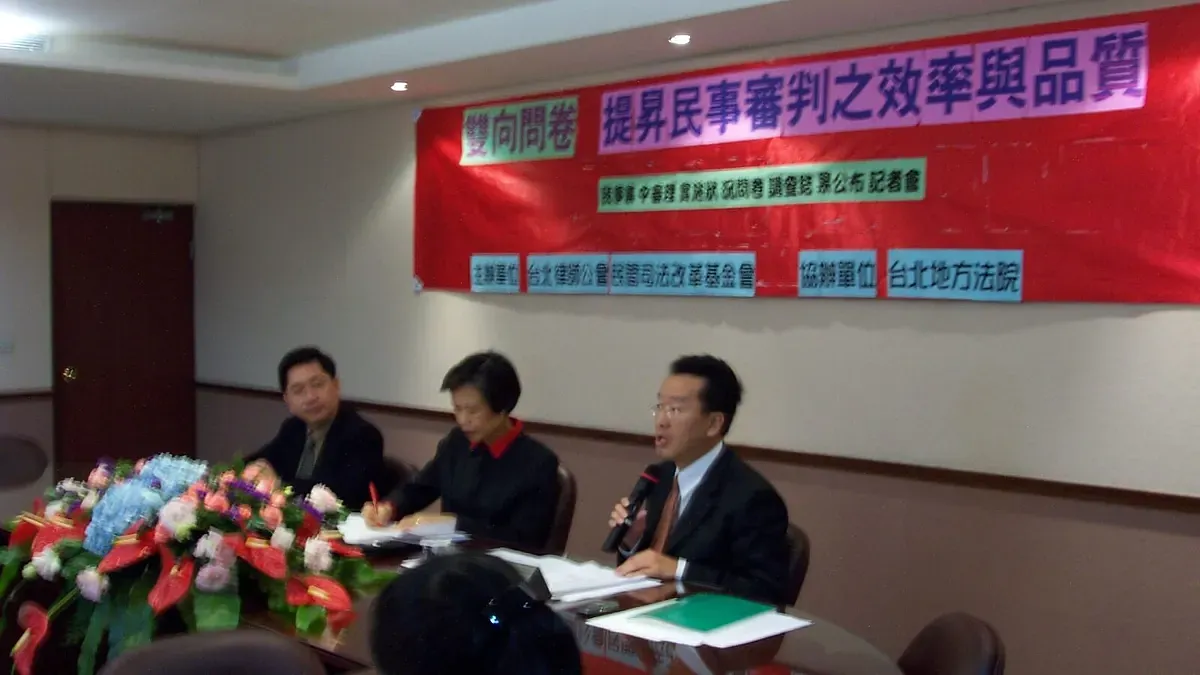
Two-Way Questionnaire to Jointly Improve the Efficiency and Quality of Civil Adjudication
Last edited: 2026-07-27
The Judicial Reform Foundation (JRF), the Taipei Bar Association, and the Taipei District Court jointly held a press conference on February 23 to release the "Results of the First Questionnaire Survey on the Implementation Status of Civil Centralized Trial System."
This questionnaire survey covered a six-month period from July 1 to December 31 of last year (2003). During this period, the organizers collected a total of 381 valid questionnaire responses, which reflect the actual evaluations by members of the Taipei Bar Association (i.e., attorneys) regarding the implementation of the civil centralized trial system by judges in the civil divisions of the Taipei District Court.
Table 1: Individual Judges
| Average Score Range | Number of Judges | Percentage |
|---|---|---|
| 70 and above, under 80 | 3 | 6% |
| 80 and above, under 90 | 12 | 24% |
| 90 and above, under 100 | 30 | 60% |
| 100 | 5 | 10% |
| Total | 50 | 100% |
Table 2: Judges Implementing Civil Centralized Trials
| Average Score Range | Number of Judges | Percentage |
|---|---|---|
| 59 and below | 0 | 0% |
| 60 and above, under 70 | 0 | 0% |
| 70 and above, under 80 | 1 | 2% |
| 80 and above, under 90 | 9 | 21.5% |
| 90 and above, under 100 | 23 | 55% |
| 100 | 9 | 21.5% |
| Total | 42 | 100% |
Table 3: Judges Not Implementing Centralized Trials
| Average Score Range | Number of Judges | Percentage |
|---|---|---|
| 59 and below | 2 | 6% |
| 60 and above, under 70 | 2 | 6% |
| 70 and above, under 80 | 6 | 18% |
| 80 and above, under 90 | 10 | 29% |
| 90 and above, under 100 | 10 | 29% |
| 100 | 4 | 12% |
| Total | 34 | 100% |
Table 4: Evaluation Items
| Evaluation Item | Count | Percentage |
|---|---|---|
| Failure to timely direct the exchange of briefs | 64 | 15% |
| Failure to timely organize issues | 102 | 24% |
| Failure to timely allocate the burden of proof | 113 | 27% |
| Failure to discuss organized issues in the reasoning of the judgment | 87 | 20% |
| Other (see Appendix) | 61 | 14% |
| Total | 427 | 100% |
Comprehensive statistical results show that among the 50 evaluated civil judges of the Taipei District Court, 70% received an average score of 90 or above. Further analysis of the correlation with the implementation of civil centralized trials reveals that 76.5% of judges who implemented centralized trials received an average score of 90 or above; conversely, only 41% of judges who did not implement centralized trials scored 90 or above, a gap of over 35 percentage points. This clearly demonstrates that judges who implement centralized trials are more likely to receive favorable reviews from attorneys than those who do not.
Secondly, looking at individual evaluation items, 27% and 24% of Taipei District Court civil judges respectively had points deducted by attorneys due to "failure to timely allocate the burden of proof" and "failure to timely organize issues." This indicates that civil division judges must particularly strengthen the two tasks of "organizing issues" and "allocating the burden of proof" when directing litigation; otherwise, it will be detrimental to the progress of adjudication.
In addition to releasing the above overall scores, the JRF will also notify each evaluated judge of their individual scores and evaluation results via confidential letters. Finally, the JRF, the Taipei Bar Association, and the Taipei District Court also announced that they will proceed with the second stage of the two-way questionnaire survey on the civil centralized trial system. Matters such as the implementation period, implementation methods, and whether to publicly disclose the names of evaluated judges or attorneys in the future will be decided upon in subsequent meetings.
Appendix
The following are reasons specifically noted by attorneys for point deductions against judges:
- Default judgment conducted, procedural handling error, resulting in oral argument being reopened twice.
- Failed to give both parties an opportunity to be heard regarding the ex officio reduction under Article 252 of the Civil Code.
- Oral argument was concluded, but reopened because the judge could not write the judgment.
- Issues were organized only on the date of oral argument.
- The plaintiff failed to submit briefs in a timely manner, and the judge failed to order rectification; every time evidence was investigated, the judge ordered both parties to reorganize the "issue briefs" and oral argument briefs.
- No preparatory proceedings, concluded in a single hearing, giving a sense of being ambushed.
- Preparatory proceedings consisted of only one hearing session, and only witnesses were examined.
- Before the first hearing, the timing for organizing issues was too early and did not cover all allegations and defenses of both parties.
- Judgment was rendered after only a single hearing; neither party had appeared in court prior to that, and all matters were conducted through the exchange of briefs and issue organization.
- Preparatory proceedings were not conducted.
- Failed to pay attention to the reduction of claims.
- Failed to timely exercise the power of clarification, leading to a distortion of facts.
- Inferences of facts were not entirely accurate.
- Fact-finding was inconsistent with the case file materials and violated rules of empirical logic.
- Some reasoning in the judgment was inappropriate.
- Investigated numerous unnecessary items of evidence in the case.
- Ordered parties to submit evidence with improper relevance to the outcome of the case.
- The court gave no instructions, resulting in the parties failing to organize issues.
- Failed to discuss all issues in the reasoning.
- Failed to grasp the statute of limitations.
- Case closure was slightly delayed.
- Case proceedings were somewhat delayed.
- Centralized trial was not thoroughly implemented; opposing party's brief was submitted on the spot in court.
- Participated in adjudication in a similar case (with a different opposing party) previously, but failed to recuse himself/herself in the present case.
Attendees
Lin Chin-fang, President, Taipei District Court
Hsieh Pi-li, Presiding Judge, Taipei District Court
Ting Pei-pei, Presiding Judge, Taipei District Court
Chang Ching-nü, Judge, Taipei District Court
Lu Yen-ju, Presiding Judge, Taipei District Court
Wu Ching-jung, Presiding Judge, Taipei District Court
Lin Hui-yu, Presiding Judge, Taipei District Court
Ku Li-hsiung, President, Taipei Bar Association
Lin Yung-sung, Board Director, Judicial Reform Foundation
This article is an AI-generated translation of the original Chinese text. In the event of any discrepancy, the Chinese version shall prevail.