
Enhancing Judicial Efficiency and Judgment Quality while Pursuing Equality in Litigation: The Advocacy of the Three Major Judicial Reform Bills Promotion Alliance
Last edited: 2026-11-03
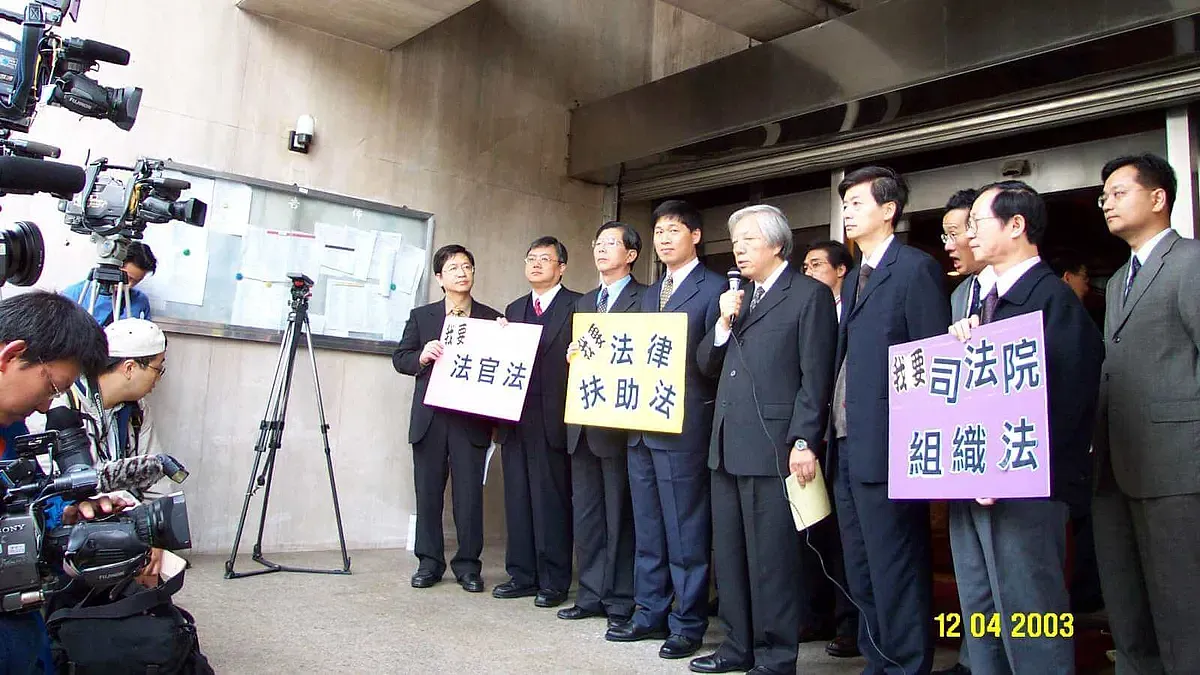
The Three Major Judicial Reform Bills Promotion Alliance, dedicated to advancing the Legal Aid Act, the Judges Act, and the Judicial Yuan Organization Act, was officially established on December 4. In addition to legal professional organizations such as the Judicial Reform Foundation, the Taiwan Judges Association, the Prosecutors Reform Association, the Taiwan Bar Association, the Taipei Bar Association, and the Taiwan Police Reform Association, as well as academic groups like the Awakening Society and the Taiwan Law Society, the Alliance also encompasses numerous human rights, social movement, labor movement, women's movement, and disadvantaged groups, including the Taiwan Association for Human Rights, the Fair and Just Alliance, the National Federation of Bank Employees' Unions, the National Confederation of Trade Unions, the Taiwan Labour Front, the Awakening Foundation, the Taiwan Association for Promotion of Peace, the National Alliance of Taiwan Women's Associations, the National League of Parents with Mentally Retarded Children, the Disabled People's Association of the ROC, and the National Coalition for Social Welfare of the Elderly.
The amendment of the Judicial Yuan Organization Act and the enactment of the Judges Act and the Legal Aid Act were all conclusions of the 1999 National Judicial Reform Conference. In particular, Judicial Yuan Interpretation No. 530 explicitly required the Legislative Yuan to amend the Judicial Yuan Organization Act by October 5 of this year. Following the successive amendments and implementation of the Code of Civil Procedure and the Code of Criminal Procedure, litigation procedures will become increasingly professional and complex, which average citizens can hardly navigate on their own. Meanwhile, the draft Legal Aid Act—crucial for state subsidies to help under-resourced citizens afford lawsuits or receive legal consultation—has stalled due to funding allocation issues by the government after committee review was completed in the second session of the fifth Legislative Yuan. Regarding the Judicial Yuan Organization Act, it has remained completely deadlocked to this day due to poor legislative performance and the legislative hall being reduced to an arena for political wrestling. As for the Judges Act, facing resistance from the Control Yuan and the Examination Yuan, aside from the civil society version having been referred to committee for review, an official version has never been proposed.
To promote the legislative completion of the Legal Aid Act, the Judges Act, and the Judicial Yuan Organization Act, the Three Major Judicial Reform Bills Promotion Alliance centers its core demands on pursuing equality in litigation, quality of judgments, and judicial efficiency. We call upon:
- The ruling and opposition parties to respect the resolutions of the National Judicial Reform Conference and promptly advance judicial reform.
- The Legal Aid Act is by no means a bottomless pit for government funds; we urge the government to pass the Legal Aid Act swiftly so that "disadvantaged individuals" can receive fair treatment in litigation through government subsidies.
- All government departments to cast aside departmentalism and assist in the prompt legislative completion of the Judges Act, in order to attract outstanding talent, weed out incompetent judges, ensure fair trials, and elevate judgment quality.
- All political parties across the pan-blue and pan-green spectrum to cease boycotting the draft Judicial Yuan Organization Act and swiftly complete its legislation, thereby achieving organizational restructuring and efficiency enhancement of the Judicial Yuan, and getting the locomotive of judicial reform moving!
The enactment of the Judicial Yuan Organization Act originally enjoyed a high degree of consensus; the current deadlock stems primarily from political wrangling between the ruling and opposition parties. We earnestly hope that all political parties will remove partisan political influences from the formulation of the judicial system and safeguard judicial independence from its very foundation. Regarding the Legal Aid Act and the Judges Act, the Alliance sets forth the following concise arguments and hopes for widespread public support.
The civil society-backed Legal Aid Act has already passed the first reading in the Legislative Yuan. This draft mainly emphasizes "explicitly stipulating that legal aid implements the people's constitutional rights to litigation and equality," "establishing a government-funded, privately-operated foundation," "guaranteeing the participation of indigenous peoples and disadvantaged group representatives in the operation of the foundation," "specifying that the state shall allocate budgetary subsidies," and "expanding the scope of legal aid."
Designed to foster a superior judicial environment, attract outstanding talent, eliminate incompetent judges, and safeguard judges' independent adjudication duties, the draft Judges Act is the key to ensuring fair trials and improving judgment quality. The characteristics of the civil society version of the draft Judges Act include: "explicitly proclaiming the abolition of the judge examination, with future judges to be selected from prosecutors, lawyers, or scholars with at least five years of experience"; "abolishing official ranks to enhance the willingness of outstanding judges to remain in the court of first instance"; "specifying a judicial disciplinary mechanism and selecting exceptionally qualified judges to form a disciplinary court responsible for weeding out incompetent judges"; "strengthening the function of judges' meetings to implement the spirit of judicial self-governance"; and "to ensure that prosecutorial reform falls not behind, stipulating that before the amendment of the Prosecutors Act is completed, prosecutors may mutatis mutandis apply relevant provisions of the Judges Act."
Given that the Legal Aid Act, the Judges Act, and the Judicial Yuan Organization Act—in pursuing the goals of equality in litigation, judgment quality, and judicial efficiency—are closely intertwined with our nation's judicial reform and the rights and interests of the people, we demand that government departments and the Legislative Yuan swiftly enact these bills, creating a win-win outcome for both the people's litigation rights and judicial reform!
Attendees
Ch'ü Hai-yüan, Convener, Three Major Judicial Reform Bills Promotion Alliance
Chien Hsi-chieh, Convener, Fair and Just Alliance & Vice Convener, Three Major Judicial Reform Bills Promotion Alliance
Tsai Chiung-tun, President, Taiwan Judges Association & Vice Convener, Three Major Judicial Reform Bills Promotion Alliance
Huang Jui-ming, Acting Chairperson, Judicial Reform Foundation & Vice Convener, Three Major Judicial Reform Bills Promotion Alliance
This article is an AI-generated translation of the original Chinese text. In the event of any discrepancy, the Chinese version shall prevail.