
Grand Search - Press Conference on the Release of Nationwide Court and Prosecutor Office Observation Results
Last edited: 2026-07-27
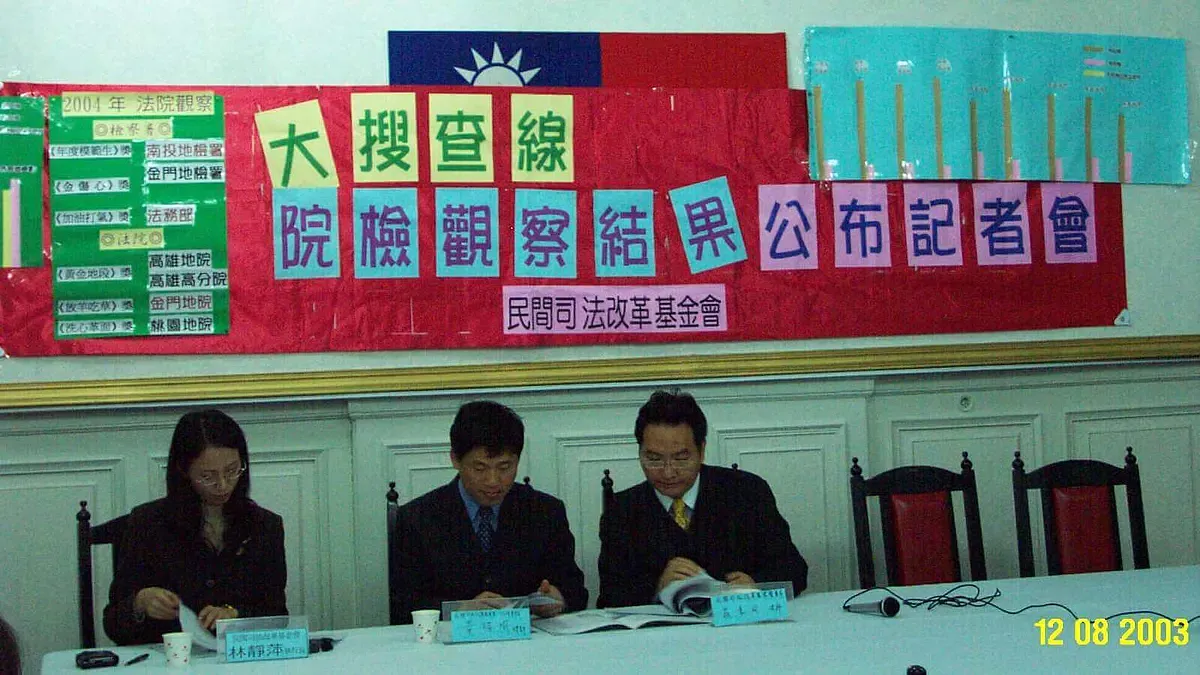
The Judicial Reform Foundation (JRF) held a press conference today (the 8th) to announce the results of its "2003 Nationwide Court and Prosecutor Office Observation Project." Among them, the Kaohsiung District Court and the Kaohsiung High Court tied for first place nationwide with a facility completeness rate of 88%, winning the "Prime Real Estate Award." Conversely, the Kinmen District Court and Kinmen District Prosecutors Office ranked last nationwide due to their remote locations (with facility deficiency rates of 38% and 53%, respectively), and were both awarded the "Herding Sheep Award" and the "Heartbreak Award." Meanwhile, the Taoyuan District Court and Nantou District Prosecutors Office received the "Turning Over a New Leaf Award" and the "Annual Model Student Award" for achieving the "greatest margin of improvement" and "capturing first place among district prosecutors offices nationwide," respectively. Additionally, the Ministry of Justice was specially awarded the "Cheer-Up Award" by the JRF because "prosecutors offices' performance this year lagged behind courts by an average of 12 percentage points.
The JRF stated that following its initial release of observation results for 17 courts across the country last year (2002), it expanded the observation project this year by "going undercover" and conducting on-site visits to every single district court, district prosecutors office, high court, branch high court (including the offshore islands of Penghu and Kinmen), and high administrative court in the nation. This was done to understand whether the services and facilities of each court and prosecutors office truly align with the spirit of "justice for the people."
Compared to last year's "court observation," the JRF noted that this year's observation project features at least the following characteristics:
- Increased observation targets: Expanding from 17 courts last year to 47 entities this year, encompassing all district courts, district prosecutors offices, high courts, branch high courts, and high administrative courts. Furthermore, this marks the first time in the country that district prosecutors offices and administrative courts have been included in the observation activities.
- Increased observation items: Expanding from just 38 items observed last year to 68 items for ordinary courts, 45 items for district prosecutors offices, and 62 items for high administrative courts, making the observation indicators even more meticulous.
- Increased manpower and time dedicated to observation: This year's observation team was composed of four groups of observers involving nearly 30 person-times. To standardize the volunteers' scoring criteria, the JRF began recruiting volunteers, conducting interviews, and holding pre-departure training in May of this year, followed by on-site observations from early July to the end of August. In addition to Taiwan proper, this year's observation regions also included the offshore islands of Penghu and Kinmen. To ensure prudence, two successive rounds of observations were conducted regarding the service quality of litigation guidance personnel at courts and prosecutors offices.
Regarding this year's observation results, the JRF further explained as follows:
Ordinary Courts
- Almost all courts observed last year have shown improvement: Although this year's observation items (68 items) increased by 30 compared to last year, it is gratifying to note that nearly all 17 courts observed last year improved in their facility completeness rates. This demonstrates that the supervisory power of civil society has indeed played a "stimulative" function. Among them, the Taoyuan District Court improved by 38 percentage points, making the most striking impression and thus earning the "Turning Over a New Leaf Award" from the organizing JRF.
- The average performance of high courts and branch high courts was better than that of district courts, with minimal variance among them: Looking at the observable Taiwan High Court, Taichung Branch High Court, Tainan Branch High Court, and Kaohsiung Branch High Court, the facility completeness rates of high courts and branch high courts this year were almost all above 85%, which is better than the district courts' average of 78%. Moreover, the difference in facility completeness rates among the aforementioned four high and branch high courts was less than 5%, having an insignificant impact on the rights of citizens in various regions to use court facilities.
- Facilities in offshore island and category 6 district courts are severely inadequate, reducing citizens in remote areas to second-class citizens: As shown in Chart 1, the two offshore island and category 6 district courts of Penghu and Kinmen had an average facility deficiency rate as high as 31%, which is inferior to district courts in other regions or categories. In particular, the Kinmen District Court, which ranked last nationwide among courts, had a facility deficiency rate as high as 38%, trailing the first-place Kaohsiung District Court by 26 percentage points. Such an allocation of judicial resources cannot help but evoke the lament that citizens in remote areas are relegated to receiving second-class citizen treatment.
- Specific deficiencies in ordinary court facilities: Generally include failing to provide nighttime document-receiving services or having nighttime document-receiving hours that do not comply with legal regulations (until midnight); lacking nursing rooms and fax machine services; lacking waiting rooms for witnesses and expert witnesses; lacking computer screens at witness stands; failing to provide reading glasses inside courtrooms; and lacking facilities for the public to change infants' diapers, etc.
District Prosecutors Offices
- Facilities in offshore island and category 6 district prosecutors offices are severely inadequate, reducing citizens in remote areas to second-class citizens: Looking at the observable Kinmen District Prosecutors Office, its facility deficiency rate is as high as 58%, ranking it not only dead last among all courts and prosecutors offices nationwide, but also lagging 37 percentage points behind the top-ranked Nantou District Prosecutors Office. This once again verifies that the judicial resources enjoyed by residents in remote areas are far inferior to those of people in other regions, which warrants serious attention from the judicial authorities.
- The average performance of district prosecutors offices is far inferior to ordinary courts: This year, the average facility deficiency rate for district prosecutors offices was 34%, which is 12 percentage points higher than that of ordinary courts. This clearly demonstrates that the Ministry of Justice should more actively urge all district prosecutors offices to improve their software and hardware facilities, rather than letting the courts take all the credit.
- Specific deficiencies in district prosecutors office facilities: According to observations, the main deficiencies in district prosecutors offices lie in the failure to properly use metal detectors, lacking computer search functions, lacking wheelchairs and reading glasses, lacking nursing rooms, failing to provide fax machines for public use, failing to set up waiting rooms for parties, witnesses, and expert witnesses, and lacking facilities for the public to change infants' diapers, etc.
The Service Quality of Litigation Guidance Personnel Must Be Upgraded
Because the JRF's observation team discovered during the first round of observations that nearly one-quarter of the litigation guidance personnel at courts and prosecutors offices exhibited terrible attitudes or provided error-ridden answers to questions, the Foundation specially redesigned the questions and conducted a second round of observations targeting the aforementioned courts and prosecutors offices. Although the situation of litigation guidance personnel in most courts and prosecutors offices improved during the second observation, it also highlights the problem that "citizens entering courts and prosecutors offices to seek assistance must rely on luck to receive better service quality," which clearly offers insufficient protection for citizens' rights. Furthermore, combining the observation results of last year and this year, the JRF believes that while the original intent of establishing litigation guidance services for the people in courts and prosecutors offices is commendable, the problem of uneven quality among litigation guidance personnel across various courts and prosecutors offices is extremely severe. For instance, some courts and prosecutors offices assign judicial volunteers, alternative military servicemen, or student workers to handle these tasks; should they provide incorrect answers, it not only impacts citizens' rights but also severely damages the public credibility of the judiciary. Therefore, the JRF solemnly urges courts and prosecutors offices to deploy cordial and more professional litigation guidance personnel to provide better services to the public.
Barrier-Free Environments Must Be Enhanced
As evidenced by this year's observation results, the environments provided by various courts and prosecutors offices are evidently extremely unfriendly to persons with physical disabilities! Not only do most courtrooms lack designated seating for persons with physical disabilities, but even where ramps for the physically disabled are established outside courtrooms, their slopes are too steep for wheelchair use. In addition, many courts and prosecutors offices fail to install accessible restrooms for the physically disabled in accordance with regulations, or even if they "do" install them, the spaces are too small, or feature thresholds and steps, making it impossible for wheelchairs to enter. All such issues have been widely criticized, and the JRF strongly demands that all courts and prosecutors offices fully accommodate the needs of persons with physical disabilities and thoroughly implement barrier-free spatial planning.
Overall, the JRF's commentary for the courts this year is 'Performance acceptable, still needs effort'; its evaluation for the prosecutors' side is 'Lagging far behind, must step up efforts'! Herein, the Foundation encourages the Judicial Yuan and the Ministry of Justice to work together to provide the public with superior service quality and comprehensive hardware facilities.
This article is an AI-generated translation of the original Chinese text. In the event of any discrepancy, the Chinese version shall prevail.