
The Civil Society's Campaign for the Three Judicial Reform Acts—With a Critique of Legislative Yuan President Wang Chin-pyng's Response
Last edited: 2026-11-03
When the Citizens' Coalition for Monitoring Grand Justice Nominees campaign came to an end, several legal professional organizations and social organizations, under the chairmanship of Ch'en Ch'uan-yueh, Chairperson of the Judicial Reform Foundation (JRF), prepared to establish the Coalition for the Promotion of Judicial Reform Bills. The meeting of the initiating organizations passed a resolution for me to serve as the Convenor of the Coalition. After repeated invitations from Attorney Ch'en Ch'uan-yueh and JRF Attorney Lin Ching-p'ing, I truly could not decline at the meeting where the Coalition was established. Upon its establishment, the Coalition immediately commenced practical work to promote the Judicial Yuan Organization Act, the Legal Aid Act, and the Judges Act. On December 4, a press conference was held in front of the Chunghsien Building of the Legislative Yuan to officially announce its establishment, followed by a meeting and petition with Legislative Yuan President Wang Chin-pyng. Those attending the press conference and the meeting with President Wang included Coalition Deputy Convenor and Judges Association Chairperson Tsai Chung-tun; Coalition Deputy Convenor and Pan-Purple Alliance Convenor Chien Hsi-chieh; Coalition Deputy Convenor, Acting Chairperson of the JRF, and Taiwan Bar Association Chairperson Attorney Ch'en Ch'uan-yueh; Prosecutor Reform Association Spokesperson Prosecutor Ch'en Jui-jen; Taipei Bar Association Chairperson Attorney Ku Li-hsiung; Taiwan Association for Human Rights Attorney Hsueh Chin-feng; Awakening Foundation Deputy Chairperson Attorney Chang Chu-fang; Prosecutor Reform Association Representative Prosecutor Wu Wen-chung; Taiwan Confederation of Trade Unions Deputy Chairperson Chung Kung-chao; Coalition Secretary-General Attorney Lin Yung-sung; and Deputy Secretary-General Attorney Lin Ching-p'ing. This grand and formidable team officially took action to urge the enactment of the Three Judicial Reform Acts. However, although many media reporters came to the scene for interviews, actual news coverage was very limited. Feeling that this movement has profound significance for the advancement of judicial reform, I am taking advantage of this column to publish the press release issued by the Coalition on that day. The content has been revised by the author and supplemented with several details regarding the meeting with Legislative Yuan President Wang Chin-pyng, allowing the general public to understand the Coalition for the Promotion of the Three Judicial Reform Acts and its action plan.
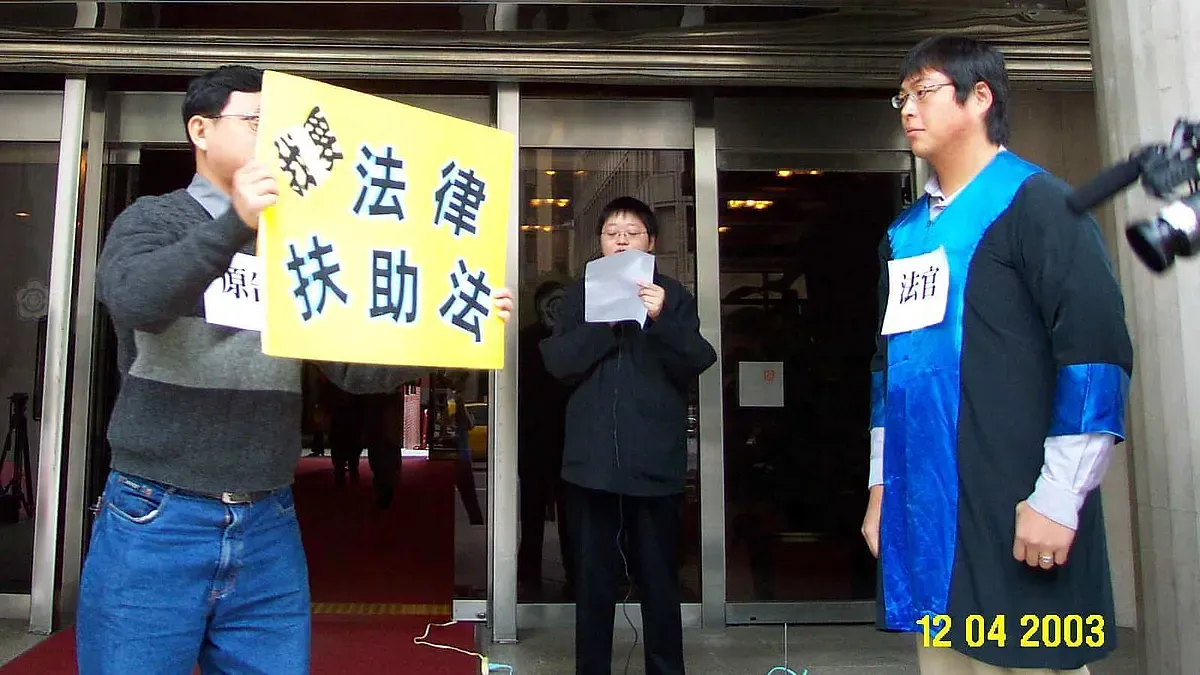
At the press conference for the establishment of the Coalition, the Coalition for the Promotion of the Three Judicial Reform Acts first used a satirical sketch to depict the plight of impoverished ordinary people who cannot afford lawyers, encounter bad judges, or get trapped in endless litigation back and forth between the second and third instances, thereby highlighting the urgency of the Legal Aid Act, the Judges Act, and the amendment to the Judicial Yuan Organization Act.
The Coalition stated at the press conference that the amendment to the Judicial Yuan Organization Act and the enactment of the Judges Act and the Legal Aid Act are all conclusions of the National Judicial Reform Conference. The draft Legal Aid Act—which concerns state subsidies for underprivileged citizens to afford lawsuits or receive legal consultations—has been delayed in legislation ever since its committee review was completed in the second session of the fifth Legislative Yuan. The main reason is that the government cited national financial inability to support it and failed to allocate a budget for legal aid. The Judicial Yuan Organization Act is the fundamental charter of judicial reform and an important basis for reform to enhance the efficiency of the judicial system. However, due to poor parliamentary legislation and the legislative chamber degenerating into an arena of political struggles, the draft amendment to the Judicial Yuan Organization Act still failed to pass during the third session of the fifth Legislative Yuan.
The draft Judges Act, jointly researched and formulated over many years by the Judges Association, the Prosecutor Reform Association, the Taiwan Bar Association, the Taipei Bar Association, and the civil society JRF, emphasizes protecting excellent judges, eliminating incompetent judges, and improving the quality of adjudication. Although submitted through the joint signature of legislators and delivered to committee review, an official government version has never been proposed. During this period, it was reportedly because the Control Yuan and the Examination Yuan held onto departmentalism and opposed it.
Following the press conference, the Coalition for the Promotion of the Three Judicial Reform Acts immediately paid a courtesy visit to Legislative Yuan President Wang Chin-pyng. During the conversation, President Wang Chin-pyng stated: Although he personally strongly supports the passage of the Three Judicial Reform Acts, aside from the Legal Aid Act which has already received a commitment from the Executive Yuan and is more likely to pass in the current session, as for the draft amendment to the Judicial Yuan Organization Act, President Wang pointed out that there is opposition from some senior judges and other resistance, and divergences in party-to-party consultations are significant. He entrusted Kuomintang Legislator Kao Yu-jen to chair the consultations, which bore no results. President Wang also asked the Kuomintang to replace its consultation representatives and sought the support of People First Party Chairman James Soong, but pointed out that the likelihood of the bill passing in the short term is not high.
During the conversation, Tsai Chung-tun, Deputy Convenor and Spokesperson of the Coalition for the Promotion of the Three Judicial Reform Acts, stated: As he himself is also a senior judge, in reality, only a very small minority oppose the "draft amendment to the Judicial Yuan Organization Act." He hopes that legislators will not ignore the consensus of the majority and be swayed by the voice of the minority. At the same time, he further pointed out that the version proposed by the Kuomintang is regressive and detrimental to judicial reform.
Regarding the Judges Act, President Wang emphasized that the Legislative Yuan has always prioritized government-proposed bills. Although the Judges Act still needs to wait for the Judicial Yuan to propose a government version before entering the substantive deliberation procedure, Coalition Deputy Convenor Huang Jui-ming immediately spoke at the meeting to state that the civil society version of the draft Judges Act was drafted and proposed by five legal professional organizations from the private sector, embodying thorough professional considerations. Since it has already been referred to the Judiciary Committee of the Legislative Yuan for review, as long as the Judiciary Committee can schedule the draft Judges Act on the agenda, it can naturally urge the official authorities to propose their version as soon as possible. After the meeting, President Wang told reporters that he would consider helping schedule the civil society version of the Judges Act on the agenda.
After concluding their meeting and petition with Legislative Yuan President Wang Chin-pyng, the convenor, deputy convenors, and decision-making group members of the Coalition for the Promotion of the Three Judicial Reform Acts unanimously expressed appreciation for President Wang's active assistance in handling the promotion of the three acts, but expressed dissatisfaction with President Wang's principles and attitude in handling the Judicial Yuan Organization Act. They generally agreed that efforts should still be made more actively to facilitate the passage of the Judicial Yuan Organization Act in the current session.
※ Published in: The People's Daily
This article is an AI-generated translation of the original Chinese text. In the event of any discrepancy, the Chinese version shall prevail.