
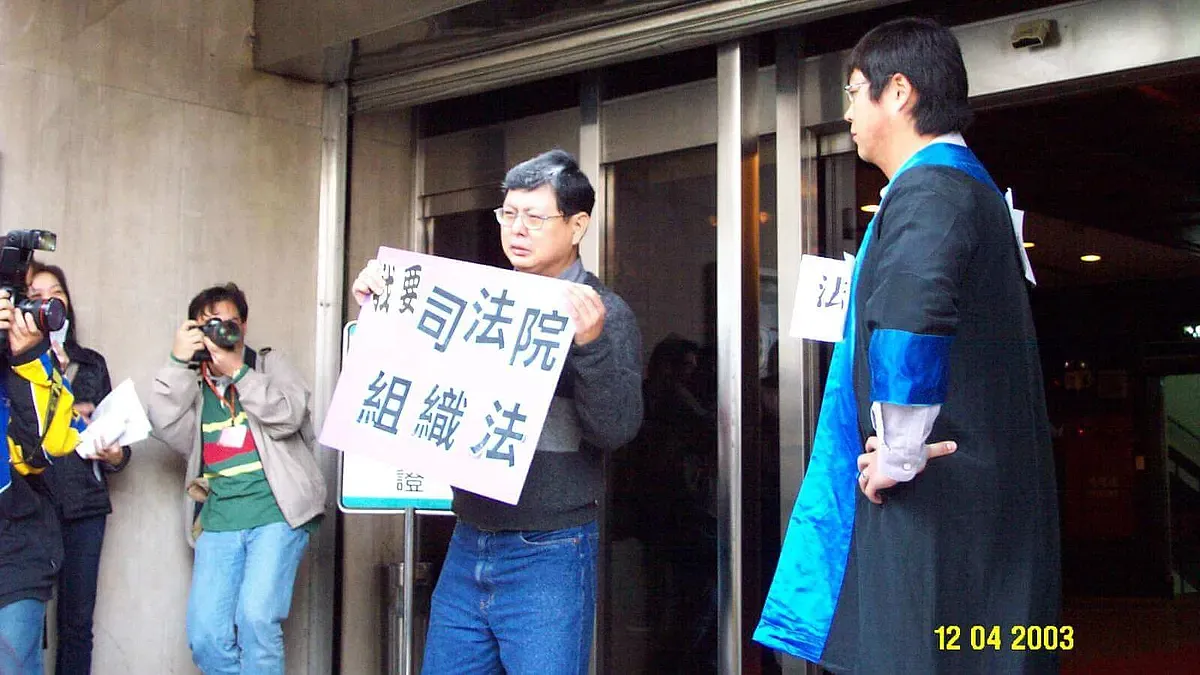
Enabling the Judicial Yuan to Truly Become the Highest Judicial Organ in Name and in Fact
Last edited: 2026-11-03
In October 2001, the Judicial Yuan Grand Justices rendered Interpretation No. 530, holding that under the current system, the Judicial Yuan—aside from the Grand Justices—only holds the status of the highest judicial administrative organ. This results in a separation between the highest judicial adjudication and the highest judicial administration, which violates the original intent of the constitutional framers. The Interpretation thus mandated that related regulations, such as the Judicial Yuan Organization Act, the Court Organization Act, the Administrative Court Organization Act, and the Organic Act of the Commission on the Disciplinary Sanctions of Functionaries, be reviewed and amended within two years. Given that the two-year legislative deadline has already passed and the relevant amendment bills remain stalled in the Legislative Yuan, the legislature's failure to respect the deadline set by the Grand Justices risks triggering a constitutional crisis. At this critical legislative juncture, a small minority of individuals have launched fierce opposition to this legal reform. However, their arguments are either based on erroneous citations or are off-topic. This raises deep concerns that this reform proposal, advocated for many years, will be stillborn due to intentional obstruction by a few, leaving judicial reform stagnant or even moving backward.
In fact, the conversion of the Judicial Yuan into an adjudicatory organ has been advocated for many years. Article 77 of the Constitution explicitly stipulates that "The Judicial Yuan shall be the highest judicial organ of the State and shall have charge of civil, criminal, and administrative litigation, and of disciplinary punishment of public functionaries." Article 78 further provides that "The Judicial Yuan shall interpret the Constitution and shall have the power to unify the interpretation of laws and orders." However, under the current system, aside from housing the Grand Justices to interpret the Constitution and unify the interpretation of laws and orders, the Judicial Yuan does not directly exercise jurisdiction over civil, criminal, and administrative litigation, or the discipline of public functionaries. Instead, it only handles judicial administrative affairs. This easily leads to the misconception that the Judicial Yuan is purely a judicial administrative organ. Not only does this contradict the designation of the Judicial Yuan as the State's "highest judicial organ" under Article 77 of the Constitution—long inviting criticism of unconstitutionality—it also creates an image where judicial administration overrides judicial adjudication, impairing public trust in judicial independence. Therefore, as early as October 1994, the First Subcommittee of the Judicial Yuan's Judicial Reform Committee deliberated on this issue, followed by the establishment of the Judicial Yuan Positioning Research Committee for ongoing discussions. By the time of the National Judicial Reform Conference in 1999, through cross-party and cross-sector participation from judges, prosecutors, defense attorneys, and academia, a consensus and conclusion to promote the conversion of the Judicial Yuan into an adjudicatory organ was finally forged. The intent of Grand Justices Interpretation No. 530 aligns with this cross-sector consensus and was originally of great help in facilitating the amendment of a national institutional setup long criticized as unconstitutional. The legislative branch should all the more uphold respect for the power of constitutional interpretation and complete the legal amendments within the deadline.
Critics of Grand Justices Interpretation No. 530 have cited arguments made by legal predecessors over the decades asserting that the Judicial Yuan is merely the nation's highest "judicial administrative organ." However, a closer examination reveals that their citations regarding the Judicial Yuan being merely the highest "judicial administrative organ" are merely descriptions of the long-standing status quo. To argue that the Grand Justices, who hold the power of constitutional interpretation, should be bound by such descriptions is nothing short of absurd. Some critics argue that the framers of the Constitution changed the term "highest adjudicatory organ" for the Judicial Yuan—as stipulated in the Draft Constitution of 1935 (the May 5 Draft)—to the "highest judicial organ" in the current Constitution, and thus boast and argue that the "original intent of the constitutional framers" was for the Judicial Yuan to be the highest judicial "administrative" organ. Nevertheless, if we base our reasoning on this constitutional drafting process, it can only be inferred that the framers deemed the phrase "highest adjudicatory organ" too narrow. The framers' modification to "highest judicial organ" precisely intended for the Judicial Yuan to oversee both "judicial adjudication" and "judicial administration." Does this not conversely prove the legitimacy of Interpretation No. 530?
We have never believed that adjusting the organizational structure of the Judicial Yuan alone can solve the problem of the public's distrust in the judiciary, nor have we ever believed that judicial reform is complete once the Judicial Yuan becomes an adjudicatory organ. However, while engaging in reforms of the litigation system and the judicial personnel system, we are also compelled to face the urgency of restructuring the court of last resort. This is an issue that must be addressed immediately once a consensus on pyramiding the litigation structure is reached. For a long time, debates over the structural design of the Judicial Yuan—whether single-track unitary, multi-track unitary, multi-track dual, or multi-track pluralistic—have persisted. These intertwined disputes, with opinions varying among the wise and the benevolent, have been debated for decades. If we remain perpetually trapped in academic debates, how can we further advance reform? Reform certainly does not have to happen in one specific way, but if critics merely oppose proposals that have already gained majority consensus without putting forward alternative reform proposals capable of persuading the majority, it inevitably gives the impression that their ultimate intention is simply to oppose any and all reforms.
We never overlook the fact that while carrying out reforms, we must simultaneously begin working on the coordination of relevant social conditions. However, to argue that reform must be halted simply because social conditions do not yet catch up with the status quo is to fall forever into the circular argument of the chicken and the egg, rendering it pointless to even speak of reform. If anyone's true intention is indeed this, they would truly be self-centered judicial figures. I do not understand how one can avoid falling into professional prejudice, but I deeply feel the past suffering of the people when facing the judiciary. Ridiculing others' "comparative law" perspectives is always easy; staying sober through the painful process of reform is the hardest part. We truly hope that the various political parties' or certain individuals' claims of acting "for the people" are more than just empty talk.
※ Published in: Taiwan Daily
This article is an AI-generated translation of the original Chinese text. In the event of any discrepancy, the Chinese version shall prevail.