
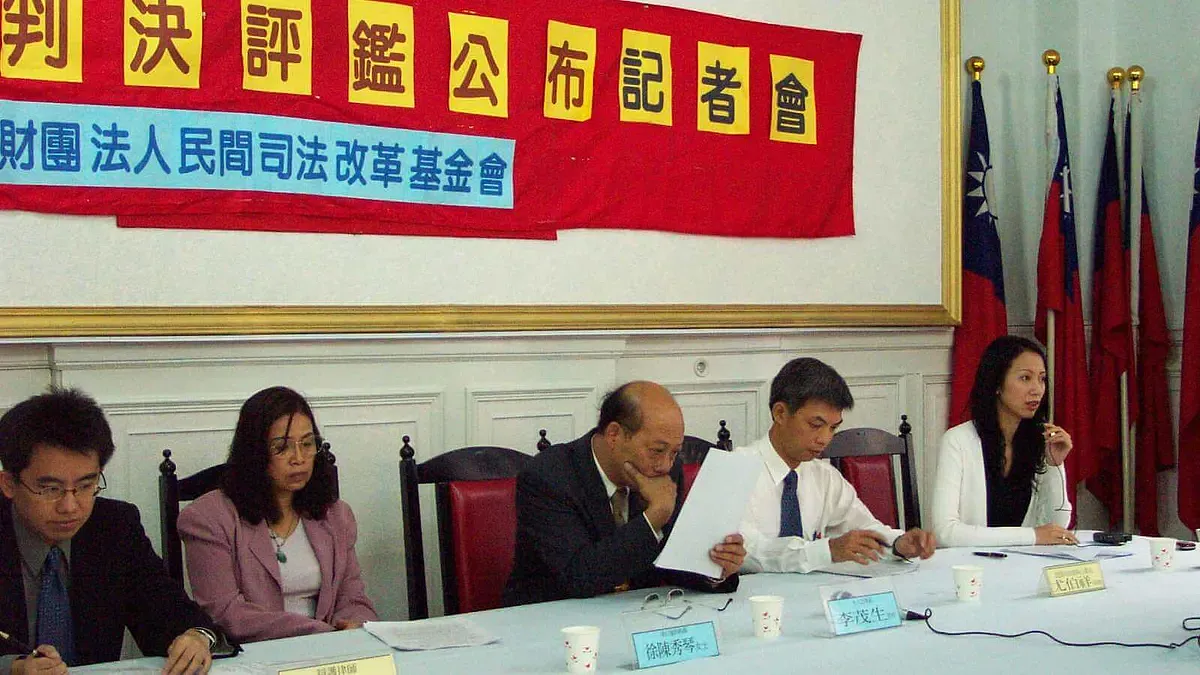
Press Conference on the Publication of the Judgment Evaluation for the Hsu Tzu-chiang Case
Last edited: 2026-07-27
Although the highly anticipated kidnapping and murder case involving Hsu Tzu-chiang resulted in a final death sentence by the Supreme Court, the Judicial Reform Foundation (JRF) invited three domestic criminal law professors—Li Mao-sheng, Ho Lai-chieh, and Huang Chao-yi—to conduct an in-depth analysis. They concluded that the judgment indeed raises serious legal questions. Therefore, the JRF specially held a press conference today (the 17th) to announce the results of the judgment evaluation to the public.
According to Professor Li Mao-sheng of the National Taiwan University College of Law, who attended the press conference, the court in this case relied solely on the confession of a co-defendant, along with the facts that Hsu Tzu-chiang shared a rented apartment and rented a car, to determine that Hsu was a co-principal in a conspiracy to kidnap for ransom and commit murder. Such a standard of judgment might align with the level seen in Japan around the 1930s to 1960s, but it falls vastly short compared to contemporary Japanese academia and judicial practice, which have significantly restricted the scope of application for conspiracy as co-principals! The extent to which the people of Taiwan are protected by law and the judiciary is truly worrisome.
In addition, Professor Ho Lai-chieh of the National Chengchi University Department of Law pointed out in the evaluation of the Hsu Tzu-chiang judgment that criminal investigators in our country are accustomed to using a "dog-eat-dog" investigative method, having co-defendants "implicate one another" to extract crimes. The legality of this practice is highly questionable. Moreover, the court in this case pieced together yet another "court-determined version" from the various "versions" provided by the co-defendants to sentence Hsu Tzu-chiang to death. Naturally, such a judgment is difficult for people to accept. On the other hand, Professor Huang Chao-yi of the Soochow University Department of Law also argued in the judgment evaluation that in the absence of corroborating physical evidence, judging that Hsu Tzu-chiang participated in kidnapping and murder based solely on an accomplice's confession is a terribly far-fetched interpretation. Furthermore, the judicial practice of treating confessions as the king of evidence—overemphasizing and even abusing confessions—will inevitably lead to more miscarriages of justice or wrongful imprisonments.
Finally, the JRF expressed its hope that through the release of this judgment evaluation, the judicial system will re-examine the Hsu Tzu-chiang case and the dangers of sentencing someone to death based solely on an accomplice's confession. At the same time, the JRF also called upon Minister of Justice Ch'en Ting-nan to stay the execution and urged the Prosecutor-General to file another extraordinary appeal for Hsu Tzu-chiang to prevent a grave injustice.
附件
This article is an AI-generated translation of the original Chinese text. In the event of any discrepancy, the Chinese version shall prevail.