
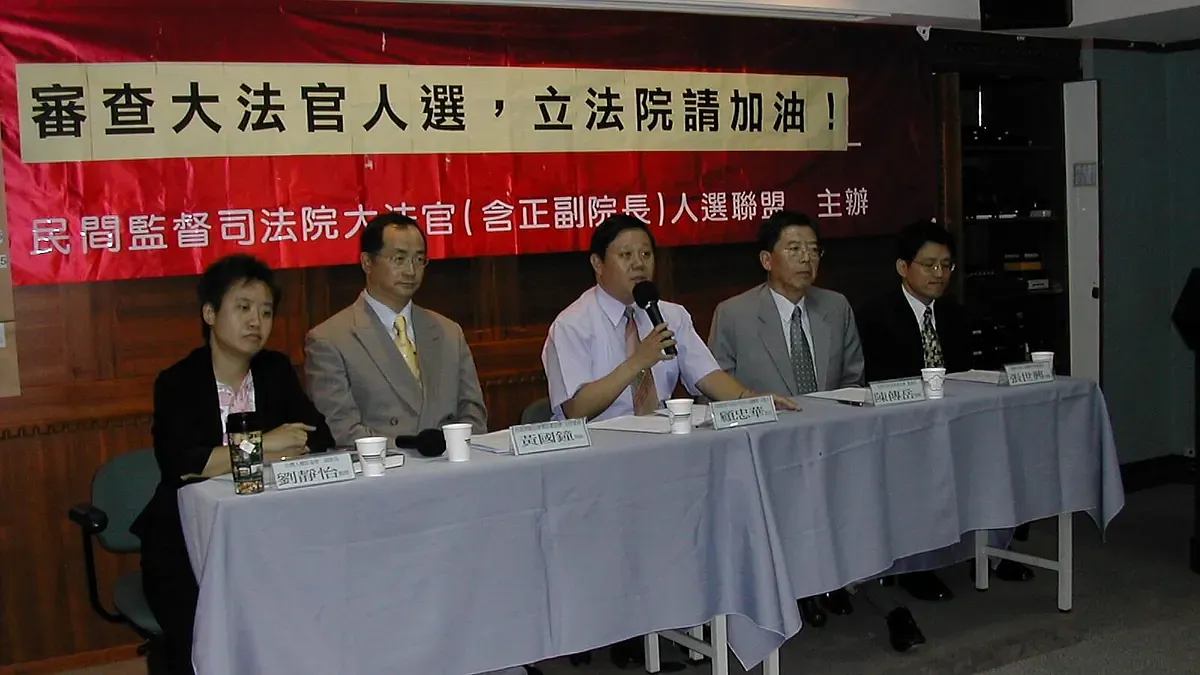
Reviewing Grand Justice Nominees: Legislative Yuan, Please Step Up!
Last edited: 2026-07-27
Following the earlier announcement regarding Ch'eng Chung-mo being deemed unfit for the position of Grand Justice (including Vice President of the Judicial Yuan), the "Alliance for Citizen Monitoring of Judicial Yuan Grand Justice Nominees" (hereinafter referred to as the Alliance) released the results of a satisfaction survey today (the 31st) evaluating the Legislative Yuan's party caucuses on their exercise of various personnel consent powers last year (2002). They also published twenty major constitutional questions to serve as a reference for legislators conducting on-the-spot questioning when reviewing Grand Justice (including President and Vice President of the Judicial Yuan) nominees in the upcoming legislative session.
According to Ku Chung-hua, convener of the Alliance, in order to remind the Legislative Yuan to rationally and prudently exercise its consent power regarding the nominees for Grand Justices (including the President and Vice President of the Judicial Yuan), the Alliance specifically conducted a telephone survey in May of this year (2003) targeting 219 legal and political scholars, lawyers, and other professionals. The survey measured their satisfaction with the performance of the Democratic Progressive Party (DPP), Kuomintang (KMT), People First Party (PFP), and Taiwan Solidarity Union (TSU) caucuses in exercising consent powers for the President and Vice President of the Examination Yuan, Examination Commissioners, and Judicial Yuan Grand Justices last year. According to the survey results, legal scholars and lawyers were largely dissatisfied with the performance of various party caucuses in exercising consent powers last year, with satisfaction regarding the KMT and PFP being exceptionally low at only 16.75% and 14.50%, respectively. Furthermore, although respondents rated the DPP and TSU higher (32.25% for the DPP, 21.00% for the TSU), overall satisfaction with all party caucuses' exercise of personnel consent powers remained lower than the rates of dissatisfaction (see Appendix I, Table 3-1).
In addition, breaking down the performance analysis of each party caucus in exercising consent power last year for nominees to the President and Vice President of the Examination Yuan, Examination Commissioners, and Grand Justices, the average highest level of satisfaction among legal scholars and lawyers was for Grand Justices, with 28.25% of respondents expressing satisfaction, followed by Examination Commissioners at 21.75%, the President of the Examination Yuan at 18.5%, and the Vice President of the Examination Yuan at only 16.00% satisfaction (see Appendix I, Table 3-2). This clearly demonstrates that the performance of the Legislative Yuan's party caucuses in exercising various personnel consent powers last year requires substantial review and improvement. In view of this, the Alliance solemnly calls upon all party caucuses in the Legislative Yuan not to repeat last year's mistakes when exercising the consent power for Grand Justice nominees (including the President and Vice President of the Judicial Yuan) this year through irrational boycotts or the invocation of party discipline, which would reduce the review of transcendent and independent Grand Justices into an arena of political struggle.
Moreover, to urge the Legislative Yuan to implement professional review of Grand Justice nominees, the Alliance has also designed twenty short-answer questions closely related to the duties of Grand Justices (see Appendix II) to serve as a reference for legislators during on-the-spot questioning when reviewing Grand Justice nominees (including the President and Vice President of the Judicial Yuan) in the next session. The Alliance stated that while these twenty questions cover three major domains: "Human Rights Issues," "Judicial Reform and Legal Systems," and "Constitutionalism and Democracy," they deliberately exclude topics such as unification versus independence, referendums, and the continued construction of the Fourth Nuclear Power Plant to avoid intensifying ruling-and-opposition confrontation and pushing Grand Justice nominees "into the line of fire" as victims of political struggle. Instead, the focus of the review is placed on the nominees' human rights ideals, constitutional awareness, and commitment to judicial reform. Not only that, but the Alliance also emphasized that publishing these twenty questions at this time will not only allow the fifteen Grand Justice nominees to prepare in advance, but will hopefully also use this opportunity to conduct a rare constitutional education for the general public, allowing citizens to concretely understand the responsibilities and functions of Grand Justices.
Finally, the Alliance stated that in order to truly exert a supervisory effect, it will dispatch an observation team during the Legislative Yuan's review of Grand Justices (including the President and Vice President of the Judicial Yuan) in the upcoming session to observe and evaluate the questioning and consent-exercising processes of all party caucuses, hoping that the Legislative Yuan will effectively fulfill its role as a gatekeeper for the Constitution.
Appendix
This article is an AI-generated translation of the original Chinese text. In the event of any discrepancy, the Chinese version shall prevail.
