
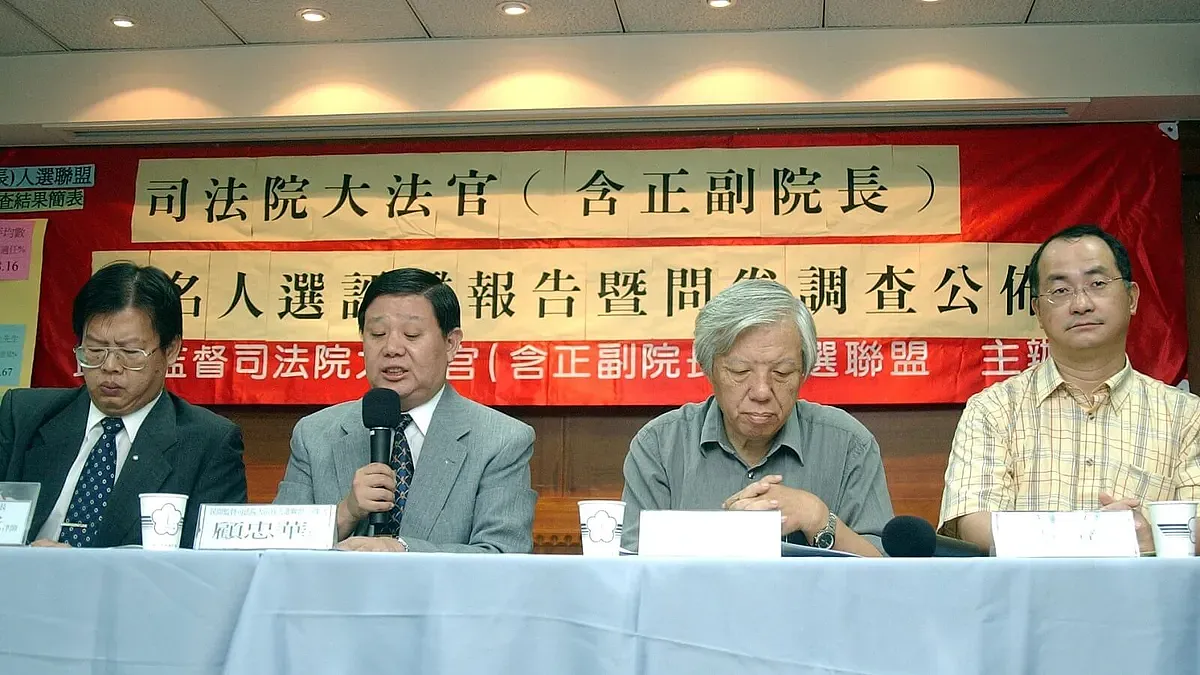
Organization and Evaluation Regulations of the Evaluation Committee for Nominees for Grand Justices of the Judicial Yuan (Including the President and Vice President)
Last edited: 2026-07-27
Article 1 (Purpose)
To conduct a fair, objective, and professional evaluation of the nominees for the President, Vice President, and the 7th term of Grand Justices of the Judicial Yuan to provide a reference for public evaluation, the Evaluation Committee for Grand Justices Nominees (hereinafter referred to as the Committee) is hereby established, and evaluations of the nominees for the 7th term of Grand Justices shall be conducted in accordance with the procedures stipulated in these Regulations.
Article 2 (Composition of the Committee)
The Committee shall be composed of fifteen members, one of whom shall serve as the Chairperson. Each initiating organization of the "Civil Alliance for Monitoring Grand Justice Nominees of the Judicial Yuan (Including the President and Vice President)" (hereinafter referred to as the Civil Alliance for Monitoring Grand Justice Nominees) shall appoint three members, and three additional professionals of high public credibility shall be invited to serve.
Article 3 (Evaluation Procedures)
Members of the Committee shall separately evaluate and analyze the nominees for Grand Justices based on four major criteria: moral character and integrity, academic and professional competence, professional performance, and understanding of constitutional government. For potential unsuited nominees, preliminary evaluation reports shall be prepared and submitted to the Committee for discussion.
In addition to fully considering the evaluee's publications, professional performance, speech and conduct related to constitutional operations, social participation, and general evaluation of moral character, the evaluation procedures referred to in the preceding paragraph shall also take into account the results of questionnaire surveys conducted by the Civil Alliance for Monitoring Grand Justice Nominees.
Article 4 (Powers and Resolution Methods of the Committee)
The Committee shall thoroughly discuss and analyze the preliminary evaluation reports submitted by individual members regarding potential unsuited nominees, striving for fairness, objectivity, and professionalism. Upon the conclusion of the evaluation procedures, with the consent of two-thirds or more (including two-thirds) of all members, an evaluation report concerning unsuited nominees for the President, Vice President, and the 7th term of Grand Justices of the Judicial Yuan shall be issued.
The number of votes and the proportion referred to in the preceding paragraph shall not include the number of members who recuse themselves in accordance with the law.
After the evaluation report is approved by a meeting of the Civil Alliance for Monitoring Grand Justice Nominees, it shall be published to the public by the Alliance, and the Committee shall be dissolved immediately.
Article 5 (Conflict of Interest)
Initiating organizations of the Civil Alliance for Monitoring Grand Justice Nominees that have previously recommended candidates to the public shall not appoint representatives to participate in the operations of the Committee.
Members of the Committee shall observe the principle of conflict of interest when evaluating Grand Justice nominees. Where a Committee member has a conflict of interest with a Grand Justice nominee, they shall proactively disclose it and recuse themselves.
Relevant recusal regulations shall be separately formulated by the Committee.
Article 6 (Principle of Confidentiality)
Except for matters that all members of the Committee unanimously agree to make public, members shall maintain the confidentiality of the Committee's operations and evaluation process.
Article 7 (Enactment and Amendment of These Regulations)
The enactment and amendment of these Regulations shall be undertaken by the Civil Alliance for Monitoring Grand Justice Nominees.
This article is an AI-generated translation of the original Chinese text. In the event of any discrepancy, the Chinese version shall prevail.