
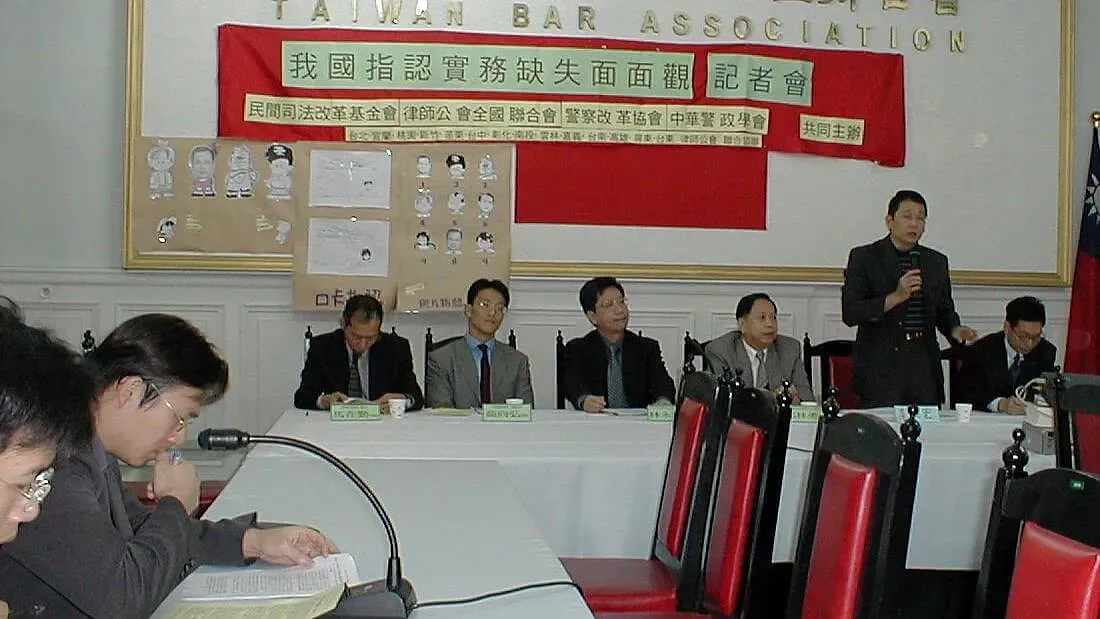
Press Conference on Flaws in Taiwan's Identification Practices
Last edited: 2026-07-27
To thoroughly review the flaws in Taiwan's current identification practices and publicly call on prosecutors, police, and investigators to conduct identifications in accordance with the "Directions for Identifying Criminal Suspects" issued by the Ministry of Justice and the National Police Agency, the Judicial Reform Foundation, Taiwan Bar Association, Chinese Association of Police Science, and Police Reform Association jointly held the "Press Conference on Flaws in Taiwan's Identification Practices" this morning (March 14) in conjunction with bar associations across Taipei, Yilan, Taoyuan, Hsinchu, Miaoli, Taichung, Nantou, Changhua, Yunlin, Chiayi, Tainan, Kaohsiung, Pingtung, and Taitung. During the press conference, a video showing the Investigation Bureau improperly leading a witness during an identification was publicly played for the first time. Furthermore, Li Ying-hung, a victim of a "botched" case in 2000 who was wrongfully detained for 77 days and nearly faced a heavy prison sentence due to a misidentification by others, was invited to share his personal experience, highlighting the numerous unreasonable aspects of current identification practices.
The Judicial Reform Foundation stated that although identifications by victims or eyewitnesses have long been frequently used in practice as a powerful tool for investigation and case-solving, human memory is extremely prone to fading or being disturbed. If front-line law enforcement officers conduct identifications in a crude and hasty manner, and prosecutors and judges responsible for shouldering the burden of proof and adjudication fail to exercise rigorous gatekeeping, then the vivid and powerful identifications made by victims or eyewitnesses can easily become the root cause of miscarriages of justice or wrongful convictions, inflicting profound harm on human rights.
In addition, the Judicial Reform Foundation also pointed out that customary practices in current operations—such as 1. single-suspect identifications, 2. mugshot and photograph identifications, 3. leading or suggesting to the person making the identification, and 4. repeated identifications—not only easily contaminate the memory of the identifier and interfere with the accuracy of the identification, but also violate the "Directions for the Ministry of Justice Regarding Procedures for Identifying Criminal Suspects," "Operational Guidelines for the Identification of Criminals," and "Directions for Police Agencies in Implementing Procedures for Identifying Criminal Suspects" issued by the Ministry of Justice and the National Police Agency in May and August of the year before last (2001). According to the aforementioned regulations, a correct identification should at least possess the following key elements:
- Identifications must be "choice-based" rather than single-suspect identifications (i.e., "yes-or-no" identifications).
- Prior to identification, the identifier must first state the characteristics of the suspect.
- The individuals presented for selection in the identification must not have major differences in their appearance.
- No arrangements that could possibly lead to suggestion may appear prior to the identification.
- Prior to the identification, the identifier must be told: "The true criminal suspect is not necessarily among the persons being presented for identification."
Not only that, in advanced legal nations such as Germany, courts are further required to examine whether identifications made during the investigative process possess "evidential competence" based on the following evaluative criteria:
- Materials from the identification process (such as photographs of all persons identified, audio and video recordings of the identification process, etc.) must be thoroughly attached to the case file; otherwise, the identification lacks evidential competence.
- The judge must investigate the identification process and state the reasons for adopting it as evidence (especially for identifications that do not fully comply with the aforementioned principles); otherwise, the judgment is unlawful.
- Repeated identifications (subsequent identifications by the same identifier) lack evidential competence under the law of evidence.
- The court may only ever review the initial identification; if there are flaws in the initial identification, they cannot be remedied.
In response to the current situation where operational identification procedures seriously diverge from the procedural guidelines issued by the Ministry of Justice and the National Police Agency, and prosecutors and judges fail to shoulder the actual responsibility of gatekeeping, the Judicial Reform Foundation stated that this is the "first installment" of a series of joint campaigns by civil groups to "eradicate improper investigations by prosecutors, police, and investigators." In the future, besides visiting organs such as the Ministry of Justice, the National Police Agency, and the Investigation Bureau to demand that they order subordinate units and personnel to strictly comply with relevant identification procedure guidelines and incorporate performance in this area into personnel evaluations, the Foundation will also visit the Judicial Yuan to request that it issue official letters instructing judges across all courts to shoulder the responsibility of actually reviewing whether any flaws exist in the identification process. Furthermore, the Police Reform Association emphasized that the government should allocate equipment funding required for identifications, allowing police departments everywhere to build complete software and hardware facilities (such as lineup rooms). Meanwhile, the Taiwan Bar Association stated that it will promptly notify its members through local bar associations of the identification procedure guidelines issued by the Ministry of Justice and the National Police Agency, reminding all lawyers handling such criminal cases to pay attention to whether their clients receive illegal treatment during the identification process and to conscientiously monitor whether law enforcement agencies comply with regulations related to identification procedures, thereby safeguarding human rights and assisting the court in discovering the truth.
Directions for Police Agencies in Implementing Procedures for Identifying Criminal Suspects
Investigative personnel shall prudently inspect criminal crime scenes, meticulously collect evidence such as fingerprints, body fluids, and trace evidence to identify criminal suspects. If it is necessary to have victims, informants, or eyewitnesses identify criminal suspects, they shall do so in accordance with the following guidelines.
- Identifications shall be non-one-on-one lineup identifications (choice-based identifications).
- Prior to identification, the identifier shall first state the characteristics of the criminal suspect.
- Individuals being identified shall not have major differences in appearance.
- No arrangements that could possibly imply or lead to suggestion shall appear prior to identification.
- Prior to identification, the identifier must be told that the criminal suspect is not necessarily present among the persons being identified.
- The implementation of identification shall take place in an interrogation room or an appropriate location.
- The implementation of identification shall involve photographing the person being identified and producing a record for preservation (the record form format is as shown in the appendix).
- The implementation of photograph identification shall not use a single photograph for identification, and the provision of old, outdated photographs for identification shall be avoided.
Appendix
This article is an AI-generated translation of the original Chinese text. In the event of any discrepancy, the Chinese version shall prevail.