
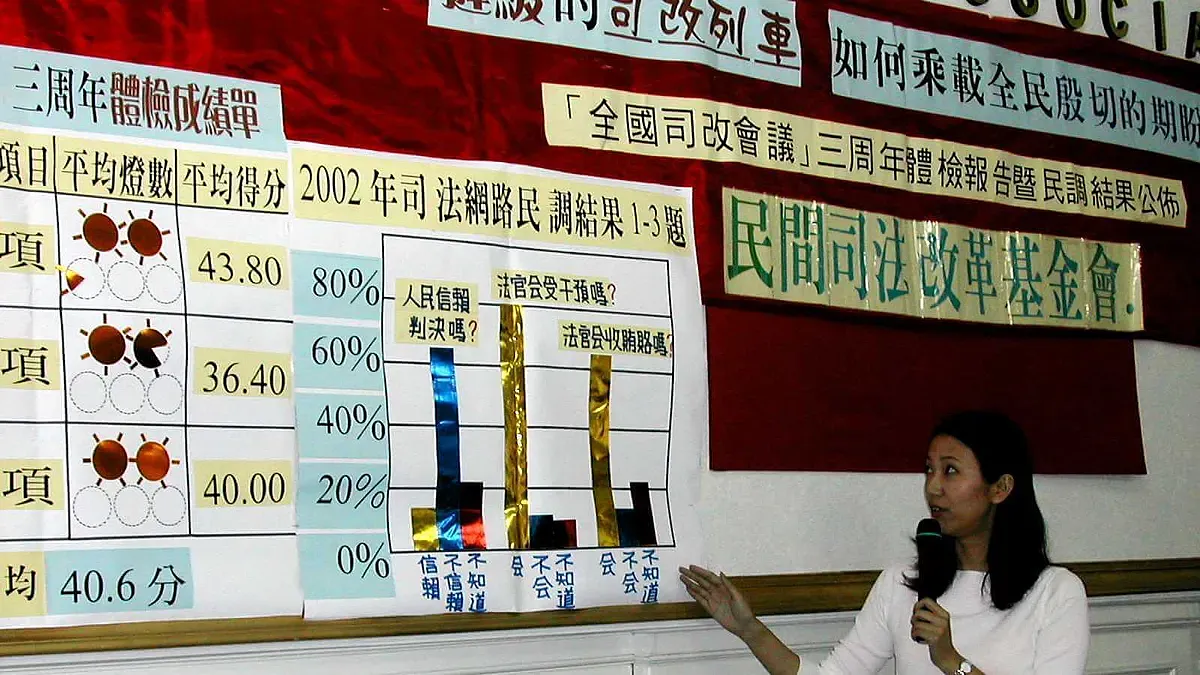
How Can the Sluggish Judicial Reform Train Bear the Public's Earnest Expectations?! Three-Year General Checkup Report on the National Judicial Reform Conference and Judicial Public Opinion Survey Results
Last edited: 2026-07-27
Three years have passed since the National Judicial Reform Conference was held in 1999. This unprecedented event in Taiwan's judicial reform history yielded fruitful results, and the Judicial Yuan promptly proposed concrete measures and an implementation schedule following the conference, demonstrating its commitment to execution. Now, three years later, to comprehensively review the official "reform" achievements over these past three years, the Judicial Reform Foundation recently completed the "Three-Year General Checkup Report on the National Judicial Reform Conference" and the "2002 Judicial Online Public Opinion Survey." Today (October 17, 2002), the Foundation releases the results to help the public understand the current state of judicial reform in Taiwan and to serve as a reference for authorities in future reviews and improvements.
Three-Year General Checkup Report on the National Judicial Reform Conference: Overall Average of 40.6 Points
Continuing the approach of last year's "Two-Year General Checkup Report on the National Judicial Reform Conference" (see Judicial Reform Magazine, Issue 34, published August 15, 2001), the Judicial Reform Foundation once again invited practicing judges and attorneys to divide into groups following the model of the original National Judicial Reform Conference (Group 1: "Judicial Administration and Civil Litigation"; Group 2: "Criminal Litigation Procedure"; Group 3: "Personnel Reform for Judges and Prosecutors"). They compared the conference conclusions formed by each group, the concrete measures and implementation schedules drafted by the Judicial Yuan, and data such as the Judicial Yuan's recently released "Implementation Results of Specific Measures and Monitored Items of the National Judicial Reform Conference up to September 2002." Using a system where one light represents 20 points and five lights represent a full score of 100 points, they evaluated item by item the completion and implementation status of agencies and organizations responsible for executing judicial reform—such as the Judicial Yuan, the Ministry of Justice, the Legislative Yuan, the Examination Yuan, and bar associations—thereby producing the "Three-Year General Checkup Report on the National Judicial Reform Conference."
Reviewing the "Three-Year General Checkup Report on the National Judicial Reform Conference" proposed by the JRF, several phenomena are particularly worthy of attention from the government and the general public:
-
The Government's Judicial Reform Performance is Far from Ideal
The government's judicial reform performance over the past three years earned an overall average of only 2.03 lights and an overall average of 40.6 points, which is truly far from ideal. The scores for each group are as follows:
Group Evaluated Items Average Lights Average Score Group 1
Judicial Administration and Civil Litigation
16 items 2.19 43.80 points Group 2
Criminal Litigation Procedure
11 items 1.82 36.40 points Group 3
Personnel Reform for Judges and Prosecutors
12 items 2 40 points -
Aside from a Few Issues, This Year's Implementation Results Show No Significant Progress Compared to Last Year
Comparing the checkup reports produced by the JRF for two consecutive years, it is evident that aside from a few issues with tangible results—such as the drafting and revision of drafts related to the positioning of the Judicial Yuan (Group 1), strengthening prosecutors' burden of proof and completing legislation on provisions related to suspension of prosecution (Group 2), and the specialization of administrative courts and reduction of judge transfers (Group 3)—there has been no significant progress this year compared to last year in implementation results for other crucial topics determining the success or failure of judicial reform. These include: implementing the centralized trial system*, the rotating system for attorneys' obligatory defense*, completing legislation on the Legal Aid Act*, expert participation in trials, fulfilling the functions of small claims and summary litigation, implementing the collegiate panel system*, reforming university legal education, establishing the first instance as a robust fact-finding trial* (the above belong to Group 1, and items marked with * are also common issues for Group 2); completing amendments to criminal evidence rules, fully implementing cross-examination, and ensuring prosecutors attend public prosecution throughout the entire proceedings (the above belong to Group 2); completing legislation on the Judges Act, strengthening in-service training for legal professionals, and establishing judge evaluation and removal systems (the above belong to Group 3). Agencies and organizations responsible for judicial reform must redouble their efforts!
-
Plagued by Internal and External Resistance, the Progress of Judicial Reform Remains Worrying
Why has the government failed to deliver a satisfactory report card on judicial reform over the past three years? In this regard, the JRF believes that while the Judicial Yuan, which leads the reform, bears unshirkable responsibility, "the inability of legal practitioners (including judges, prosecutors, and attorneys) to adjust their mindset" and "the new government's failure to exert its utmost effort in reforming the judiciary" are the critical factors hindering judicial progress at this stage. Regarding the inability of legal practitioners to adjust their mindset, an example is how the civil centralized trial system has completed legislative amendments but still cannot be implemented in practice. Furthermore, the new government's failure to exert its utmost effort in judicial reform has led agencies such as the Directorate-General of Budget, Accounting and Statistics of the Executive Yuan, the Department of Prosecutorial Affairs of the Ministry of Justice, the Examination Yuan, and the Control Yuan to cling to institutional turf wars when deliberating important bills such as the Legal Aid Act, amendments to the Code of Criminal Procedure, and the Judges Act, thereby creating obstacles to judicial reform—which is deeply regrettable! In reality, the initial framework in which Taiwan's judicial reform was led by the Judicial Yuan was inherently inferior to Japan's approach of combining all administrative and legislative resources under the cabinet to drive reform. Now, if the government's relevant departments still lack consensus and act on their own, it is conceivable that under such "congenital deficiencies and acquired weaknesses," the progress of our country's judicial reform will naturally become even more concerning.
2002 Judicial Online Public Opinion Survey Results: 53% Deeply Mistrust the Judiciary, 21% Affirm the Government's Judicial Reform Performance
Around the time of the National Judicial Reform Conference, to understand the public's perception and views of the judiciary, the JRF conducted the 1999 Judicial Online Public Opinion Survey (see Judicial Reform Magazine, Issue 22, published August 15, 1999). In September of this year, the Foundation once again conducted an online public opinion survey targeting the general public to understand their views on the judiciary and the effectiveness of judicial reform over the past three years. This poll collected a total of 519 questionnaires. Excluding samples under 18 years old (29 samples) and invalid samples (35 samples), there were 455 valid samples. Among all valid samples, respondents engaged in non-legal work accounted for 66%, those in legal-related work accounted for 15%, and students accounted for 19%; among them, 37% had been to court, while 63% had never been to court. This survey contained a total of 12 questions: questions 1 to 3 concerned public trust in the judiciary, questions 4 to 9 related to the resolutions of the National Judicial Reform Conference, and questions 10 to 12 further probed public awareness and feelings regarding the three-year anniversary of "judicial reform."
Reviewing the "2002 Judicial Online Public Opinion Survey Results" proposed by the JRF, several messages are revealed that deserve serious attention from all sectors:
-
Public Trust in the Judiciary Remains Low
A poll conducted by the JRF three years ago showed that 69% of people distrusted the judgment results of our country's courts, while only 13% trusted them. This year's poll further indicates that the proportion of citizens who distrust court judgment results remains as high as 65% (with only 13% trusting them), while 81% of citizens believe that judges are influenced by interference and lobbying (only 10% believe they are not), and 66% believe that judges accept bribes (only 12% believe they do not). Furthermore, cross-analysis shows that citizens who both distrust our country's court judgment results and believe that judges are influenced by interference and lobbying and accept bribes still account for as much as 53% of the total! Such alarming figures not only indicate that public trust in the judiciary remains low, but also show that the realization of judicial independence and the integrity of judges are widely questioned by the public.
-
The Reform Direction of the National Judicial Reform Conference Highly Aligns with Public Expectations
From this year's poll, more than 80% or even 90% of citizens support issues such as the centralized trial system (Question 4: 87%), avoiding trial delays (Question 5: judgments finalized within one year at 82%), legal aid (Question 6: 97%), establishing specialized courts (Question 7: 96%), and removing incompetent judges (Question 9: 98%). This shows that the reform direction of the National Judicial Reform Conference back then indeed matched the expectations of the majority of the public. Regrettably, although the reform direction was correct, poor implementation results (refer to the JRF's "Three-Year General Checkup Report on the National Judicial Reform Conference") still fail to satisfy the public's expectations for judicial reform.
-
The Public's Reaction to the Government's Judicial Reform is Unfavorable
There are more concrete figures to illustrate how the government has failed to satisfy public expectations for judicial reform over the past three years: nearly half (47%) of the public are still unaware that the Judicial Yuan is promoting judicial reform. This shows that either the government's public advocacy over the past three years has failed, or its reform results are too inconspicuous to attract outside attention. In addition, only about two-tenths (21%) of citizens in this poll affirmed that the quality of court judgments or the service attitude of court personnel has noticeably improved, demonstrating that the general public still holds a low evaluation of the government's judicial reform achievements over the past three years.
-
Overall, Perceptions of the Judiciary are Best Among Those Who Have Been to Court and Work in Legal-Related Fields, Followed by Those Who Have Been to Court But Do Not Work in Legal Fields, and Worst Among Those Who Have Never Been to Court
If we divide respondents based on their background data into three groups—"have been to court and work in legal-related fields," "have been to court but do not work in legal fields," and "have never been to court"—and cross-analyze Questions 1 to 3 with Questions 11 and 12, we find that although those who negative the judiciary's performance outnumber those who affirm it across all groups (with a gap of over 10% in each), overall, perceptions of the judiciary remain best among those who have been to court and work in legal-related fields, followed by those who have been to court but do not work in legal fields, and are worst among those who have never been to court. This may explain why citizens who have never been to court largely retain traditional, critical impressions of the judiciary; conversely, those engaged in legal-related work, having more opportunities to contact courts and judicial personnel, naturally find it easier than others to perceive the transformation and improvement of the judiciary.
Recently, when President Chen Shui-bian attended the opening ceremony of the 43rd class of the Judges and Prosecutors Training Institute, he specifically quoted Judicial Yuan President Weng's remark: "The judicial reform train has reached the steep slope right before the station." However, the "Three-Year General Checkup Report on the National Judicial Reform Conference" and the "2002 Judicial Online Public Opinion Survey Results" released by the Judicial Reform Foundation cannot help but cause concern: how will the "judicial reform train," which has an overall average score of only 40 points and has won the affirmation of only two-tenths of the public, ever reach the station? And how can it bear the earnest expectations of the entire populace? Here, the JRF not only earnestly calls upon the agencies, organizations, and all judicial personnel responsible for executing judicial reform to seriously reflect and make improvements, but also respectfully urges President Chen to take concrete action by convening the Five Yuans to jointly promote judicial reform in order to respond to the public's long-standing, deep-seated expectation for a renewed judiciary.
2002 Judicial Online Public Opinion Survey Results
This poll collected a total of 519 questionnaires. Excluding samples under 18 years old (29 samples) and invalid samples (35 samples), there were 455 valid samples.
Occupation: □ Non-legal work 66% □ Legal-related work 15% □ Student 19%
Other: □ Have been to court 37% □ Have never been to court 63%
- Do you trust the judgment results of our country's courts?
□ Trust 13% □ Distrust 65% □ Do not know 22% - Do you think judges are influenced by interference or lobbying?
□ Yes 81% □ No 10% □ Do not know 9% - Do you think judges accept bribes?
□ Yes 66% □ No 12% □ Do not know 22% - If you had a dispute and went to court, would you prefer fragmented trials (e.g., holding ten court sessions, each lasting 10 minutes) or a centralized trial (e.g., holding one or two court sessions, each taking about half a day)?
□ Fragmented trials 8% □ Centralized trial 87% □ No opinion 5% - If you had a dispute and went to court, within how long would you expect to obtain a finalized judgment? (Note: A finalized judgment refers to a judgment that cannot be appealed or contested further)
□ Within one year 82% □ Over one year to three years 17% □ Over three years to five years 1% □ Over five years 0% - Do you agree that the state should establish a system to help people who lack financial means to litigate lawsuits (including civil and criminal court cases)?
□ Agree 97% □ Disagree 1% □ Do not know 2% - Do you agree that courts should establish specialized courts for different types of cases, such as labor courts, family courts, and intellectual property courts?
□ Agree 96% □ Disagree 2% □ Do not know 2% - Do you agree that judges should be selected from experienced attorneys or prosecutors rather than through examinations?
□ Agree 74% □ Disagree 16% □ Do not know 10% - Do you agree that incompetent judges should be removed?
□ Agree 99% □ Disagree 0% □ Do not know 1% - Are you aware that over the past three years, the Judicial Yuan has been promoting judicial reform work?
□ Aware 53% □ Unaware 47% - Do you agree that over the past three years, the quality of court judgments has noticeably improved?
□ Agree 21% □ Disagree 34% □ Do not know 45% - Do you agree that over the past three years, the service quality of court personnel (including judges, administrative staff, etc.) has noticeably improved?
□ Agree 21% □ Disagree 30% □ Do not know 49%
Appendix
Three-Year General Checkup Table of the National Judicial Reform Conference
This article is an AI-generated translation of the original Chinese text. In the event of any discrepancy, the Chinese version shall prevail.