
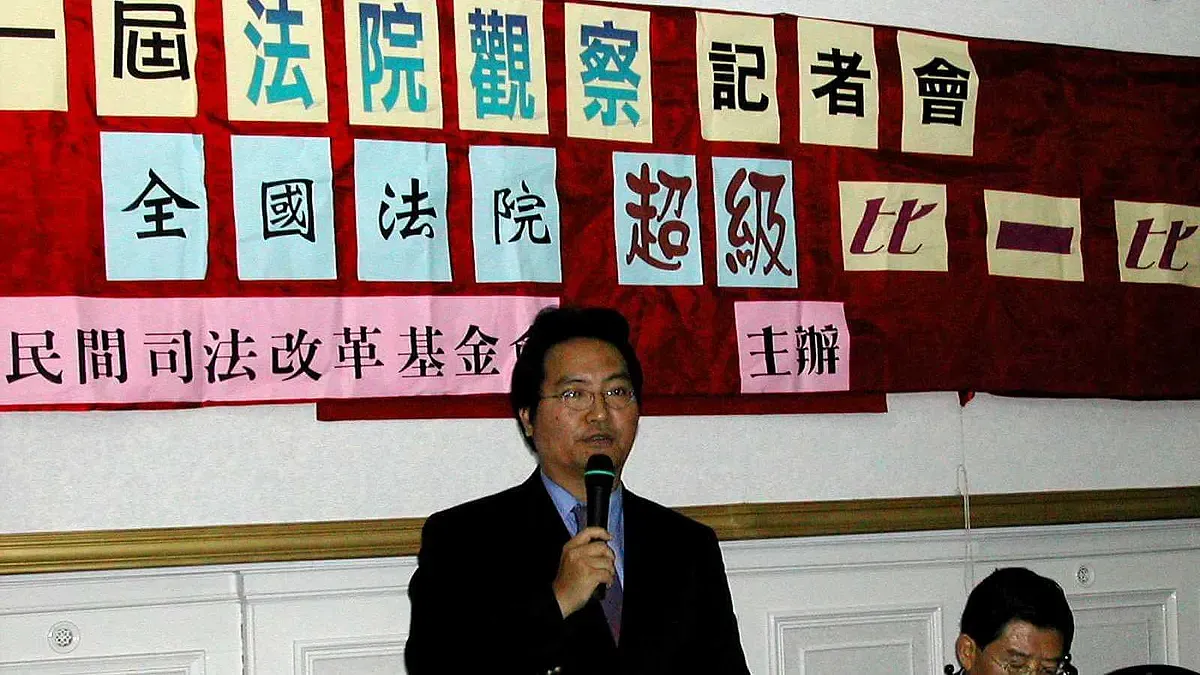
Hoping the Spirit of "Justice for the People" Becomes Standard Equipment in Courts Nationwide—The First Court Observation
Last edited: 2026-07-27
Since 1995, the Judicial Reform Foundation has mobilized large numbers of student, teacher, and lawyer volunteers every year to conduct court observations to record judges' demeanor during court sessions and periodically publish the results for public evaluation. Over the years, while this observation record has effectively exercised a supervisory function and improved judges' questioning attitudes, we firmly believe that the public's evaluation of the judiciary is by no means limited to activities inside the courtroom. Everything from a court's physical and digital infrastructure to the service quality and attitude of court personnel profoundly affects the general public's impression and perception of the justice system.
In 2002, to understand whether the spirit of "justice for the people" championed by Judicial Yuan President Weng had been implemented in courts nationwide, the JRF formed its first "Court Observation Team" in July. Splitting into two groups and conducting undercover visits, they inspected 17 courts across the country to evaluate their hardware facilities and the service quality of their personnel. This initiative not only brought the realities of each court to light but also used empirical, scientific methods to test the effectiveness of the Judicial Yuan's "reforms" over the past few years.
Observation Methods
First, in early July of this year (2002), the JRF recruited and trained a group of volunteers to form the "Court Observation Team," officially launching the court observation activities from late July to early August. The courts selected for this observation included first-tier district courts designated by the Judicial Yuan (including Taipei, Shihlin, Panchiao, Taichung, Tainan, and Kaohsiung, totaling seven courts), second-tier district courts (selecting Changhua and Hsinchu from among them, totaling two), third-tier district courts (selecting Nantou, Yilan, and Hualien, totaling three), as well as all high courts (including the Taiwan High Court and its Taichung, Tainan, Kaohsiung, and Hualien branch courts, totaling five). The items observed included all necessary court facilities, such as barrier-free spaces required by the Physically Disabled Citizens Welfare Act, reading glasses for the convenience of elderly visitors, and name tags for identifying court personnel—amounting to 38 indicators in total. In addition, to test the service quality of court personnel, several fixed questions were designed for volunteers to ask bailiffs, volunteers, and litigation guidance personnel respectively, in order to gauge their enthusiasm and professionalism in serving the public.
Observation Results
-
Hardware Facilities
Regarding hardware facilities, among the 12 district courts observed, aside from the Taipei District Court where nearly 80% of facilities met standards, the "grades" of the remaining courts were unsatisfactory. More shockingly, the Taoyuan District Court and Changhua District Court—classified as first- and second-tier courts respectively—had only 37% and 47% of their facilities meeting requirements, prompting one to feel aggrieved for the "subpar treatment" received by local citizens. In contrast, because the high court branches were opened more recently, the scores of the five high courts and their branches were generally higher than those of the district courts. Among them, the Tainan Branch of the Taiwan High Court ranked first nationwide with 92% of its facilities meeting standards. This shows that "district courts are inferior to high courts" and "old courts are inferior to new courts" can be considered an accurate portrayal of our country's court hardware facilities. As for specific deficiencies in district courts, the most severe issues outside the courtroom included a lack of waiting rooms for parties, waiting rooms for witnesses/expert witnesses, separation of defendants' and visitors' pathways, and nighttime acceptance of case filings. Inside the courtroom, urgent improvements were needed in areas such as court employees failing to wear name tags, witness stands lacking seats, and "recording in progress" indicator lights failing to light up. Furthermore, as for the high courts, if they could prepare wheelchairs and fax machines for public use, their customer-friendly measures would feel even more considerate.
-
Service Quality of Court Personnel
Regarding the service quality of court personnel, among the 12 district courts observed, those belonging to the first tier received the highest recognition from the observation team for the bailiffs, volunteers, and litigation guidance personnel at the Taipei District Court. Conversely, personnel at the Taoyuan District Court and Tainan District Court were criticized by the observation team for being unenthusiastic, goofing off, dozing off, or displaying poor attitudes. Coincidentally, at the second-tier Hsinchu and Changhua district courts, the performance of litigation guidance personnel—who draw government salaries—did not measure up to that of the judicial volunteers; such a cart-before-the-horse practice truly deserves greater attention. Moreover, according to the observations of the JRF volunteers, the service attitudes of personnel including bailiffs, judicial volunteers, and litigation guidance personnel at the third-tier Nantou, Yilan, and Hualien district courts all deserved commendation. This shows that it is human effort that counts, and the quality of personnel service has nothing to do with the size of the court. As for the high courts and their branch courts, because there were far fewer people entering and leaving the courts and joint service centers compared to district courts, their personnel generally appeared more "leisurely." At the Taichung Branch of the Taiwan High Court, there was even the bizarre phenomenon where, before 12:00 noon, the front gate security guard was nowhere to be found, and even the service center personnel had finished dining and turned off the lights to rest! Of course, where there is criticism there is also praise; this time, the observation team volunteers encountered two enthusiastic section chiefs and a bailiff at the joint service center of the Tainan Branch of the Taiwan High Court who proactively offered guided tours introducing court facilities, trial conditions, and courtroom equipment, which won high favor from the observation team.
Overall, the JRF gave these 17 courts a score of 70 this year, along with the evaluation of "barely passing, subject to probation." Here, besides admiring the observation team volunteers who braved the hottest weather in 52 years to visit 17 courts from north to south and west to east, we further encourage the Judicial Yuan and courts at all levels to work hard, hard, and harder still, so that the spirit of "justice for the people" may one day truly become standard equipment in courts nationwide!
Overall, the JRF gave these 17 courts a score of 70 this year, along with the evaluation of "barely passing, subject to probation." Here, besides admiring the observation team volunteers who braved the hottest weather in 52 years to visit 17 courts from north to south and west to east, we further encourage the Judicial Yuan and courts at all levels to work hard, hard, and harder still, so that the spirit of "justice for the people" may one day truly become standard equipment in courts nationwide!
Attachments
This article is an AI-generated translation of the original Chinese text. In the event of any discrepancy, the Chinese version shall prevail.