
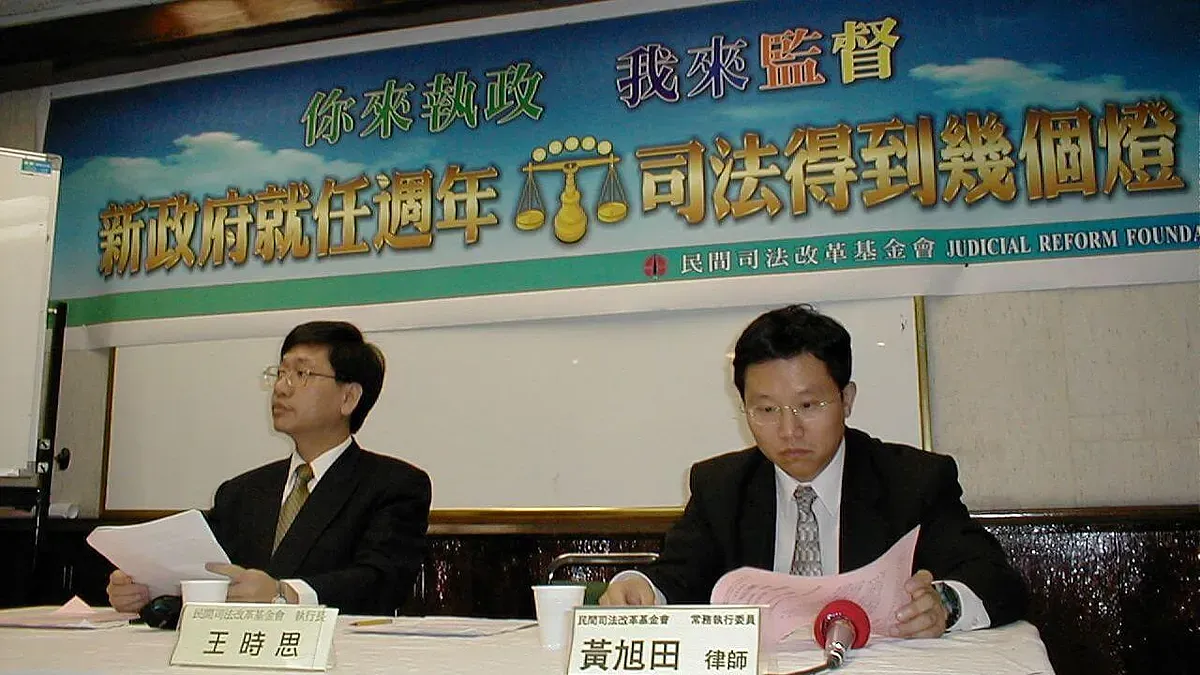
Press Conference on the General Health Check of Judicial Policies on the First Anniversary of the New Government's Taking Office
Last edited: 2026-07-27
Foreword
Since May 20 of last year, the new government has officially been in power for one full year. Over this past year, the new government has carried the people's dreams and expectations, hoping that through the peaceful transfer of political power, a brand-new political culture and reform ideology would be brought to Taiwan. Based on the governing experience of this past year, the performance of the new ruling team has received both praise and criticism; some of the campaign promises made at the time have been gradually fulfilled, while others have been reduced to empty talk. Upholding its consistent stance of monitoring the judiciary and promoting judicial reform, the Judicial Reform Foundation (JRF) has reviewed the 'Judicial Reform White Paper'—a series of policy demands proposed by President Ch'en during last year's presidential election—in order to urge the new ruling team to make progress and implement judicial policies, thereby building a judiciary worthy of the people's trust in Taiwan at an early date.
Although in this evaluation of the general health check of judicial policies, the new government's judicial policies only accumulated a score of 33.5 points (out of a total of 100 points), we also want to remind those in power not to be discouraged. After all, relative to President Ch'en's four-year term, this year represents merely one-fourth of the effort; if they can continue to move in the direction of reform, the potential for future scores is something to look forward to. We hope through this evaluation to remind President Ch'en not to forget his campaign promises. Judicial reform and a nation based on human rights were both important demands during the presidential election. We expect that starting with President Ch'en, politicians' promises can become a basis for voters to examine them, rather than being empty checks issued arbitrarily solely for the purpose of winning an election!
General Description
Police Administration: Rigid Systems and Corrupted Culture
Compared to the sincerity and ambition demonstrated by the legal and judicial systems toward judicial reform, the police administration system can be said to be the most backward and most 'unfazed by crises' among judicial-related units. On the one hand, President Ch'en's initial personnel appointments failed to transcend party politics and interest considerations as promised in the white paper, or to appoint independent and outstanding police leaders; subsequently, in the course of judicial reform, the police administration often strayed alone, becoming a 'missed link.' Over the past year, several police-involvement cases have reflected long-standing chronic problems of poor police quality, and the collective police corruption scandal that erupted a short while ago further exposed the tip of the iceberg regarding collusion between frontline police officers and local interests. As for the police, who occupy the very upstream of judicial cases and decisively dominate the quality of evidence after a case enters the judicial proceedings, the cultivation of scientific policing and forensic capabilities has been repeatedly neglected. Not only has sufficient budget not been allocated to enrich the domestic forensic science software and hardware equipment and training, but the cultivation of forensic capabilities has not been listed as a key focus of police officer training. Extortion of confessions through torture is frequently heard of, and criminal cases are helpless in subsequent judicial procedures every time due to insufficient preliminary evidence collection by the police. Coupled with a long-term lack of human rights education for police officers, leading to a habitual disregard for human rights, the so-called principle of non-disclosure of investigation has failed to be truly implemented even through policy declarations. The police, who originally served as the guardians of the people, have repeatedly become the chief culprits in violating human rights. Faced with such an absurd result, the police administration units have consistently failed to propose a reform timetable to face and improve the problem, continuing to allow the corrupted culture to erode the frontline police force.
Therefore, we strongly suggest that the new ruling team should prioritize police reform in future judicial reform issues, thoroughly rectifying the upstream of judicial cases so as to truly clear a clean stream of justice!
Ministry of Justice: A Mixture of Love and Hate, Praise and Criticism
Under the new government's explicit declaration of its anti-organized crime policy, the Ministry of Justice has continuously made high-profile moves, ranging from the establishment of the Special Investigation Division to several individual anti-organized crime cases. Minister Ch'en Ting-nan's persistence in maintaining the space for handling cases and upholding the external independence of prosecutors should be affirmed. However, amidst the soaring calls against organized crime, it also nakedly exposed the problems of prosecutors' case-handling quality needing improvement and their human rights literacy being obviously insufficient.
Since the second half of last year, in several major search and seizure cases, the police and prosecutors have continuously walked the fine line of the law. Among them, the search cases involving the China Times Express (中時晚報) and National Cheng Kung University (成功大學) were the most startling, resembling the reappearance of the White Terror era, which relatively gave some implicated politicians an excuse to cry 'judicial persecution.' Furthermore, because of a series of flaws in search procedures, the Ministry of Justice paid the price of having the 'search warrant power returned to the courts.'
We emphasize once again that the spirit of a modern rule-of-law state lies in the persistence in procedural justice for handling cases in accordance with the law. If heroism is allowed to continue dominating the Ministry of Justice's thinking and dictating prosecutors' case-handling models, it is undoubtedly putting the car of democracy and the rule of law in reverse, serving as a warning signal heading back toward a police state. Therefore, the primary task for the Ministry of Justice in the future is to re-establish the prosecution system's understanding of and adherence to rule-of-law procedures, and not to let crude case-handling methods ruin the people's trust and support for the prosecution system.
Judicial Yuan: Stable Growth, Slow Progress
Following the National Judicial Reform Conference the year before last, the Judicial Yuan has established short-, medium-, and long-term timetables for judicial reform; therefore, in terms of overall performance, it is indeed gradually moving in the direction of judicial reform. However, one must admit that relative to the public's earnest expectations for the judiciary, this pace of reform is indeed too slow! From the problems of court case backlogs and the elimination of incompetent judges, to protracted and inefficient litigation procedures and the inability of experienced senior judges to be transferred to the court of first instance, all these issues prevent parties in the courtroom from feeling the fruits of judicial reform. Therefore, how the Judicial Yuan can accelerate the pace of reform in the future, implement the steps of reform, allow the people to feel the concrete results of judicial reform, and stop ridiculing the courts' snail-like pace will be the most primary issue.
Description of the Scoring Method
- Each policy demand is scored with a maximum of 5 lanterns, and evaluations are given respectively based on objective factual standards such as whether concrete policies or bills have been proposed, whether they are actively promoted, the degree of concrete implementation, and implementation effectiveness.
- Excluding the first item, a total of 20 demands are included in the lantern evaluation scope, accumulating to a total of 100 lanterns.
Scores and Reasons for the Twenty-One Concrete Reform Proposals in President Ch'en Shui-bian's Judicial Policy White Paper
| Item | Twenty-One Concrete Reform Proposals in the Judicial Policy White Paper | Score | Reason / Evaluation |
|---|---|---|---|
| Nominate individuals as Grand Justices who are politically independent, have excellent academic backgrounds and practical experience, possess a macro perspective, hold a humanistic outlook, are grounded in human rights, are rooted in local society, and absorb the ideological essence of various countries. | Not Scored | As Article 12 of the Additional Articles of the Constitution stipulates that starting from the 92nd year of the Republic (2003), the number of Grand Justices shall be changed to 15, and there are currently 15 Grand Justices, nominations cannot be made. | |
| 1 | The appointment of heads of the judiciary, Ministry of Justice, and prosecution, police, and调查 (investigation) agencies shall have fairness, professionalism, and capability as the sole considerations, without any consideration of party politics or political factors. | ○○●●● |
|
| 2 | Manifesting popular sovereignty: establish a system for citizen participation in investigation and adjudication / appropriately establish a system whereby parties may mutually agree to select professional or non-professional judges to adjudicate civil cases. | ○○○●● |
|
| 3 | Promote plain-language culture for legal provisions and judicial documents. | ○●●●● |
|
| 4 | Based on humanized principles, adjust the seating arrangements of parties in the courtroom so that the people have dignity when entering the courtroom. | ○○○○● |
|
| 5 | Enact special laws to construct a special institution for purging corruption. | ○○○●● |
|
| 6 | Implement a comprehensive evaluation system for judges and prosecutors, and establish a mechanism for eliminating incompetent judges and prosecutors. | ●●●●● | A comprehensive evaluation mechanism has not been established, nor has legislation to eliminate incompetent judges and prosecutors been promoted; it remains stalled at ineffective case-by-case evaluations. |
| 7 | Ensure the external independence of the prosecution system and effectively combat organized and financial crimes. | ○○○●● |
|
| 8 | Conduct a comprehensive health check of the police system and raise police quality to enhance the capability to combat crime and maintain public order. | ●●●●● | Neither has a comprehensive health check of the police system been conducted, nor are there concrete measures to raise police quality. |
| 9 | Abolish the judicial examination and select judges from among outstanding prosecutors, lawyers, and legal scholars. | ○○○●● | The Judicial Yuan has formulated the latest measures, planning to abolish the judicial examination starting from the 96th year of the Republic (2007) and select judges from lawyers and prosecutors. |
| 10 | The criminal litigation system shall compel prosecutors to truly shoulder the substantial burden of proof and strengthen courtroom activities of attack and defense by both parties. | ○○○●● |
|
| 11 | Raise the quality of judges of the first instance and establish a pyramid-shaped litigation system. | ○○●●● |
|
| 12 | comprehensively review and resolve case backlogs and delay problems. | ○●●●● |
|
| 13 | Universalize the notary system to prevent disputes, and strengthen out-of-court dispute resolution procedures such as mediation, settlement, and arbitration. | ○●●●● |
|
| 14 | Cultivate forensic personnel and enrich scientific forensic equipment to enhance the capability of police and investigation personnel in scientific case handling. | ●●●●● |
|
| 15 | Strengthen the status and function of defense counsel during investigations, and extend the mandatory defense system for felony offenses to the investigative stage. | ●●●●● | No concrete policies have been seen. |
| 16 | To protect disadvantaged groups, a Basic Act on Legal Aid should be enacted to soundly develop the legal aid system, establish a crime victims protection system, and set up legal service centers for impoverished areas or disadvantaged groups. | ○○○●● |
|
| 17 | Universalize legal concepts, awaken the people's ideals of fairness and justice, and raise the people's legal awareness. | ○○●●● |
|
| 18 | Legal education and the training of legal professionals should strengthen professional ethics education. | ○●●●● | Aside from the original few opportunities for ethics education, relevant subjects have not been added in universities, and there are no new policies in vocational training education. |
| 19 | Reform the attorney system, implement attorney evaluations, strengthen the public interest role of attorneys, and provide continuing education for attorneys. | ○●●●● |
|
| 20 | Comprehensively review prison administration, parole, offender rehabilitation, and other systems to raise the reformatory function of prisoners and reduce recidivism. | ○○●●● | The Ministry of Justice has issued multiple administrative measures or individual measures regarding prison administration, parole, and offender rehabilitation, planning to improve the current situation. However, regarding long-standing chronic problems such as lowering the recidivism rate and the reformatory function of prisons... |
This article is an AI-generated translation of the original Chinese text. In the event of any discrepancy, the Chinese version shall prevail.