
Statement on the Search Incident at National Cheng Kung University
Last edited: 2026-07-27
Image source / Student Movements, Student Actions
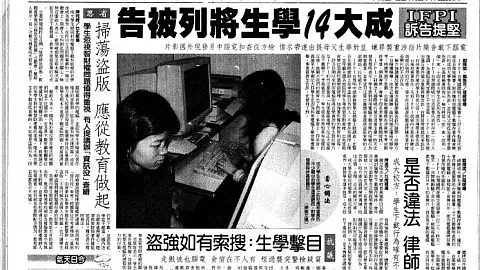
The recent incident where prosecutors and police entered the dormitories of National Cheng Kung University to conduct a search and seized fourteen computers on the grounds that students were suspected of illegally reproducing copyrighted material by downloading MP3 music has not only drawn widespread public attention, but more importantly, exposed numerous flaws in both legal provisions and judicial enforcement, and even brought the issue of rule-of-law education to the surface. In response to these aspects, the Foundation expresses its views as follows:
-
Poor Human Rights Literacy Among Police
According to reports, the origin of this case was that police entered the student dormitories at National Cheng Kung University to "inquire" about the use of MP3s to download music. Upon seeing students "inaugurating downloads" and feeling they could not "sit idly by," the police requested prosecutors to conduct an immediate search, and prosecutors arrived at the scene about an hour later. Our first question in this process is: By what authority did the police enter the student dormitories without a search warrant? Regardless of whether prosecutors arrived at the scene for the subsequent search, even if accompanied by the Office of Student Affairs or a dormitory administrator, the police had no reason whatsoever to freely enter the student dormitories to "inquire" without holding a search warrant. Once the fact of illegal trespassing was established, even if the prosecutor subsequently arrived and consented to the search, it could only be regarded as a retrospective "whitewashing" act, and the evidence thus obtained should naturally be treated as illegally obtained "tainted evidence" lacking evidentiary force.
-
Hasty Initiation of Search Powers by Prosecutors
From the China Times Evening News search case to the searches at the Legislative Yuan, the rampant exercise of search powers by prosecutors in practice and their failure to strictly adhere to due process have long been criticized by all parties. Therefore, early this year, the Code of Criminal Procedure was amended; starting July 1, prosecutors no longer possess search powers, which have instead returned to the court to decide whether to approve a search. However, disregarding the aforementioned amendment and failing to exercise their search powers with restraint, prosecutors still hastily initiated a search, treating human rights as if they were nothing.
-
Fishing-style, Unbounded Search Concepts Dominated Police-Prosecutorial Actions
The search conducted by prosecutors and police in this case was neither directed at specific targets nor restricted to a defined scope, resulting in the absurd outcome where "those living on the first and second floors were unlucky enough to be searched, while others escaped by running fast." In fact, even if the police discovered that "someone was downloading," the search and seizure should have been limited only to that specific computer for the purpose of "preserving evidence." Why did the prosecutors and police deem it necessary to search all dormitories at the time and directly carry out an illegal search aimed at "finding evidence"? This demonstrates that the mindset of prosecutors and police regarding searches remains stuck in the police-state mentality of "search first, ask questions later," utterly showing contempt for the principle that the exercise of search powers must also have its limits.
-
Students' Rule-of-Law Awareness Needs Enhancement
Putting aside whether downloading MP3 music is illegal, the students' reactions before and after this search incident clearly lacked the legal common sense expected in a democratic, rule-of-law society. When the police initially intruded into the dormitory, no students (or administrative personnel) asserted that this was an illegal intrusion. Later on, remarks were made such as "going after campus slaughter instead of cracking down on night-market piracy." This reflects that students still harbor a primitive, opportunistic mindset regarding acts that may constitute crimes—believing that "as long as there are worse offenders, I should not be caught"—without reflecting on whether their own actions have infringed upon others' intellectual property rights.
-
Questionable Practices of Police and Prosecutors Entering Campuses
As a stronghold of academia, campuses enjoy a certain degree of autonomy and should be protected by the Constitution and relevant laws. Therefore, based on the autonomous spirit of university autonomy, prosecutors and police should thoroughly weigh whether they are infringing upon "university autonomy" before entering campuses to investigate crimes, acting with caution and restraint, rather than acting hastily merely on the grounds of being "accompanied by the Office of Student Affairs or a dormitory administrator." Otherwise, generating panic over academic freedom is hardly a phenomenon that should exist in a democratic, rule-of-law society.
-
Education on Technology Law Needs Improvement
Whether in terms of current legal provisions or law enforcement personnel's understanding of technology law, it is evident that they fail to keep pace with the times. Consequently, this has led to the absurd practice of "defending online social order" through means that infringe upon human rights and violate criminal procedural rules. Therefore, education for prosecutors and police regarding technology law regulations must be strengthened so that they can accurately judge whether citizens in online society are exercising their rights or engaging in criminal acts.
Whether in terms of current legal provisions or law enforcement personnel's understanding of technology law, it is evident that they fail to keep pace with the times. Consequently, this has led to the absurd practice of "defending online social order" through means that infringe upon human rights and violate criminal procedural rules. Therefore, education for prosecutors and police regarding technology law regulations must be strengthened so that they can accurately judge whether citizens in online society are exercising their rights or engaging in criminal acts.
This article is an AI-generated translation of the original Chinese text. In the event of any discrepancy, the Chinese version shall prevail.