
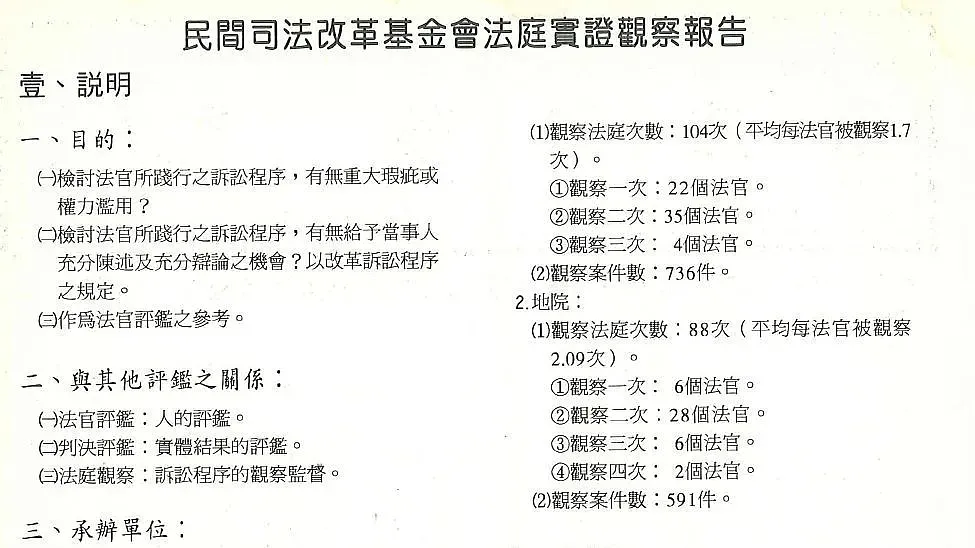
1995 Empirical Court Observation Report
Last edited: 2026-07-27
I. Description
1. Objectives
- To review whether the litigation procedures practiced by judges contain major flaws or involve abuses of power.
- To review whether the litigation procedures practiced by judges provide parties with sufficient opportunities for full statement and full debate, in order to reform procedural regulations.
- To serve as a reference for judges' evaluations.
2. Relationship with Other Evaluations
- Judges' Evaluation: Evaluation of personnel
- Judgment Evaluation: Evaluation of substantive outcomes
- Court Observation: Observation and monitoring of litigation procedures
3. Organizing Unit
Planned and executed by the Action Committee of this Foundation
4. Observers
- 30 attorneys and 29 law students
- Underwent five volunteer training sessions
5. Observation Period
August and September, Year 84 of the Republic (1995)
6. Observation Targets
All criminal court judges of the Taiwan High Court (Principal Court) and the Taipei District Court.
7. Observation Methodology
Observers were requested to personally visit courtrooms to observe each judge's proceedings, from the first case to the last case, and to complete a record sheet for each case (see attached table).
8. Number of Observations
In principle, each judge's court proceedings were observed for two half-days.
9. Record Sheet Retrieval Status
(1) Number of Judges Observed
| Unit | Observed Count / Total Count | Percentage |
|---|---|---|
| High Court | 61 / 68 | 89.7% |
| District Court | 51 / 42 | 82.3% |
(2) Number of Court Sessions and Cases Observed
| Frequency | High Court (Count) | District Court (Count) |
|---|---|---|
| Observed 1 time | 22 | 6 |
| Observed 2 times | 35 | 28 |
| Observed 3 times | 4 | 6 |
| Observed 4 times | -- | 2 |
| Total Observations | 104 | 104 |
| Total Cases Observed | 736 cases | 591 cases |
※ Each judge was observed an average of 1.7 times
II. Analysis
1. Delays in Court Proceedings
| Item | High Court | District Court |
|---|---|---|
| Average scheduled trial time (minutes/case) | 10.77 mins per case | 10.25 mins per case |
| Average actual trial time (minutes/case) | 14.51 mins per case | 18.18 mins per case |
| Case delay rate (%) | 73.6% (542 delayed out of 736 cases) | 77.49% (458 delayed out of 591 cases) |
| Delayed by 20 minutes or more (number of cases) | 304 cases (41.3% of 736 cases) | 250 cases (42.3% of 591 cases) |
| Delayed by 40 minutes or more (number of cases) | 136 cases (18.5% of 736 cases) | 102 cases (17.25% of 591 cases) |
| Delayed by 60 minutes or more (number of cases) | 56 cases (7.6% of 736 cases) | 36 cases (6% of 591 cases) |
| First case delay rate (%) | 88% (88 delayed out of 100 cases) | 72.4% (63 delayed out of 87 cases) |
| Delayed by 10 minutes or more (number of cases) | 60 cases (60% of 100 cases) | 36 cases (41.3% of 87 cases) |
| Delayed by 20 minutes or more (number of cases) | 13 cases (13% of 100 cases) | 15 cases (17.2% of 87 cases) |
| Delayed by 30 minutes or more (number of cases) | 10 cases (10% of 100 cases) | 11 cases (12.6% of 87 cases) |
| Average delay time per case (minutes) | 24.56 mins | 20.67 mins |
Analysis and Ratios of Causes for Delay
| Item | High Court | District Court |
|---|---|---|
| Judge arrived late | 92 cases (16.9% of 542 delayed cases) | 52 cases (11.3% of 458 delayed cases) |
| Judge did not hold sessions in order | 54 cases (9.9% of 542 delayed cases) | 44 cases (9.6% of 458 delayed cases) |
| Previous case ran late | 388 cases (71.5% of 542 delayed cases) | 311 cases (67.9% of 548 delayed cases) |
| Waiting for prosecutor | 4 cases (0.7% of 542 delayed cases) | 22 cases (5.9% of 548 delayed cases) |
| Waiting for parties and attorneys | 4 cases (0.7% of 542 delayed cases) | 2 cases (4.8% of 458 delayed cases) |
| Waiting for public defender | -- | 2 cases (0.4% of 458 delayed cases) |
Special Notes
- Longest delay caused by judge arriving late:
- High Court: Longest delay for the first case due to judge's lateness: 63 minutes (another case: 60 minutes; two cases: 40 minutes).
- District Court: Longest delay for the first case due to judge's lateness: 35 minutes.
- Shortest scheduled trial time by judges:
- High Court: Average of 3 minutes or 4.28 minutes per case, etc.
- District Court: Average of 3.33 minutes, 3.7 minutes, 4.58 minutes per case.
- Longest wait time for parties before court:
- High Court: Longest wait of 100 minutes (50 cases waited over 60 minutes)
- District Court: Longest wait of 135 minutes (24 cases waited over 60 minutes)
2. Court Trial and Hearing Proceedings
(1) Instances of judges (presiding judges) using derogatory, scolding, threatening, enticing, or harsh words or attitudes, and failing to allow parties to make full statements or listening attentively to their statements:
| High Court | District Court |
|---|---|
|
|
(2) Prosecutor Attendance at Hearings
| Unit | Investigative Proceedings | Trial Proceedings |
|---|---|---|
| High Court | No prosecutor attended in all 373 cases (0%) | Unable to analyze due to inability to distinguish between private prosecution and public prosecution cases |
| District Court | Prosecutors attended only 3 out of 301 cases (1%) | Prosecutors attended 145 out of 212 cases (68.4%) |
(3) Prosecutor Closing Arguments
| Item | High Court (Total 201 cases) | District Court (Total 145 cases) |
|---|---|---|
| Stated the four words "Judgment according to law" | 180 cases (89.5%) | 113 cases (78%) |
| Merely read the written indictment or appeal | 13 cases (6.5%) | 19 cases (13%) |
| Full debate | 1 case (0.5%) | 3 cases (2%) |
| Stood up without uttering a sound | 7 cases (3.5%) | 7 cases (4.8%) |
| Expressed "Unclear" | -- | 3 cases (2%) |
(4) Special Notes
| High Court | District Court |
|---|---|
|
|
(5) High Court Collegial Panel Proceedings
- Rate of inattentiveness among associate judges: 168 out of 213 cases (78.9%)
- Rate of inattentiveness among judges-in-charge: 56 out of 213 cases (26.3%)
- Special Notes
Associate Judges Judges-in-Charge - Associate judge was cutting and pasting, making noise by tearing paper.
- Associate judge blinked repeatedly, appearing sleepy.
- "Associate judge fell asleep," "Associate judge is still sleeping," "Associate judge woke up," "Associate judge began closing their eyes to rest again," "Associate judge opened their eyes."
- Associate judge sometimes supported their head with their hand, removing glasses as if sleeping.
- Associate judge fell asleep, jerked their head up sharply, and startled awake.
- Associate judge slept; upon waking up, read their own personal materials.
- Associate judge arrived at court only right before the end of the trial.
- Judge-in-charge was reading their own case files.
- Judge-in-charge appeared very fatigued, periodically closing their eyes to rest.
- Judge-in-charge leaned their head back and closed their eyes to rest.
(6) Other Special Notes
| High Court | District Court |
|---|---|
|
|
III. Interpretation and Recommendations
1. Delays in Court Proceedings
- The delay rates for all cases in the High Court and district courts reach as high as 73% and 77% respectively, clearly showing that court delays are quite severe, and the underlying reasons are worth examining.
- The delay rates for the first case in the High Court and district courts reach as high as 88% and 72% respectively. First cases are delayed mostly due to judges arriving late—most notably, the longest lateness by a High Court judge was 63 minutes, and 35 minutes at the district court. The shortcoming of judges arriving late deserves improvement.
- Parties wait an average of 24.56 minutes per case at the High Court and 20.67 minutes at the district court, with the longest waits reaching 100 minutes at the High Court and 135 minutes at the district court. Such a waste of the public's time truly requires thorough improvement.
- An analysis of the causes of delay shows that delays caused by previous cases running over account for 71.5% at the High Court and 67.9% at the district court, making it the primary cause of delay. In addition, the average scheduled trial time per case is 10.77 minutes at the High Court and 10.25 minutes at the district court, whereas actual trial times are 14.51 minutes at the High Court and 18.18 minutes at the district court. In other words, actual trial times consistently exceed scheduled trial times. Previous cases repeatedly running late lead to even longer delays for subsequent cases. In particular, the shortest scheduled trial times were 3 minutes at the High Court and 3.33 minutes at the district court. Scheduling trials in this manner inevitably leads to delays. Therefore, if judges can properly schedule trial times according to the needs of the case, the phenomenon of court delays can be effectively ameliorated.
- In addition to reasons such as judge lateness, poorly scheduled trial times, and failing to hold sessions in order, judges have too many cases and, aside from two half-days per week available for trials, lack sufficient courtrooms to use. This reason also merits review and improvement.
2. Court Trial and Hearing Proceedings
- Criminal defendants possess legal rights under the law; they are not merely objects of litigation procedures but also subjects of litigation. However, in actual litigation, as shown by the notes above, criminal defendants are rarely given the opportunity to make full statements or present arguments.
- Criminal defendants are presumed innocent until a judgment is finalized. Even after being finalized as guilty, criminal defendants retain their dignity and human rights. Yet, as demonstrated by the records above, judges frequently make subjective determinations of guilt prior to the conclusion of a trial, and even resort to scolding or insults.
- Judges hold power only within the scope of the law; judges have no right to scold people. In actual litigation, however, judges frequently scold and insult parties. This is not a problem of the legal system, but a problem of "people" and "education." This shows that judicial reform should not be limited to the reform of legal systems, but must include the education and reform of personnel.
- Judges at both the High Court and district courts exhibit behaviors of scolding and refusing to listen to statements, but this is evidently more severe at the High Court.
- Judges not only refuse to listen to the statements of parties, but even for defense counsel's arguments, they have already packed up their files and stopped listening. How can the adversarial principle be realized under such conditions?
3. Prosecutor Attendance
- In criminal proceedings, prosecutors act as plaintiffs and should be present in court regardless of whether the judge is conducting investigative or trial proceedings. In reality, however, for investigative proceedings—whether at the High Court or district courts—prosecutors almost never attend to perform their duties.
- According to the provisions of the Code of Criminal Procedure, trial proceedings involve closing arguments by prosecutors, responses by parties, and arguments by defense counsel. Prosecutors must attend trial proceedings. In practice, however, during district court trials, a staggering 32% of prosecutors failed to attend to present closing arguments—a severe violation of law.
- When prosecutors attend court to present closing arguments, they overwhelmingly merely utter the four words "Judgment according to law" or read the indictment, completely failing to engage in full debate (full debate occurred in only 0.5% of cases at the High Court and 2% at district courts). Some even stand up without uttering a sound or state that they are "unclear." Such perfunctory behavior clearly violates the spirit of the adversarial principle.
- As mentioned previously, criminal court judges frequently harbor preconceived biases, deny parties the opportunity to make full statements, and fail to listen to defense counsel's arguments, while the plaintiff prosecutor also fails to fulfill their duty of closing arguments. How can there be any debate under such conditions? Therefore, criminal proceedings should be transformed into an adversary system.
4. High Court Collegial Panel Proceedings
- Associate judges and judges-in-charge during trial proceedings frequently serve as mere procedural window dressing, failing to participate in trials, reading other case files, or dozing off. This seriously undermines the authority of the court and makes it difficult to gain public trust.
- District courts generally adopt a single-judge system, whereas the High Court adopts a collegial system. The purpose of adopting a collegial system is to have three judges try and deliberate together in order to improve the quality of judgments. In reality, however, the presiding judge and associate judges do not participate in investigative proceedings, and during trial proceedings, associate judges doze off or read their own case files, clearly failing to fulfill the function of the collegial system.
5. Summary
Through this empirical court observation, the following flaws were identified in the criminal proceedings of the High Court and district courts, which merit review and improvement:
- Severe delays in court sessions, which waste the public's time.
- Judge lateness, poorly scheduled trial times, and a shortage of courtrooms are the main causes.
- Judges occasionally scold or insult parties, failing to respect their human rights and dignity.
- Judges frequently deny parties the opportunity to make full statements and fail to listen to defense counsel's arguments.
- Prosecutors almost never attend investigative proceedings, and sometimes fail to attend trial proceedings. When present, their closing arguments are merely perfunctory readings from scripts.
- During collegial panel proceedings at the High Court, associate judges and judges-in-charge exhibit a remarkably high rate of inattentiveness, failing to implement the spirit of collegial deliberation.
IV. Outlook
- This empirical court observation report will be submitted to President Shih of the Judicial Yuan, demanding a thorough reform of the aforementioned shortcomings in order to build a judiciary worthy of public trust.
- This empirical court observation report will also be provided to experts and scholars for analysis and research, in order to thoroughly explore the causes of these flaws and ways to improve them.
- This observation focused exclusively on the criminal divisions of the Taiwan High Court and the Taipei District Court; in the future, observations will also be extended to other courts and civil divisions.
- This observation has only published general analytical reports and has not yet targeted specific judges. In the future, empirical observations will lock onto targets who demonstrate exceptionally poor procedural conduct, and will be published in conjunction with judges' evaluations.
This article is an AI-generated translation of the original Chinese text. In the event of any discrepancy, the Chinese version shall prevail.