
Cyber Student Movements and Detention to Extort Confessions
Last edited: 2026-11-03
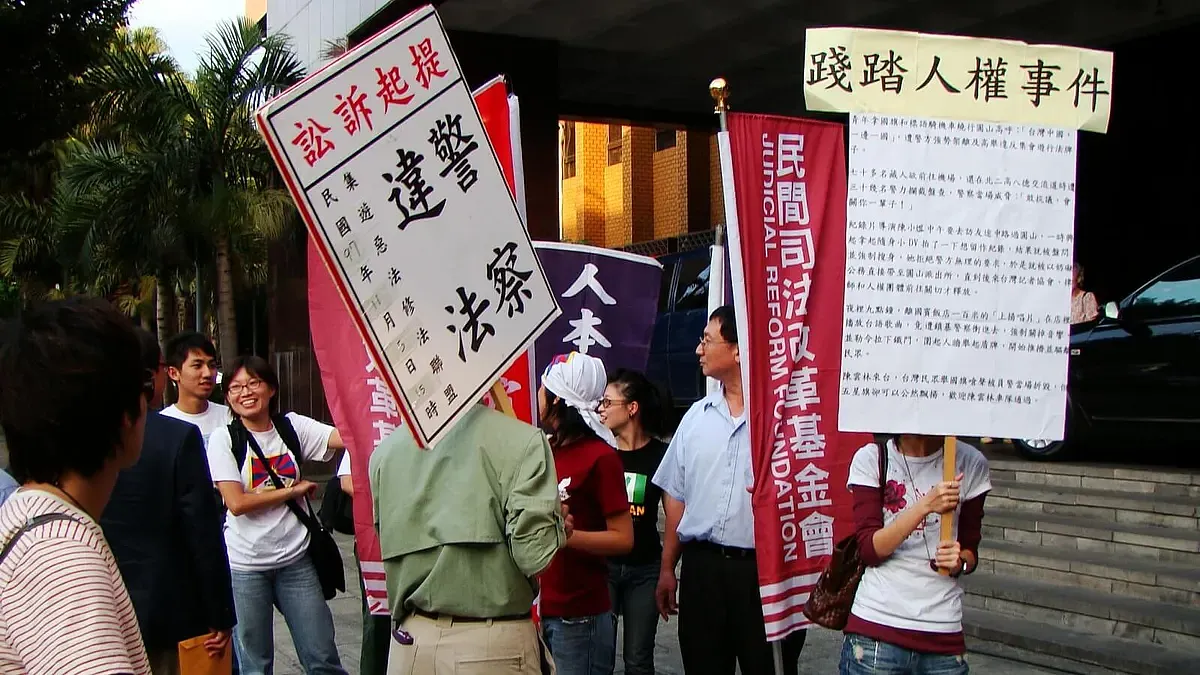
Starting November 6, in protest of the police isolating crowds and unlawfully applying coercive force during the visit of Association for Relations Across the Taiwan Straits (ARATS) Chairman Ch'en Yün-lin, university students in Taiwan gathered at the main entrance of the Executive Yuan for a sit-in. On the evening of the 7th, the police launched a forced dispersal. However, the students stood firm on their rational demands and relocated to Liberty Square to continue their sit-in, demanding that President Ma and Premier Liu apologize for the police's unlawful actions, that National Security Bureau Director-General Ts'ai Ch'ao-ming and National Police Agency Director-General Wang Cho-chün step down, and that the Assembly and Parade Act be amended.
Enduring harsh weather conditions over consecutive days and the challenge of mobilization during the students' mid-term exam period, the students at Liberty Square gritted their teeth and refused to back down. Furthermore, students in Hsinchu, Taichung, Tainan, Kaohsiung, and other areas successively launched solidarity actions, finding suitable local venues to stage sit-in protests. For a time, news of the student movement dominated media headlines, making people realize that student movements had returned.
This new generation, born around the lifting of martial law and raised in a democratic era, has never witnessed the intense scenes of police treating dissidents during the authoritarian era. Democracy and human rights seemed to be bestowed by heaven and taken for granted; yet, triggered by the police-civilian conflicts stemming from the Ch'en Yün-lin incident, their anger instantly ignited, and they resolved to fight for rights guaranteed by the Constitution, such as the freedom of assembly, parade, and speech, demanding that the ruling administration immediately amend the long-outdated Assembly and Parade Act.
Aside from giving our full support to the university students' actions in defending human rights and freedom, we also observed how they utilized internet technology—via live video streaming and multilingual live broadcasts—to transmit every single move in the square to every corner of Taiwan and to people around the world concerned about the development of this event. The demands of the movement and the form of the sit-in may be old, but through the assistance of new technology, its diffusion and infectiousness are truly incomparable. This is the ability and wisdom of the new generation, and it allows people to see hope for Taiwan.
Looking back at our judicial departments, what do we see?
Over the past two months, the Special Investigation Division (SID), investigating the money-laundering case involving former President Ch'en Shui-bian, has continuously detained defendants, with the hierarchy extending upward to former Presidential Office Deputy Secretary-General Ma Yung-ch'eng and former National Security Council Secretary-General Ch'i I-jen. In addition, Chiayi County Magistrate Ch'en Ming-wen and Yunlin County Magistrate Su Chih-fen were also detained on charges of corruption. Relevant case details were extensively exposed by the media amidst alternating conditions of "non-disclosure of investigation" and "disclosure of investigation." However, because prosecutors from the SID and local prosecutors' offices have yet to conclude their investigations, various unverified case details have circulated everywhere, subjecting the judiciary to constant questioning, and voices claiming that the prosecution is detaining defendants to extract confessions have grown increasingly louder.
Times are changing. The tactic of detaining defendants has long been a favorable weapon for prosecutors in handling cases. However, following the clear direction toward prioritizing human rights protection in our Code of Criminal Procedure in recent years, whether prosecutors are still tightly clinging to old concepts and how to adapt and adjust to the times regarding the conflict between the basic principle of the presumption of innocence and the pre-trial detention system are issues that obviously should no longer be evaded.
To address the above dilemmas, the human rights amendment bill to the Code of Criminal Procedure jointly promoted by the JRF and other civil society groups has proposed a solution: establishing that the detention system does not exist for the prosecution's pursuit, while mitigating this by reducing the period during which prosecutors may detain a defendant during investigation from four months to 20 days (following Japanese legal practice). This would balance human rights protection with rational criminal prosecution. Why shouldn't all sectors seriously consider this and jointly rescue the judicial credibility that has long lingered at a low level?
In a brand-new era, student movements can utilize internet video live-streaming; surely the detention system, which has repeatedly sparked questions of detaining people to extract confessions, should also be reflected upon and adjusted with a brand-new perspective. New era, new concepts—it is time to get on the road.
※ Part of this article was published in the Liberty Times on November 13, 2008. This is the complete and full text.
This article is an AI-generated translation of the original Chinese text. In the event of any discrepancy, the Chinese version shall prevail.