
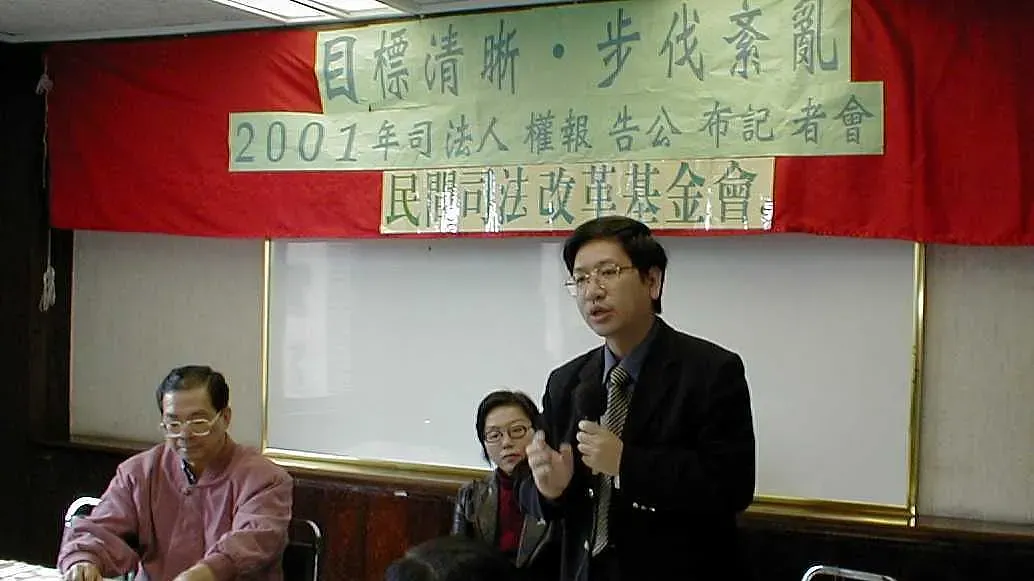
Clear Goal, Disordered Steps—Press Conference on the 2001 Judicial Human Rights Report
Last edited: 2026-08-28
Since President Chen took office, human rights issues have finally been brought to the fore, marking a new milestone in our nation's international image while capturing the recognition and attention of civil society. Among these, "judicial human rights" stepped out of the closed judicial world with the launch of the human rights train, coming under re-examination in the sunlight. Starting from the three presidential pardon cases granted by President Chen Shui-bian on Human Rights Day last year, to the retrial of the Su Chien-ho case which had been delayed for a decade, a brand-new stimulus was brought to Taiwan's judicial human rights. Looking back a year later at the dynamics of judicial human rights over the past year, we have the following observations:
-
The Case That Refuses to Admit Fault: The Su Ping-kun Pardon Case
Ever since President Chen Shui-bian pardoned Su Ping-kun on Human Rights Day last year by exempting him from both crime and punishment, civil judicial reform organizations have been continuously observing: who should bear responsibility for this miscarriage of justice clearly caused by human error? After paying visits to the Ministry of Justice and the Judicial Yuan, neither the police, prosecutorial, nor court systems have had anyone step forward to admit fault. Not only did the police officers who used torture escape any administrative disciplinary action, but due to legal provisions governing pardons, compensation for wrongful confinement is also inapplicable. As a result, Mr. Su Ping-kun's fifteen years of fleeing and two and a half years of imprisonment seem to have been completely written off with a single pardon decree. The judicial system failed to learn from this case—which required a presidential pardon—the courage to sincerely review and confront its mistakes. Admittedly, civil judicial reform and human rights organizations have repeatedly specified the judicial personnel who committed errors in this case or who insisted on pursuing a commendable exoneration, yet none of these efforts received any response, save for a passive statement: "Let's wait for the Control Yuan's investigation report to come out." Possessing neither the courage to admit mistakes nor the accountability expected of judicial officers, they merely awaited the Control Yuan's decision with folded arms. Looking back a year later, it is all the more infuriating and regrettable.
-
The Unit Most Lacking in Human Rights Literacy: The Ministry of the Interior
The Ministry of the Interior, which "stole" citizens' fingerprints during the replacement of national ID cards, can be rated as the most "blatant" ministry among the new governing team in treating human rights as if they were nothing. Minister Chang Po-ya, as the leader of internal affairs, not only stubbornly insisted on taking advantage of the ID card replacement to forcibly collect citizens' fingerprints, but even confused the public perception by equating fingerprint collection with the maintenance of public order, claiming that the ability to obtain fingerprints is the key to determining public order. Lacking both the basic common sense of fingerprint identification and the ABCs of human rights concepts, she can be said to have won the crown as the ministry most devoid of human rights literacy this year.
-
The Worst Law Enforcement Officers: The Police
Those most closely related to human rights incidents this year, yet plagued by the most problems, were naturally the police, who bear the fine reputation of being "the people's guardians." According to the investigation report released in May by Control Yuan members Chao Chang-ping, Liao Chien-nan, and Chan I-chang, judicial police organs still "from time to time" engaged in unlawful arrests, detentions, searches, seizures, and solving two cases with a single arrest during the course of handling cases. This severely infringed upon human rights, and incidents of torture even persisted and occurred endlessly. As for disciplinary cases, the police handed down a completely failing scorecard: collective corruption scandals involving police officers occurred in the Shihlin Precinct of Taipei City, Tainan County, and Kaohsiung City. Incidents that ruined the police image—such as the Taipei City Police Department's corporal punishment involving branding chests, kidnapping prostitutes for ransom, and volunteer firefighters drinking at hostess bars—left citizens who rely on the police for public order trembling with fear, unsure of which side of human rights protection the police were actually standing on. However, district courts successively issued judgments defending judicial human rights. In April of this year, the Taipei District Court delivered the first judgment explicitly declaring that unlawful evidence-gathering by the police cannot be used as evidence. This caused the police—who traditionally "chatted until cooperation was sufficient" and then read from a standardized script to record statements as audiovisual evidence—to hit a brick wall for the first time, thereby reducing from the source the "demand" for unlawfully obtained confessions by the police. Moreover, cases such as the wrongful arrest of Huang Chün-da and two others in Tainan County, as well as four juveniles wrongfully arrested by the police in the Wu Ju-yu robbery case, not only regained their innocence, but the Hsinying Precinct of the Tainan County Police Bureau and the Shihlin Precinct of the Taipei City Police Department were found guilty of violating the principle of non-publicity of investigations and the crime of compulsion, respectively. The victims were subsequently awarded national compensation, which serves as a warning that the police must pay a price for abusing law enforcement power.
-
The Most Deranged Ministry: The Ministry of Justice
The most encouraging and concrete human rights policy at the beginning of this year should have been the Ministry of Justice's "accidental discharge" of the policy to "abolish the death penalty within three years." This policy, which both conformed to global human rights trends and had a concrete implementation timetable, pleasantly surprised human rights organizations. Unfortunately, when viewed broadly from its performance over the past year, one can only say that the Ministry of Justice is a ministry with a split personality. Even as Minister Ch'en announced the gradual abolition of the death penalty, we recently heard our Minister—amid the rampant problem of counterfeit currency—suddenly conceive of using the death penalty to deter counterfeit currency crimes in media interviews, instantly forgetting the timetable for the abolition of the death penalty that he had promised. Furthermore, while the crackdown on vote-buying received nationwide support, we witnessed an unprecedented surge in wiretaps launched in the name of investigating vote-buying, which openly trampled upon basic human rights using state judicial public power and easily destroyed the guarantees of freedom of communication and the boundaries of the right to privacy. Meanwhile, the blank search warrants issued by prosecutors from the Panchiao District Prosecutors Office to facilitate police expediency became the swan song before the return of search powers to the courts on July 1st. Continuing the ferment from major controversial cases caused by prosecutorial law enforcement accumulated over the past year, this year saw the National Cheng Kung University MP3 search case, once again allowing society to witness the crude nature of searches by prosecutors and police. The prosecutorial personnel reshuffle triggered by the Cheng Kung University case sparked a chain-reaction backlash within the prosecutorial community; some prosecutors even used "withdrawing from the Special Investigation Division" as a threat to demand that the Minister of Justice retract his order, serving as an extreme negative example of judicial human rights. Although prosecutors have always appeared as the embodiment of defending justice, when confronted with conflicts involving their own interests, they ultimately failed to resist defending those self-interests, and the rights of the people instantly became chips to be traded. On the positive side of human rights performance, the Ministry of Justice combined "community service disposition" to provide "extra-judicial disposition," developing different treatment mechanisms for inmates. Additionally, starting from the 42nd term, the Judicial Officers Training Institute will extend the practical training period for prospective judicial officers by half a year, which can be seen as a slight response to the public's long-standing demand that judicial officers are too young and lack social experience. It is hoped that this half-year practical training will be a planned and effective exercise rather than a mere formality.
-
A Revived Resolution: The Supreme Court Abolishes Precedents of the "Presumption of Guilt"
This resolution is an important decision that concretely changes the current status of judicial human rights in Taiwan, except that it has come far too late! The resolution by the Supreme Court Criminal Division Precedent Review Meeting to abolish three precedents of the presumption of guilt "resurrected" the basic human rights principle originally stipulated in the Criminal Code but consistently rejected by individual precedents, returning to the core intent of the presumption of innocence under the Criminal Code. No one has the obligation to self-incriminate, ensuring that the responsibility of "proving guilt" truly rests back on the shoulders of the prosecutor. However, the distortion from the "principle of presumption of innocence" to the "principle of presumption of guilt" that has prevailed in the practical field over the past few decades has left an untold number of defendants with unredressed grievances, forever unable to obtain exoneration.
-
A Classic Work of Judicial Human Rights Legislation: Amendments to the Armed Forces Criminal Code
Among judicial human rights-related legislation, the most significant change must be the amendment to the Armed Forces Criminal Code, which underwent its first reform in seventy years. It reduced the number of offenses originally carrying a mandatory death penalty from forty-three down to two, and subjected active-duty military personnel to trial by ordinary courts. This can be hailed as the classic representative work of judicial human rights this year. Other related judicial human rights legislation includes the amendment taking effect on January 1 of this year, which changed sexual assault and indecency offenses from crimes subject to complaint to crimes subject to official prosecution. This shifted the legal interest hierarchy infringed upon by "sexual assault" from the level of individual legal interests to social legal interests, strengthening the protection of sexual autonomy. Furthermore, the maximum sentence eligible for commutation to a fine for fixed-term imprisonment was extended from a three-year limit to five years, thereby mitigating the ills of short-term custodial sentences.
-
The Most Painful Accusation: The Case of a Mother Burning Herself to Death with Her Child
Every year, painful events occur regarding individual judicial human rights cases, and this year, the unbearable weight for judicial organs must be the death of Ms. Liu, who set herself and her child on fire following a traffic accident case. This drastic protest by death shocked the judicial circle, and strong protests also laid bare problems in case-handling and attitudes ranging from the police and prosecutors to the courts. Several other cases that shook the judicial circle or astonished society included Ms. Tzu's alimony dispute case, the acquittal on bribery charges in the second remand trial of the Chou Jen-shen case, the dismissal in the second remand trial of Pastor Tang Tai-sheng's collective sexual assault case, the acquittal in the second remand trial of Chang Chih-hui, the acquittal of "Taxi Wolf" Lo Tsan-jung after six years of legal battles, and the acquittal of Li Ying-hung in the kidnapping-for-ransom case involving a stolen ID card. The parties in these cases drifted and sank in the torrent of justice; some survived while others drowned, forming a series of judicial human rights teaching materials that weigh heavily on the judiciary and startle society.
-
A Failed Example of Judicial Human Rights Education: The National Cheng Kung University MP3 Search Case
The problems reflected by the National Cheng Kung University MP3 search case are not only the crude search methods employed by police and prosecutors; equally drawing public attention is the widespread low level of legal common sense among university students, and their complete ignorance regarding the boundaries of whether an action violates the law and their own basic rights. This proves that our country's legal education is in urgent need of re-examination. Another negative example of legal education that can be listed is the case of the "Huakang Wolf" entering National Taiwan University. In this case concerning whether an inmate admitted to a premier university should be granted parole, National Taiwan University launched a petition called the "Student Safety Self-Rescue Alliance" to oppose his admission to the school, emphasizing that once the Huakang Wolf entered the school, it would trigger panic among the community and teachers and students. This shows that regarding preparations for inmates released on parole, the Ministry of Justice, correctional institutions, society, and premier universities evidently no one is prepared. Viewed from several dimensions—including the reformatory effects of correctional institutions, the standards of whether inmates themselves have "repented," and society's legal education—all sectors still have a vast amount of room for learning.
-
The Most Industrious Unit: The Judicial Yuan
Ever since the National Judicial Reform Conference in 1999, the Judicial Yuan has formulated various judicial reform policies item by item in accordance with the implementation timetable, and traces of hard work can indeed be seen under the diligent efforts of the Judicial Yuan. These include the revision of related ancillary provisions of the Code of Criminal Procedure and the promotion of legislation, the specialization of judges through the separation of civil and criminal cases, the promotion of centralized trials for civil cases, the trial run of online access to courtroom records, urging the establishment of a judge elimination mechanism, rewriting Judicial Yuan judgments in plain language, and promoting the system of expert participants, among other policy and institutional changes. However, as this Association pointed out in our two-year review of the National Judicial Reform Conference, although the Judicial Yuan is well-intentioned, due to excessive internal resistance within the courts and the difficulty in achieving consensus with the Ministry of Justice, the implementation effectiveness of various policies and measures has been very limited, and the outcomes of implementation are not as ideal as expected. Related legislative bills often get stuck in the Legislative Yuan and cannot move because opinions differ from those of the Ministry of Justice, while policy systems show uneven implementation rates depending on the degree of cooperation from various courts. As a result, the phenomenon where judicial quality varies by person remains the keynote of judicial cases. When the standard of judicial human rights no longer needs to rely on luck, but can enjoy uniform guarantees of a high standard, that should be the ultimate goal toward which the Judicial Yuan strives.
Looking broadly at this year's judicial human rights performance, generally speaking, the bright goal seems to have emerged in the distance, but the pace of pursuit remains disordered, and different government departments have exhibited differing philosophies and even scenes of mutual undermining. The state, serving as both the most severe violator of human rights and the most powerful human rights gatekeeper, should perhaps seriously contemplate its own role and implementation steps, so that human rights are not merely a slogan, allowing Taiwan to truly establish its nation on human rights and shake off the infamous reputation of a human rights laggard.
This article is an AI-generated translation of the original Chinese text. In the event of any discrepancy, the Chinese version shall prevail.