
Payment Orders Truly Must Be Amended
Last edited: 2026-08-28
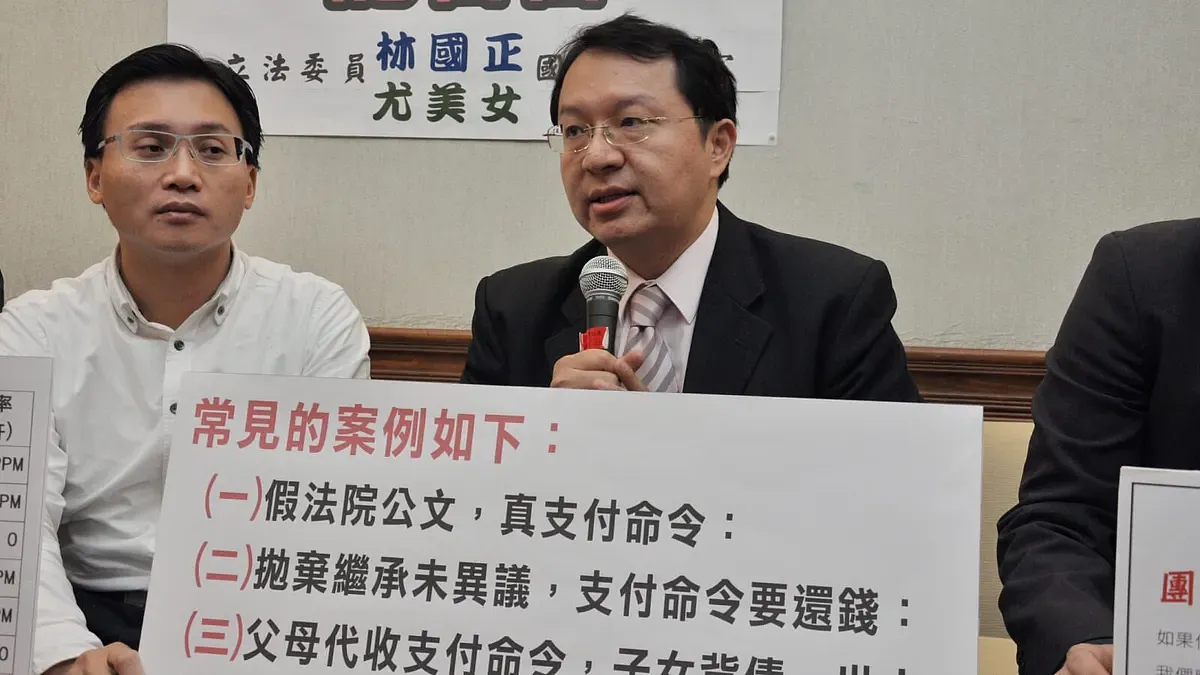
In over a decade of practicing law, I have frequently encountered cases where victims of payment orders could not obtain redress or relief, and inquiring with senior lawyers and judicial officer friends yielded no solutions. Ultimately, this is a systemic issue that can only be resolved through legislative amendment. As early as the 713th meeting of the Civil Procedure Amendment Committee of the Judicial Yuan in 2000, numerous scholars had already suggested removing the res judicata effect of payment orders to align with fairness and justice, yet this suggestion was shelved by the Judicial Yuan. It was not until 2013 that legislators finally held a press conference for victimized citizens to call for legal amendments, but the Judicial Yuan remained completely silent. Early this year, the JRF cordially invited numerous legislators from both the pan-Blue and pan-Green camps to jointly propose an amendment draft, all hoping to mend the legal loopholes surrounding payment orders. However, last Tuesday, during the review of the payment order amendment bills by the Legislative Yuan's Judiciary and Organic Laws and Statutes Committee, Judicial Yuan officials even claimed that the amendments should not be rushed, stating they had not yet even fully reviewed all the amendment materials! Does this not plainly demonstrate that the Judicial Yuan is unwilling to resolve the issues inherent in payment orders?
Judge Ch'en's article mentions the argument that "if the res judicata effect of payment orders is rashly abolished, financial institutions will inevitably resort to direct litigation to protect the time-bar benefits of their loan claims, which will cause massive traffic jams in the litigation system." This is sheer alarmism. In fact, based on my personal experience as a banker, the evidence preserved by financial institutions regarding their related transactions is quite comprehensive. Following the amendment, the application procedure for the payment order system will still be simpler than litigation and its procedural fees cheaper, and it can still be used as a basis to apply for compulsory execution. There is simply no such scenario where financial institutions will "inevitably" resort directly to litigation as Judge Ch'en worries. Furthermore, regarding the issue of bad debt recognition concerning financial institutions, the proof of court prosecution and debt collection referred to in Article 94 of the Regulations Governing Assessment of Profit-Seeking Enterprise Income Tax inherently includes supporting documents for procedures such as applying for payment orders, compulsory execution, or initiating litigation in accordance with the law (referencing Ministry of Finance Decree Tai-Tsai-Shui No. 31145, dated February 20, 1978). This amendment still preserves the effect of payment orders allowing for compulsory execution, and they can naturally continue to be used as proof for recognizing bad debts, making it unnecessary to alter current accounting operations. The amendments will not impose unnecessary burdens on the courts, yet they will resolve currently irremediable disputed cases, preventing the courts from becoming accomplices to fraud.
Refusing to cancel the res judicata effect of payment orders while tolerating the inability of victims to find relief is akin to ignoring prolonged physical discomfort without seeking medical treatment, letting it continue as if the pain does not exist. This ostrich mentality will only worsen the condition and cause the public to grow even more disappointed in the judiciary. I hereby call upon legislators to seize the opportunity of the current legislative session's final bill-review period, and ensure the passage of the payment order amendment bill before the session concludes on June 16. Let victims who remain in the abyss of suffering escape their misery as soon as possible!
This article is an AI-generated translation of the original Chinese text. In the event of any discrepancy, the Chinese version shall prevail.