
Pragmatic Reform of Payment Orders
Last edited: 2026-08-28
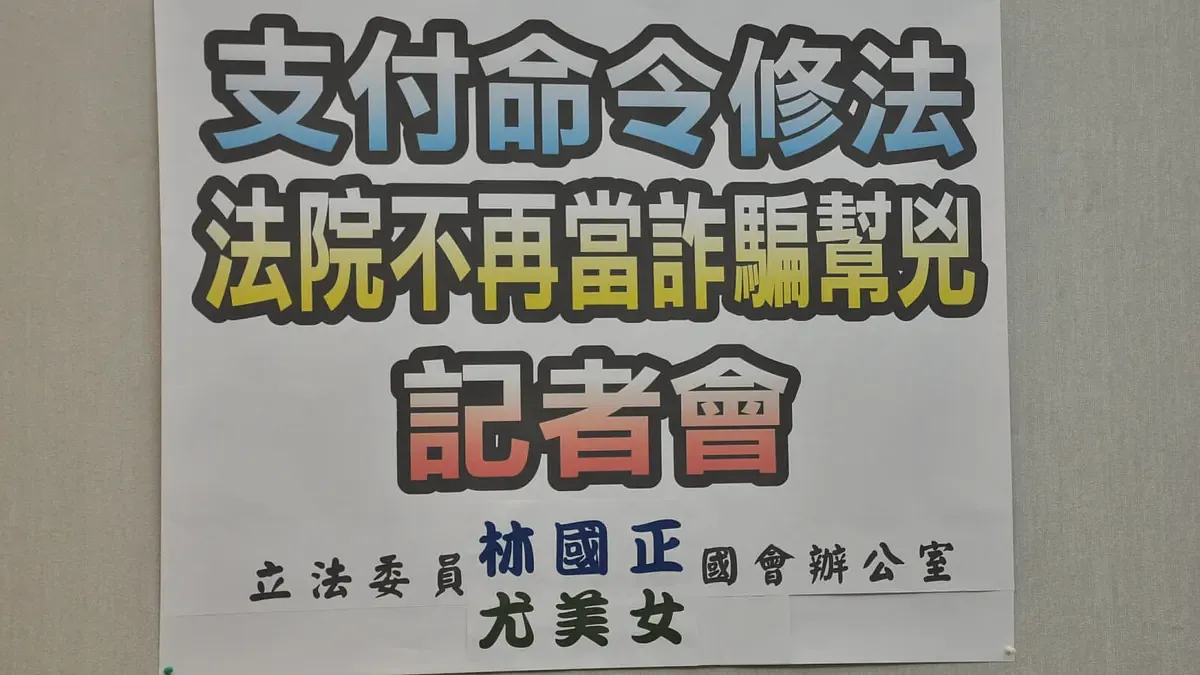
The Legislative Yuan recently passed the preliminary review of the amendments to the payment order provisions. While the general public largely welcomes this development, an academic submitted an op-ed labeling it as "a payment order amendment that makes a laughingstock of the international community." As the article raises several doubts, clarification is necessary.
The academic argues that the draft amendment does not conform to German and Japanese legal systems. In reality, regarding Germany's expedited payment procedure system, scholars Shen Kuan-ling and Yang Shu-wen have both written research analyses: when a court issues a payment order and the debtor fails to legally file an objection, the creditor may only petition for an enforcement ruling based thereon; if the creditor fails to petition for an enforcement ruling within a certain period, the payment order automatically becomes void. Japan also adopts a two-stage expedited procedure system; however, when Japan amended its Compulsory Execution Act in 1996, payment orders practically lost their res judicata effect, a topic already discussed by scholars Chiu Lien-kung, Lin Ming-de, and Wang Chia-i in the 2000 Civil Procedure Law Research and Amendment Committee. Currently, finalized payment orders in both Germany and Japan indeed lack res judicata effect. Furthermore, when our country amended the Code of Civil Procedure in the Republic of China year 60 (1971), a payment order lacking objection within the statutory period would acquire res judicata effect, long ago forming a unique expedited procedure system with local characteristics. There is truly no need for excessive comparison with the legal systems of other countries.
After the amendment, payment orders will only possess enforceability, similar to promissory note rulings. The academic criticizes the promissory note ruling system as a legislative mistake that should be abolished, because promissory notes can be completed in an instant, immediately acquiring an execution title; debtors colluding with friends and family can preemptively request the court for execution or participate in distribution, obviously opening wide the door for debtors to evade debts and conceal assets. However, under current law, a payment order requires only a written application by the creditor, without attaching evidence and without substantive review; as long as the debtor fails to file an objection within the statutory period, it acquires res judicata effect, which is likewise a fine method for individuals with ulterior motives to conceal property. Following the academic's logic, since current payment orders possess even stronger res judicata effect than promissory note rulings, shouldn't they not only be amended, but directly abolished? In truth, the draft amendment explicitly stipulates that payment orders possess only enforceability, and creditors may subrogate to dispute fraudulent claims under a payment order, which can actually prevent the risk of debtors concealing property.
The Constitution bestows upon judges various protections such as independent adjudication and life tenure, intending for them to act as guardians of the people's rights. Expedited procedures should not become a reasonable basis for restricting people's right of litigation, and reducing caseloads cannot serve as a justification for payment orders having res judicata effect. Moreover, while scholars maintain that payment orders function to filter cases so that courts can concentrate on adjudicating cases that must be handled "cautiously"...
However, facing other victims whose cases were filtered out by payment orders—whose survival and property have suffered severe judicial coercion and infringement and who still find no door to seek help—how can legislators lightly ignore their loud cries of sorrow? The preliminary review amendment passed by the Legislative Yuan amends four legal provisions, pragmatically reforming judicial deficiencies on the foundation of the current legal system. This echoes the academic's argument that avenues for relief regarding payment orders should be broadened, and describing the payment order amendments as a laughingstock internationally is surely a misunderstanding.
This article is an AI-generated translation of the original Chinese text. In the event of any discrepancy, the Chinese version shall prevail.