
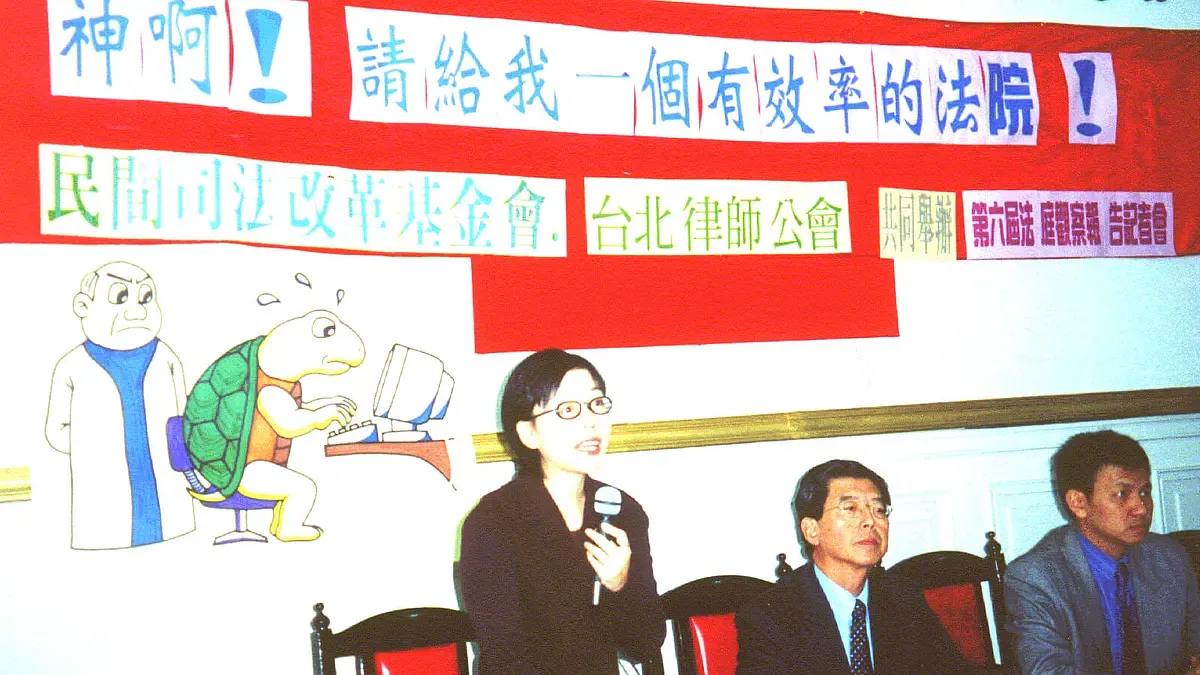
Oh Lord, Please Give Us an Efficient Court! Press Conference on the Release of the Judicial Reform Foundation's 6th Court Observation Report
Last edited: 2026-08-28
Since 1995 (the Republic of China Year 84), the Judicial Reform Foundation has embarked on its sixth round of court observation, setting a steadfast benchmark for long-term monitoring of courtroom proceedings, urging judges to maintain proper decorum, and elevating the administrative quality of the courts. This year's court observation adopted a methodology of random, unannounced observations throughout the year targeting unspecified cases. A total of 212 volunteer shifts were mobilized. Each observation volunteer underwent preliminary training courses, including lectures on litigation procedures and courtroom visits, to qualify for observation. Adherence to courtroom observation rules and the principle of not disrupting court proceedings served as the highest guidelines during observations.
Statistics show that a total of 727 cases at the Taiwan High Court, 657 cases at the Taipei District Court, 47 cases at the Shilin District Court, and 10 cases at the Taoyuan District Court were observed this year. The most prominent characteristic was that, despite having entered the e-generation, court efficiency falls far behind societal expectations. Consequently, all observation notes were compiled to summarize five major characteristics, in the hope of admonishing all relevant judicial authorities to redouble their efforts in improving the current courtroom conditions so that the courts can truly provide a reasonable and efficient trial space for all citizens.
-
Inefficient Court Hearings
The primary causes of inefficiency include the sluggishness of court clerks in producing transcripts, the absurdity of waiting around for prosecutors to make a "court appearance" just to go through the motions, judges spending time reprimanding parties, the unreasonableness of the segmented trial system, public defenders failing to fulfill their obligations, parties failing to retain attorneys, and the low efficiency of administrative support surrounding the court. In particular, the Judicial Yuan's aggressive promotion over the past year or so of having clerks handle computerized transcript generation can be deemed almost a complete failure. Except for a few "exceptional talents" capable of keeping pace with courtroom questioning speeds, virtually all courtrooms are bogged down waiting for court clerks to finish typing. The Judicial Yuan should fundamentally re-evaluate whether assigning computerized transcript duties to court clerks is viable, and whether alternative solutions exist to increase the speed of courtroom transcripts.
-
General Improvement in Judges' Courtroom Decorum
Although judges venting their bad moods on litigants are still heard of from time to time, overall, this year saw a substantial increase in records noting good courtroom decorum among judges, while judges with poor decorum were almost exclusively concentrated in the criminal divisions of the High Court. This indicates that, generally speaking, through years of advocacy and monitoring, judges' mindsets have gradually shifted, increasingly recognizing that good courtroom decorum is also a right that people should enjoy when entering the court.
-
Enhancement of Judicial Administration
Regarding peripheral personnel supporting court hearings, aside from the single-window system in courts having won public recognition last year, bailiffs showed the most marked improvement in attitude, whereas the attitudes of court clerks (ting-wu-yuan) were divided roughly fifty-fifty, leaving room for improvement. Meanwhile, the role and function of court interpreters were the most criticized; either their function in the courtroom was entirely imperceptible, or their inappropriate actions actually hindered the progress of court proceedings.
-
Lack of Dignity in Court Hardware
Compared to newly built courts such as the Keelung District Court and the Tainan District Court, the Taipei District Court and the High Court consistently suffer from insufficient space, resulting in noisy scenes outside courtrooms where parties await their hearings. How to improve this and enhance the efficiency of judicial budget utilization are issues that the Judicial Yuan should address by budgeting and planning for the long term.
-
Judicial Reform Requires Greater Dedication and Perseverance
Other issues, such as the display of judges' nameplates and courtroom order, have in fact been criticized for a long time, but the scope of improvement has consistently been limited. The reasons for this can hardly be blamed on any single individual; rather, judicial reform requires more people's dedication and constant perseverance, rather than treating it as a routine bureaucratic formality with a perfunctory attitude.
Culprit of Inefficiency No. 1: Court Clerks' Snail-Pace Transcripts
- The judge kept dictating to the clerk for typing, causing the party's statements to pause for a period after every single sentence, rendering the expression of intent seemingly disjointed. The defense team in this courtroom was massive (4 attorneys), outnumbering the parties present. The judge obviously only cared about the transcript, eyes fixed straight on the clerk's screen, and probably did not look at the party for over a minute. Most of the time from start to finish was silent, with only the sound of the clerk typing to be heard, while the party gave disjointed statements.
- The clerk types fast enough, but the judge spends too much time repeating things word for word.
- The clerk types too slowly, forcing the entire courtroom to wait for the clerk to finish typing before the judge proceeds to ask questions.
- While the presiding judge and the clerk were discussing the contents of the transcript and correcting certain parts, the defense attorney was still speaking. At this point, the presiding judge stared at the computer screen, and unsure whether the judge heard them, the defense attorney had no choice but to keep repeating the same content, feeling somewhat awkward and uncertain whether to sit down.
- The clerk's typing speed is comparable to mine (equally slow).
- The entire investigation procedure proceeded very slowly because, after asking questions, the judge would reorganize the content themselves and then dictate it word for word to the clerk. It felt as though the courtroom had become a training ground for the clerk, and this phenomenon appeared throughout the subsequent case-number investigation procedures.
- The clerk's typing was entirely dictated by the judge.
- The clerk is truly frighteningly slow.
- At the very beginning, the clerk was nowhere to be found and only returned after a while, with a shockingly slow typing speed.
- The presiding judge kept instructing the clerk, leaving the parties standing and waiting idly.
- The clerk's speed was too slow, so the judge stopped several times to wait for the clerk to make records.
- The clerk types too slowly.
- I really wanted to type for the clerk myself.
- The clerk types rather slowly.
- The judge frequently had to instruct the clerk, affecting the operational procedure.
- Only because the clerk typed too slowly, the progress of the entire litigation procedure was affected, with the judge also correcting and instructing alongside.
- The clerk did not use typing and instead used handwriting, which was somewhat strange; the interrogation speed was somewhat slow.
- The clerk types too slowly, resulting in everyone waiting for the clerk.
- The clerk was more up to speed than the one I saw at the district court last time.
- The clerk types somewhat slowly, and the judge frequently leaned over to repeat what was said.
Culprit of Inefficiency No. 2: Prosecutors Going Through the Motions at Hearings
- Around 16:35 to 16:40, the entire room waited for the prosecutor alone (including the judge)—what a big shot. The prosecutor finally arrived, but what a disappointment; their speech was muffled and soft. (To put it bluntly, their arrival was no different from not coming at all.)
- When attending court, the prosecutor only knows how to answer: "Judge in accordance with the law." Wouldn't it be better to have a parrot come to court in the future? A parrot can say that too.
- The prosecutor is really... sigh... truly like a decorative fixture there! Even reading "Prosecution as stated in the indictment, judge in accordance with the law" in a very quiet, formulaic, and muffled second, spending the rest of the time sitting there with their head down.
- The prosecutor only appeared during the argument procedure (I heard they were in another courtroom before and rushed over after finishing that hearing; while the prosecutor was absent, the judge utilized the time to try the next case). Afterward, the prosecutor arrived, but merely read "Prosecution as stated in the indictment, judge in accordance with the law." I really don't know why a prosecutor needs to be invited here—I could read that myself!
- The prosecutor is as sparing of words as gold; when their turn came, they simply uttered... "Judge in accordance with the law." I really suspect that a prosecutor's job is this effortless.
- Once again waiting for the prosecutor to arrive (4:00 - 4:20) to participate in oral arguments. ◎ Waiting for the prosecutor and the defendant took quite a bit of time.
- What kind of prosecutor is this! Reads two sentences and walks away.
- The prosecutor arrived before the hearing started, but only read a single sentence: "Everything shall be judged in accordance with the law."
- The prosecutor hurried into the courtroom only at 4:40.
- As soon as the prosecutor came in, they quickly blurted out a sentence I didn't understand; they seemed very bored.
- The prosecutor stood up midway and sat right back down again; truly incomprehensible.
- The prosecutor did not attend the trial and only appeared at the very end to say: "Please adjudicate in accordance with the law."
- The prosecutor did not attend the trial proceedings. After the judge finished questioning the party, they asked the party to wait in their seat for the prosecutor to conduct the arguments. During the waiting time, the judge continued investigating or trying other cases. In the end, after the prosecutor arrived, no arguments were conducted; they only said to judge in accordance with the law.
- The prosecutor seemed to have no reaction whatsoever, sitting there silently most of the time.
- The prosecutor arrived, though 5 minutes late, and when the judge asked if the prosecutor had anything to supplement, the prosecutor gave a reply so soft I couldn't hear it.
- Midway through, the presiding judge asked the prosecutor to be present. During the waiting time, they proceeded with the next hearing. When the prosecutor arrived, they read a few words and left again before the presiding judge finished the trial.
- The prosecutor also just read "Please judge in accordance with the law" and walked away.
Exceptional Performance:
- The prosecutor in today's hearing had the best attitude among all the ones I've seen; they didn't put on official airs.
- The prosecutor attended the hearing and participated in the arguments.
Culprit of Inefficiency No. 3: Defendants Failing to Retain Counsel
- The defendant in this case had just completed a sentence for a previous case (also firearms-related) on October 6. The defendant believed this case and the previous case involving confiscated detonators for dynamite fishing were from the same batch. However, the defendant is a ship captain, and due to his educational background, he seemed unable to express his thoughts. I don't know why no attorney or public defender was defending him. I feel that forcing someone who does not understand legal rules to defend themselves is extremely cruel and disadvantageous to the defendant.
- The judge handled the case very earnestly, but was just too impatient; sometimes their tone when questioning was not very pleasant. The public also needs further legal education; otherwise, coming to court empty-handed with nothing prepared, no wonder the judge would snap.
- This defendant also did not hire an attorney. It seems lawyers are not something everyone can afford.
- The presiding judge's attitude seemed much better toward those who had retained attorneys, and they were very polite to the attorneys.
- With an attorney present, the judge became extremely polite.
- With both sides employing attorneys, things were resolved quickly, cleanly, and neatly.
Culprit of Inefficiency No. 4: Judges Overboard with Scolding
- The judge was so fierce! Seemingly full of disdain! Probably a "professional hazard"! They kept refuting the statements of the attorney and the plaintiff, almost escalating into a quarrel. Moreover, the judge's case file was incomplete! The file for April 28 was actually missing (while the attorney had a transcript).
- When a party attempted to argue, the judge often said: "The prosecutor's transcript is written like this, why are you still talking nonsense?" ◎ When the attorney was speaking, the judge frequently interrupted to express their own views.
- During questioning, the judge frequently interrupted the party's answers with their own experience, and also told the party: "I am an insider in this regard, you shouldn't speak."
- The judge repeatedly interrupted the party's statement with the phrase "I don't think you were wronged." The judge seemed to believe the first-instance judgment was correct, saying "The district court wouldn't convict you arbitrarily," and while seemingly giving the party a choice on whether they had any objections to being temporarily detained in the detention center, in reality the party had no choice at all.
- The judge's tone toward the defendant was very poor. Because the defendant did not confess, the judge remarked, "Are you saying the prosecutor and the land administration agency colluded to frame you?" When the party said, "That's how civilian life is," the judge retorted, "Do you think judges are out of touch with reality?" and added, "If I go measure it myself, and you've encroached even a sliver of someone else's land, I'll sentence you to a year and a half and send you inside."
- The judge read out the defendant's rights on behalf of the prosecutor (though reading very quickly). Today is my first day of court observation, and also the first time I saw a judge fly into a rage, details as follows: The plaintiff was an old grandmother in her fifties or sixties. Because her speech lacked logic, and the judge subsequently discovered she had mistaken the victim for an extortionist, the judge became displeased and said, "Look at where I put a checkmark—is that him (pointing to the defendant)?" Perhaps the old grandmother was too nervous and didn't know where to look, so the judge said, "Do you even know how to read or not?! Look at where I put the checkmark! If you don't know, why are you signing randomly!" The grandmother said, "I'm sorry." The judge said, "Sorry for what! Do you know how much the state spends on you people, wasting state resources, and now you're saying he's not the person? Do you take the court and the judges for fools!" Finally, the judge slammed the notebook fiercely onto the interpreter's desk. It was terrifying.
- The judge's temper was somewhat poor. Because the party did not understand the law and asked the judge to teach them what to do, the judge's attitude was very poor, responding: "If you don't understand the law, don't file a private prosecution. Do you know you have to shoulder the responsibilities a prosecutor should shoulder? Don't ask me to teach you; did you pay money to hire me?" The plaintiff could only quietly endure the scolding.
- Judge Ch'en lectured the party, saying: "Don't waste taxpayers' money." The tone was poor; such language should not be used toward unconvicted individuals.
- During the investigation process, it was as if the party was already a convicted criminal. This is deplorable; people trained in the law should not act this way.
- Judge: "I can't read this! The handwriting is ugly, I have many cases, can you hurry up?"
- The judge seemed to be in a poor mood, because they thought, "You people come to have this kind of case heard, we are very helpless," and repeatedly questioned the parties using poor-toned phrasing like "What is this thing?"
- Judge: "Wasting everyone's time, you know what kind of play you've been acting out from start to finish."
- The judge kept flipping through the case files, obviously lacking thorough preparation! Seemingly not knowing what to ask.
- The judge's questioning was somewhat fierce, fitting the general public's impression of how judges question. During questioning, the judge would occasionally raise their volume, demanding the parties give on-topic answers—perhaps because the parties' answers were not what the judge wanted. It felt like the parties were all terrified of the presiding judge (perhaps because the presiding judge's questioning attitude was not amicable). At the beginning, the presiding judge asked the defendants to state their accounts one by one; some gave answers that strayed from the topic, so the presiding judge corrected them, and some were even directly prompted by the presiding judge with specific questions to answer.
Culprit of Inefficiency No. 5: The Interpreter, a Slacker
- The interpreter seemed very bored, tossing and turning in their chair, and dozed off several times.
- The interpreter asked me, "Did you guys get paid?" How strange, I'm not here to work a part-time job...
- After the hearing adjourned, the interpreter came over to chat with me.
- The suspect only spoke Taiwanese, and the judge had a Mainland accent, so the interpreter finally came in handy.
Culprit of Inefficiency No. 6: Public Defenders Failing to Fulfill Duties
- The clerk only started recording halfway through the judge's questioning. The public defender was late, so the judge temporarily suspended the trial for this case and tried the second case instead. The public defender, who arrived in a rush afterward, looked completely indifferent toward this case. To the judge's inquiries, they merely read two sentences from a notebook and left beforehand, without exchanging a single word with the appellant, and without even glancing at the appellant. I seriously doubt whether the public defender even knew what the appellant looked like or could recognize them?! What a pathetic public defense system.
Culprit of Inefficiency No. 7: Waiting One Hour, Hearing Five Minutes
- How strange, why would the scheduled hearing time be 5 minutes? Such a short duration is not enough, compared to the actual hearing time later.
- Falling short by an hour, the judge read a single sentence about the next judgment date being month X, day X, and it was over. The speed was so fast I couldn't believe it; it was over before I even started taking notes.
- Because time was tight, the judge dismissed the party's requests simply with the reason "to be considered by the bench." The entire hearing process took no more than 10 minutes, but the party had already waited for over two hours. Even while the party was still stating their request, the judge had already left the bench.
- Judge Lei sat on the bench nodding vigorously, looking like they were dozing off with eyes unable to stay open.
- An associate judge named Ku XX was dozing off.
- The two judges on either side seemed preoccupied with their own thoughts and appeared absent-minded.
- This case was super fast ~ it ended at 10:28 (the hearing started at 10:25). The judge said to submit a written brief ~ (seemingly due to the lack of new evidence).
Culprit of Inefficiency No. 8: The Courtroom is Like a Traditional Market
- The attorneys waiting for the hearing spoke too loudly, affecting the questioning inside the courtroom—truly lacking in class! (For some reason, the doors to the High Court courtrooms are never closed; I don't know if it's because the weather is too hot and they need ventilation? Otherwise, closing the doors would prevent outside interference.)
- The conversation sounds outside the courtroom were too loud, and mobile phone ringtones kept going off without anyone stopping them.
- Cell phone rings echoed one after another outside the courtroom.
- Bailiffs chatting outside—absurd.
- Outside sounded like a vegetable market.
- It was very noisy outside. Before the previous group finished signing their names, the next trial started. The surrounding quality was poor.
Progress Award No. 1: General Improvement in Judges' Attitudes
- The judge even encouraged an unemployed party to hang in there.
- The judge would tell the parties what rights they could fight for or what mistakes they had made, and carefully listened to the parties' statements.
- The judge questioned meticulously, paying extreme attention to every minor detail, and immediately questioned witnesses regarding doubts in the case.
- The judge showed concern regarding whether the defendant had insurance, and reminded the defendant three times to seek help from a bank.
- The judge was very sympathetic toward the defendant, repeatedly advising them to find evidence favorable to themselves and promising to find a public defender for them.
- The defendant offered no defense against the accusation, but was a recidivist. Since the defendant indicated their nuclear family had been established not long ago, the judge seemed inclined to be lenient, gently and kindly advising the defendant to turn over a new leaf and think more of their family, wife, and daughter.
- The judge greatly respected the party and defense counsel who were not currently being questioned; when they were standing while unexamined, the judge invited them to sit down.
- The judge showed considerable respect and politeness toward the parties, defense counsel, witnesses, etc., frequently using considerate phrasing in their wording such as "Would that be alright?" or "Is it convenient?"
- The judge had a very good attitude and followed a rigorous investigative sequence. After understanding a party's statement, the judge would repeat it, dictating it word for word to the clerk for typed record, and questioned the disputed points in great detail.
- The judge fully exercised the right of clarification. When a party asked a bunch of questions, the judge pinpointed the core of the issue, but refrained from answering further due to judicial neutrality.
- Sometimes parties interrupted the judge's questioning; although the judge's expression turned unsightly for a single second, it was understandable, as some parties truly showed zero respect for the judges. Some parties did not understand the law, yet when judges kindly provided clarification, they snapped back—that was just... something else! The judges were about to snap! Their patience was worn thin. The plaintiff scolded the defendant right in court, and the defendant's agent wanted to sue the plaintiff. The judge pleaded for the plaintiff, asking them not to talk nonsense. The plaintiff kept pulling rank, and the judge asked them to stop asking random questions and respect the court. What a chaotic hearing.
- The judge handled the case very earnestly, but was just too impatient; sometimes their tone when questioning was not very pleasant. The public also needs further legal education; otherwise, coming to court empty-handed with nothing prepared, no wonder the judge would snap.
- The judge's attitude was very good, even patiently explaining the principles and methods of testifying to witnesses. However, the entire investigative process proceeded very slowly because, after asking questions, the judge reorganized the content themselves and dictated it word for word to the clerk to type into the computer, causing a waste of time. It felt as though the courtroom had become a training ground for the clerk. This phenomenon appeared throughout the subsequent case-number investigation procedures.
- The presiding judge in today's hearing was exceptionally wonderful and very patient. If the appellant or appellee went on rambling tangents, the presiding judge would pull them back and sort out the key points, causing the lost-in-the-woods appellant or appellee to nod in sudden enlightenment. From my personal experience, I feel this is good interaction and communication, because sometimes when parties talk endlessly, they forget which specific point their argument targets and what they actually want to claim. The presiding judge's timely reminders help parties understand their current situation, focus on their arguments, elaborate on them, and avoid wasting time on speech or statements unhelpful to the case.
- The judge played a recording of the scene at the time in the courtroom. Although the content was very long, chaotic, and of poor audio quality, the judge listened attentively from start to finish, questioning witnesses and parties on the details, demonstrating thorough professionalism.
- The judge politely asked the child to go outside and wait first (isolated interrogation). The child was very nervous, and the judge gently told them not to be nervous. Great! Quite compassionate. When asking questions, the judge also smiled so the child could express themselves naturally.
- Although the judge earnestly analyzed the pros and cons to urge both sides to reconcile, there was no coercive attitude, and the opinions of both sides were respected.
- Regarding sharper issues, such as fights, the judge was able to take the child away beforehand to avoid affecting them, isolated the questioning between adults and children, and spoke in a gentle tone with a very good attitude.
- This judge only summoned witnesses. The witness summoned had the mindset that coming to court is just having terrible luck. The judge directly corrected this erroneous mindset, explaining that for the sake of justice, everyone might have to come to court; otherwise, wouldn't everyone coming to court every day have terrible luck? Moreover, judges work very hard. It is possible their descendants might have the opportunity to become judges, so being a witness is truly not a shameful thing.
- The judge hoped they could reach a settlement (in fact, before the hearing began, the judge told the attorney that when disputes arise, both sides have rights and wrongs, so after coming to court, they hoped to conclude with a settlement. Avoid absolute rights and wrongs, because writing a judgment is easy, but the purpose is to forge fairness between the two parties). This female judge was quite amiable and very thoughtful, acting like a peacemaker capable of concluding with a settlement. She approached their problems as an objective third party to figure out ways to resolve them for them. I feel the courtroom needs many such justice-driven judges who are earnest and do not close cases casually.
- Presiding Judge Huang must be a good judge; his meticulousness leaves no detail unchecked, and his patience with both sides is equally commendable. He even slowly helped guide them to the core of the issue, enabling both sides to express their original intents as fully as possible.
- The judge greatly respected the party and defense counsel who were not currently being examined; when they were standing while unexamined, the judge invited them to sit down.
- The judge was super gentle!
- The judge was very nice. During a lull, they asked if I had any questions, and even told me they welcomed me to join the ranks of the judiciary, adding that it didn't matter and I could ask questions now while business was slow.
- I feel young judges are all very responsible, informing parties of their due rights, unlike senior judges who always project an attitude of "I knew that already, you don't need to tell me."
- The judge was so young, probably around 25 years old, with a soft, slender voice that was somewhat hard to hear.
Progress Award No. 2: Friendly Bailiffs
- When the defendant started talking about the victim, the judge ordered the courtroom cleared. The bailiff very politely invited me to observe from another courtroom. This was worlds apart from the attitude of the district court bailiffs when I attended the Judicial Reform Foundation's 4th court observation two years ago. Looking at today's court hardware and the judge's attitude, I feel Taiwan's judicial quality has progressed, and our Judicial Reform Foundation's aspiration seems to have taken a giant leap forward.
- The bailiff was very polite and friendly, expressing an attitude of "Please come in, you are welcome" to the writer. However, because it was a sexual assault case, the writer was quickly ushered out by the judge.
- The bailiff and court clerk even asked: "No classes today? You guys look so hardworking, you better write nicely about me!"
- The bailiff came over to ask what I was recording. I replied that I was with the Judicial Reform Foundation, and they asked no further questions.
- The bailiff was very polite.
Court Clerks' Attitudes Leave Room for Improvement
- The court clerk initially prohibited the writer from taking notes, but after the writer stated their identity, their attitude changed 180 degrees, not only apologizing repeatedly but also addressing the writer as "Handsome" over and over. When the writer finished taking notes and prepared to leave, they even asked the writer to sit a while longer!?
- Because I arrived over an hour early, Auntie Court Clerk enthusiastically introduced which courtrooms I could go listen in on.
- Seeing that both parties had been standing the whole time, the court clerk proactively invited both parties to sit down.
- The court clerk asked me to take good notes and record the best parts, saying that we JRF volunteers are the saviors of the court (how embarrassing). I smiled and said the court's condition is already very good now, just write objectively.
- Activities inside the courtroom were appropriate, except it would be even better if the court clerk could call out names a bit more softly!
- The court clerk was secretly playing a video game.
- The sound of the court clerk clipping their fingernails was so loud, and after finishing, there was even the sound of patting their thighs.
- As the hearing was about to start, I asked the court clerk for the case sequence number. They were very impatient and told me to observe in another courtroom.
- The court clerk forbade me from taking notes and said I needed the presiding judge's consent.
- The court clerk even introduced me to which courtrooms to observe, saying those courtrooms needed us.
- The court clerks chatting outside were very noisy, drowning out the parties.
Others
- During the witness examination process, because one of the witnesses was an Indonesian migrant worker, there was a language barrier between both sides, and it was uncertain whether the witness understood what the judge was asking. The witness signed and took an oath seemingly without knowing anything—rather perfunctory.
- There was no nameplate on the bench (no judge's name displayed).
- There was no computer for the parties to view below the bench, no judge's name on the bench, and no judge's name posted outside. ◎ The computer below the bench seemed broken.
- Due to computer issues, the start of the hearing was delayed.
- The judge didn't seem very familiar with computers...
- I am certain the party did not attend this case, and no trial was conducted on the bench, yet a stamp indicating trial completion was affixed to the notice outside the courtroom.
- The bailiff forbade me from taking notes.
- This is my first time coming to the district court for observation. I distinctly noticed quite a few female clerks and some female judges in the district court, whereas the High Court is a male-dominated domain.
- The air conditioning in this courtroom was truly strong; I kept shivering.
This article is an AI-generated translation of the original Chinese text. In the event of any discrepancy, the Chinese version shall prevail.