
JRF Newsletter: In 2015
In 2015
Last edited: 2026-08-28
The renowned scientist Stephen Hawking dedicated his life to promoting popular science. To ignite the passion for science in the next generation, he even authored several children's books on the subject. In fact, "legal popularization" is also one of the core missions of the Judicial Reform Foundation (JRF). Changing the public perception that "the judiciary has nothing to do with me" and finding entertaining ways to spark children's interest in the judicial system have always been major challenges.
In 2014, Jung-Chih and I consulted a senior predecessor for advice on the direction of judicial reform. When the predecessor talked about education, he was full of enthusiasm, saying: "Seeing happy activities in the eyes of children is truly moving!" This remark inspired us to plan the 2015 campus tour.
Activity 1: Justice is Still on the Way—Hsu Tzu-Chiang's Life with a Wrongful Conviction
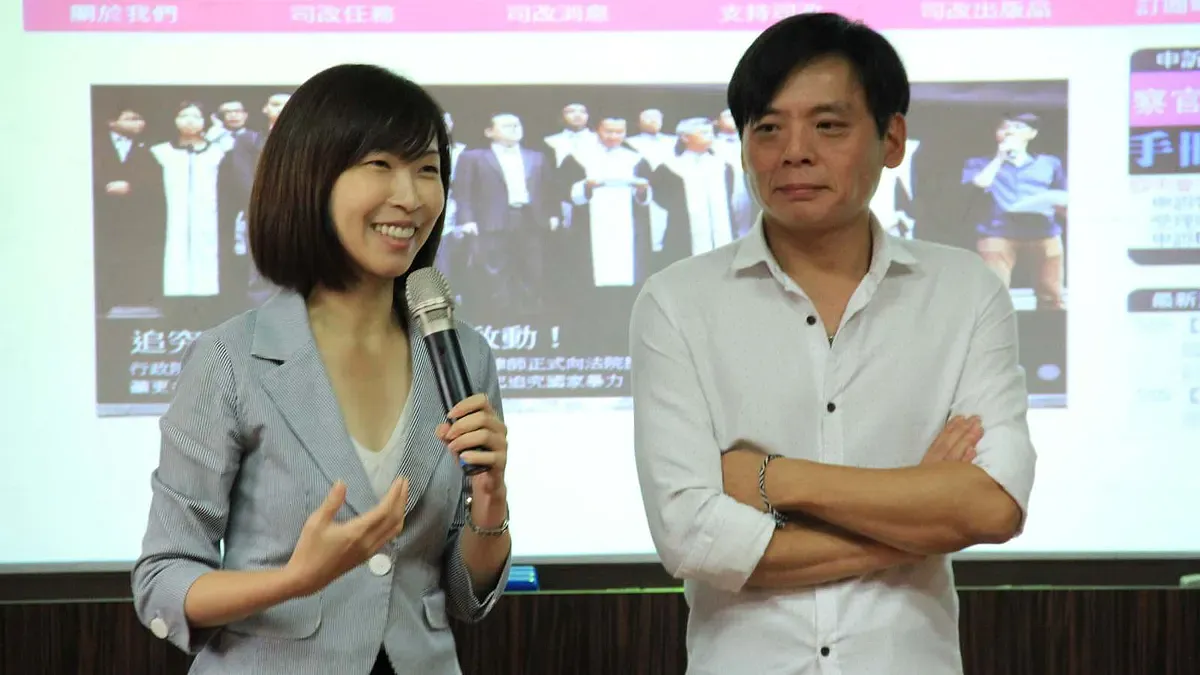
To help students truly empathize with wrongful convictions, hearing directly from the person involved is the most powerful approach. Hsu Tzu-Chiang, who was temporarily released in 2012 following the enactment of the Criminal Speedy Trial Act, began giving a series of speeches to fight for his innocence. His real-life experience of wrongful imprisonment is deeply touching.
The Hsu Tzu-Chiang case is not just about Hsu Tzu-Chiang; it confronts the presumption of innocence principle that "everyone knows, but no one seems able to put into practice."
During his speech, Hsu Tzu-Chiang said:
"Over these past 20 years—perhaps starting from the retrial's ninth remand—I have never felt the presumption of innocence. After I surrendered to the authorities, I was locked up. When I was first brought in for a hearing, there were only the clerk and the judge in the courtroom; my lawyer was not notified. The moment the judge spoke, he told me, Hsu Tzu-Chiang, you committed this crime. Just confess quickly and don't waste time. Because my lawyer had repeatedly warned me to be careful not to attend a hearing alone, I told the judge I wanted to wait for my lawyer. Upon hearing this, the judge became angry and slammed the case files..."
"Do you know how important the presumption of innocence is? The judge always asked me what evidence I had to prove I didn't do it? I was in agony. How do you prove something you didn't do? I presented an alibi, but he didn't believe it. In this case, it was just me fighting the judge alone; how could I possibly win?"
The Hsu Tzu-Chiang case is a vivid testimony to Taiwan's judiciary transitioning from authoritarian and conservative to gradually progressive.
"Have any of you ever gone to observe a courtroom? I suggest everyone go into a courtroom and observe. Things are much better now; in the past, there were no prosecutors at hearings. When attending hearings, I wore handcuffs and leg irons. There were no chairs in the courtroom, and the judge wouldn't let me speak much, permitting me only to answer 'Yes' or 'No'... I just wanted them to treat me like a human being"...
"The judge who got my case just felt unlucky and didn't want to investigate; they just wanted to push the procedure through quickly. Anyway, after a reversal and remand, the case wouldn't be assigned to them again. After one trial-level judge sentenced me to death, I went back to him to get my detention warrant. As soon as he saw me, he asked, 'Did you appeal yet? There is still a lot of room for your case, you need to appeal quickly...' When I heard that, I really wanted to curse him out. If there is still a lot of room in my case, why did you sentence me to death? He wasn't willing to investigate thoroughly, yet he didn't want me to die on his watch"...
"The judiciary has truly progressed. The ninth remand trial featured a high-tech courtroom, projecting the transcripts onto a large screen for lawyers to use during arguments, and for observers to see as well. Contradictions were crystal clear, which was a huge help to the case."
The Hsu Tzu-Chiang case so directly challenges the fairness and justice that you and I assumed existed.
I remember after the ninth remand court found him not guilty, during a sharing session, students asked: "Mr. Hsu, after being found not guilty this time and looking back at the past 20 years of your life, do you feel you have truly received fairness and justice?" Ah-chiang thought for a long time and said: "I don't know how to answer that question yet, because the prosecutor has already appealed, and the not-guilty verdict is not yet final... To be honest, I don't know what fairness and justice are, but I still believe in people, and I believe judges will change. If it were today, and the judges were willing to carefully review my case, I believe they wouldn't find me guilty."
The victim Hsu Tzu-chiang's optimistic and positive attitude is the most precious lesson for every student.
"I stopped hating a long time ago. Being wrongfully accused is truly painful... very painful, especially when betrayed by your own friends. But I am truly lucky; my family never gave up on me. I have the best family, and so many people are willing to help me."
"For a full four years, I never thought about the word 'tomorrow,' nor did I think about 'what ifs.' I just lived today well, that is the most important thing." "If life gives you a reason to smile, why should I cry?"
The significance of the Hsu Tzu-chiang case extends beyond being a capital wrongful conviction; for 20 years, it has intertwined with Taiwan's judicial system. Through this case, we lead students to examine whether the judiciary is moving away from or closer to the presumption of innocence, to understand the flaws in the judicial system, the root causes of wrongful convictions, and what changes we can make to truly put an end to wrongful convictions. Let us not forget that Chiou Ho-shun, Cheng Hsing-Tse, and Hsieh Chih-Hung are also awaiting rescue. These sharing sessions always receive an enthusiastic response, and the heartfelt messages written by students to Hsu Tzu-Chiang have helped heal a spirit worn down by wrongful accusations.

Activity 2: Mock Jury Trial
Closely tied to the principle of the presumption of innocence, we wondered why Judge Pao (Bao Qingtian)—a fictional figure defying modern democratic governance and rule of law—remains so immensely popular? Why do elite professional judges, who have passed the narrow gate of national examinations, render judgments ridiculed as "dinosaur rulings"? Why do wrongful convictions occur in judicial trials? If the current system is flawed, what other possibilities do we have?
We didn't want to just stand at the podium and lecture students one-way about how important judicial neutrality and objectivity are, or how many problems the judiciary has. Building on our experience organizing professional-version mock jury trials, we decided to bring the jury courtroom into the classroom. Volunteer attorneys wrote a script, and students were assigned roles as judges, jurors, prosecutors, defense attorneys, defendants, and witnesses. In the courtroom, witnesses underwent rigorous cross-examination by the prosecution and defense, judges presided over courtroom proceedings, and finally, the jury deliberated. Through the process of jurors discussing and persuading each other based on their respective arguments, it challenged students' ability to adhere to the presumption of innocence. Beyond mutual critical thinking, this also opened a pathway to reflecting on Taiwan's judicial issues.
I was very deeply impressed when, before the start of one activity, a student playing the prosecutor said: "I want to be a prosecutor in the future because prosecutors represent justice." But after the activity ended, when asked for their thoughts, the student said, "I think the job of a prosecutor is truly difficult. You have to convince the jury that the defendant is guilty, but sometimes the evidence is just unclear. I still want to be a prosecutor, but I know it's not easy." The activity allowed students to experience the importance and difficulty of the prosecutor's burden of proof.
In an era where the media generally pursues speed rather than quality, when a police "suspect" is branded as "guilty" by the media, it is easy for us to "jump to conclusions" about social cases based merely on fragmented reports. However, one student serving as a juror said: "I think this activity is 'not fun' because 'making a decision' is simply too difficult!"
"Today we have many jurors to discuss together. If the judge making the decision in the courtroom were only one person or three people, I would worry they might act arbitrarily."
Another student acting as a juror fell into a deadlock during deliberation over whether the defendant committed the crime, holding their head in frustration: "Oh god, by the end of the discussion everyone's opinions directly contradicted each other, and I'm contradicting myself too!" Students realized that when a defendant's freedom and life are in their hands, the responsibility is immense and the decision is arduous!
Students always want to know what the judge's decision would be in reality, but trials have no standard answer. Guilt or innocence is determined solely by the jury. During the plenary discussion, we ask jurors to share their reasoning with each other. "Witness A's testimony contradicts Witness B's. Judging from the photographs showing their positions, Witness A is probably more credible." Compared to us standing at the podium talking about evidence-based adjudication or the presumption of innocence, this is a far better way to learn.

Achievements and Outlook
Constrained by manpower over the past year, the 2015 campus tour only visited 9 counties and cities. However, through the team's hard work, we were able to interact face-to-face with nearly 3,700 students. A teacher teaching at an elite school noted that most of our students will likely hold power in the future, yet they have few opportunities to encounter marginalized social issues; sharing sessions like this allow students to understand more diverse facets of society.
Another teacher teaching in the south shared that they hope students have equal opportunities to enjoy learning activities similar to those available to students in metropolitan areas. Unequal distribution of educational resources is precisely what we aim to break down. Thank you to all cooperating teachers and friends. Standing at different posts, we are all working hard together for Taiwan's future hope; this encouragement drives us to keep going.
Christmas Eve is a day for sharing love and blessings with one another. Regardless of our religious beliefs, we encourage ourselves to remain full of conviction so we can go further in the coming year, allowing even more students to experience "fairness and justice" through our activities, and continuing to strive for the island we love!
This article is an AI-generated translation of the original Chinese text. In the event of any discrepancy, the Chinese version shall prevail.