
Statute of Limitations Too Short, Prosecutors Evaluation Commission Refuses to Help: Press Conference on the 4th Anniversary of the Individual Judge and Prosecutor Evaluation System
Last edited: 2026-08-28
The "Individual Evaluation System" under the Judges Act has been in force for four years since its implementation on January 6, 2012. Each term of the Judge Evaluation Commission (JEC) and Prosecutor Evaluation Commission (PEC) lasts for two years, with the third term taking office in January 2016. Data shows that after the composition of the second JEC and PEC in January 2014, the attitudes of the JEC and the PEC toward reported cases differed completely.
First, the rate at which the PEC referred cases to the Control Yuan dropped precipitously. In 2015, the PEC's referral rate fell below 10% (see Table 1).
Table 1: Referral Rates of Evaluation Request Cases to the Control Yuan by Evaluation Commissions Over the Years (2012–2015)
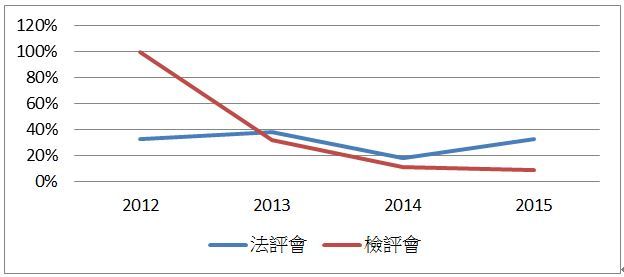
| Evaluation Commission Term | Year | Judge Evaluation Commission | Prosecutor Evaluation Commission | ||
| Number of Referrals to Control Yuan / Cases Reviewed | Referral Rate | Number of Referrals to Control Yuan / Cases Reviewed | Referral Rate | ||
| 1st Term | 2012 | 1 case / 3 cases | 33% | 1 case / 1 case | 100% |
| 2013 | 3 cases / 8 cases | 38% | 6 cases / 19 cases | 32% | |
| 2nd Term | 2014 | 2 cases / 11 cases | 18% | 2 cases / 19 cases | 11% |
| 2015 | 5 cases / 15 cases | 33% | 1 case / 11 cases | 9% | |
Second, nearly half of the complaints against prosecutors were blocked at the door: PEC members dismissed them after merely conducting a formal review, without ever discussing whether the facts concerning the prosecutor's misconduct were serious. The second PEC rendered 30 resolutions (see Table 1), of which only 3 were deemed to warrant disciplinary action and referred to the Control Yuan for investigation. Of the 27 unreferred cases, as many as 12 were dismissed on the grounds of being "submitted overdue," making it the top reason for dismissal (see Table 2).
Table 2: Types of Cases Decided by the Second Evaluation Commission Not to Be Referred to the Control Yuan
| Type | JEC | PEC |
| Not subject to evaluation—Individual evaluation request submitted overdue | 1 case | 12cases |
| Not subject to evaluation—Request is manifestly without merit | 0 cases | 2 cases |
| Not subject to evaluation—Same incident already impeached by the Control Yuan | 0 cases | 1 case |
| Not subject to evaluation—Request for evaluation based on legal interpretation | 0 cases | 1 case |
| Not subject to evaluation—Request for evaluation concerning matters outside individual judge evaluation | 1 case | 0 cases |
| Evaluation request unfounded | 13 cases | 10 cases |
| Evaluation request founded, but no disciplinary action necessary | 4 cases | 1 case |
| Total | 19 cases | 27 cases |
Two Major Reasons Why Prosecutor Evaluations Are Difficult to Establish: Statute of Limitations Is Too Short, and the PEC Restrictively Interprets It
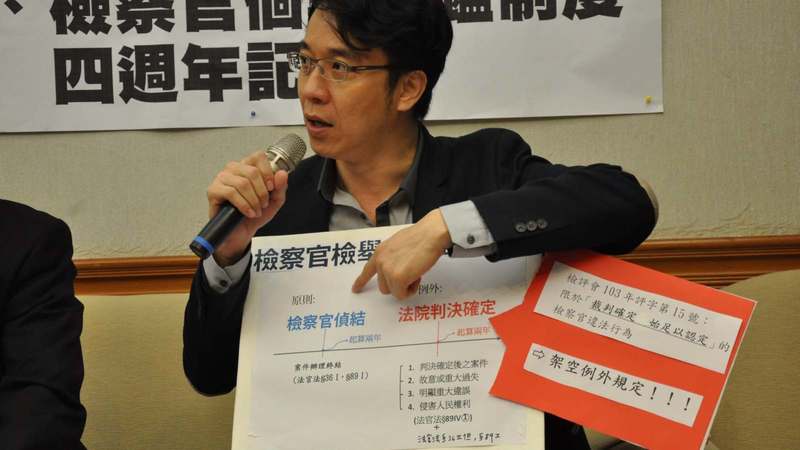
Under the Judges Act, a request to evaluate a prosecutor must be filed "within two years after the conclusion of the prosecutor's investigation." The problem is that once a case is prosecuted, it enters a lengthy trial process. Defendants are exhausted from responding to litigation and typically have no extra bandwidth to report prosecutors. By the time a judgment becomes final and binding, the statute of limitations for reporting the prosecutor has usually long since expired.
Although the Judges Act establishes a special provision[1]—allowing an exception where a prosecutor has acted with "intent or gross negligence, resulting in a manifest and grave error that severely infringes upon people's rights," in which case the two-year limitation period begins to run only after the court judgment becomes final and binding—
the PEC, however, has (1) passively applied a very restrictive interpretation to this special provision, and even (2) actively not hesitated to create even harsher requirements, raising the threshold for applying the special provision, rendering it practically a dead letter.
The cases cited today illustrate that the limitation provisions in the current Judges Act completely fail to take into account the practical dilemmas faced by citizens reporting prosecutors; coupled with the PEC's comprehensive restriction, negation, and even hardening of the special limitation provision, the result is that the individual prosecutor evaluation system has been practically hollowed out by limitation rules.
Reason 1: The Evaluation Limitation Period Is Too Short
[Case 1]
Prosecutor: "If you don't talk today, you're getting locked up."
Prosecutor: "How many kids do you have? How old is the youngest? Eight and ten years old can take care of themselves, let's just detain him. Kids at that age can take care of themselves."
[Case 2]
Prosecutor: "What do you mean 'no other meaning'? You are not being honest when you speak; it doesn't matter, it doesn't matter, there's nothing much to say either. Do you have anything to add?"
Defendant: None.
Prosecutor: "Motion for detention. The previously ordered NTD 50,000 bail is revoked; changed to a motion for detention."
[Case 3]
Defendant: "Prosecutor, don't detain me. I still need to see a doctor."
Prosecutor: "I don't know, I already gave you plenty of chances just now."
Defendant: "Fine, yes, I had the intent to sell. Just don't detain me."
The contents of the three cases above are all excerpted from transcripts produced after courts examined the audio recordings of prosecutors' interrogations. In rare moves, the courts ruled that the prosecutors had obtained confessions through improper methods such as coercion and inducement, thereby excluding the admissibility of the testimonial evidence.
These three cases are among seven relatively clear and serious cases identified when our foundation executed the "Study Project on Improper Prosecutor Interrogations" in 2015, systematically collecting cases from the past two years where courts determined that investigating prosecutors had obtained confessions improperly and thus excluded the evidence (for case details, please refer to the appendix).
Regrettably, even in these cases where the courts had examined the interrogation recordings and "certified" through their judgments that the investigating prosecutor's method of obtaining confessions violated the Code of Criminal Procedure, by the time our foundation retrieved them from a sea of judgments, the two-year evaluation statute of limitations from the time of the prosecutor's indictment had long since passed.
Moreover, in cases involving over a decade of litigation, such as [Case 1], when the court judgment determined that the investigating prosecutor constituted improper confession-obtaining (2014), it had been more than 10 years since the prosecutor's indictment (2002), exceeding the disciplinary limitation period[2] as well, making it impossible to appeal to the Control Yuan under the Public Functionary Disciplinary Act.
Reason 2: Strict and Restrictive Interpretation by the PEC
"Since the investigating prosecutor in this case ordered the release of defendant Shih XX on January 31, 2011, by revoking his detention, as demonstrated by the aforementioned explanations, the law naturally could not restrict defendant Shih XX's right to work. However, based on the statements of the aforementioned defendant Shih XX and attorney Chang XX and related documentary evidence, this court reasonably believes that the investigating prosecutor likely orally instructed defendant Shih XX at the same time not to return to work at XX Company."
The above content is excerpted from Taipei District Court Judgment 100-Chin-Chung-Su-8. The judgment shows how the court, during trial, examined interrogation recordings and cross-referenced defense counsel testimony with defendant briefs to reasonably infer that the investigating prosecutor very likely instructed the defendant in the interrogation room not to return to work at the company.
Based on this judgment, our foundation filed a request for individual evaluation against the prosecutor, arguing that even though the filing was made more than two years after the prosecutor's indictment, the prosecutor's abuse of compulsory powers to prohibit the defendant from returning to work severely affected the defendant's right to work, and therefore the two-year limitation period should exceptionally be calculated "from the time the court judgment became final and binding."
However, the PEC ultimately calculated the two-year limitation period from the "time of the prosecutor's indictment." The reasoning given was extremely bizarre: Whether the prosecutor ordered the defendant not to return to work could be determined before the court judgment became final and binding, and therefore the special provision could not apply[3].
Yet, looking at the wording of the special provision itself, there is absolutely no statement that when a prosecutor uses indictment as the method of concluding an investigation, the act of reporting the investigating prosecutor's illegality must be limited to matters that "can only be ascertained after the court judgment becomes final and binding!" Article 89, Paragraph 4, Subparagraph 1 of the Judges Act cares only about whether the prosecutor's conduct is serious and infringes upon people's rights, not when it can be ascertained.
Thus, through its resolutions, the PEC created new requirements and set higher thresholds for the application of the special provision, thereby covering up outrageous conducts that prosecutors might have committed, leaving them uninvestigated and unaccountable.
Observation Report and Demands on the 4th Anniversary of the Individual Judge and Prosecutor Evaluation System
The JRF established a complaint center to accept public complaints regarding unfit judges and prosecutors, aiming to articulate judicial and prosecutorial misconduct with greater precision and nuance, thereby eliminating unfit judges and prosecutors.
Marking the fourth anniversary of the individual evaluation system, the foundation has compiled an observation report summarizing our participation experience thus far, analyzed the factors hindering the system from functioning effectively, and put forward the following demands:
- We call upon the Judicial Yuan and the Ministry of Justice to promptly review current deficiencies and swiftly submit a draft amendment to the Judges Act, establishing independent and separate regulations for calculating the time limit for individual prosecutor evaluation requests to resolve the current flaw of incomplete regulations. Specifically, regarding the limitation period for prosecutor evaluations, according to Article 89, Paragraph 1 of the Judges Act, provisions concerning judge evaluations are mutatis mutandis applicable by interpretation[4]. We suggest amending the article to add: "A request for the individual evaluation of a prosecutor shall be made within two years from the date the evaluated conduct ends. However, if it involves individual cases handled by a prosecutor, it may be extended to within three years from the date of the final judicial ruling or within ten years from the date the case handling is concluded."
- We strongly condemn the Ministry of Justice for directly repurposing personnel specialists from the Personnel Department to concurrently handle all business of the PEC, and demand that the Ministry of Justice assign dedicated staff to support the administrative work of the PEC, at least matching the standards of the Judicial Yuan.
- We call upon the Judge and Prosecutor Evaluation Commissions to squarely face the practical dilemmas of evaluation requests and actively operate the individual evaluation system to enhance oversight and win public trust in the judiciary.
Appendix
- List of Cases in the Past Two Years Where Courts Determined Prosecutors Obtained Confessions Improperly
- Observation Report on the 4th Anniversary of the Individual Evaluation System under the Judges Act
Attendees
LIN Yung-sung, Attorney at Law, Chairperson, Judicial Reform Foundation
KAO Jung-Chih, Attorney at Law, Executive Director, Judicial Reform Foundation
Press Contact
Attorney KAO Jung-chih
Footnotes
[1] Article 89, Paragraph 4, Subparagraph 1 of the Judges Act: "A prosecutor shall be subject to individual evaluation if they fall under any of the following circumstances: 1. In cases where a judgment has become final and binding, or cases where six years have elapsed from the date of first-instance docketing without a final judgment being rendered, or cases where a disposition of non-prosecution or suspension of prosecution has become final and binding, there are facts sufficient to recognize that, due to intent or gross negligence, there is a manifest and grave error that severely infringes upon people's rights."
[2] Article 25, Subparagraph 3 of the Public Functionary Disciplinary Act (prior to amendment): "A disciplinary case shall be rendered a decision of dismissal without penalty under any of the following circumstances: ... 3. Where ten years have elapsed from the date the illegal or derelict conduct ended to the date the case was referred to the Public Functionary Disciplinary Commission."
[3] PEC Resolution 103-Pee-Tzu-15: "As stated above, the two circumstances referred to by the requester regarding the evaluated person both occurred when the evaluated person applied for the revocation of detention; and regarding the evaluated person's oral instruction to Shih XX not to communicate with defense counsel, the requester also stated that defense counsel Chang XX for Shih XX, who was present at the time of the revocation of detention, can testify to this. Accordingly, if the evaluated person indeed committed the two circumstances alleged by the requester, it would not be a matter that could only be ascertained after the judicial ruling became final and binding. Therefore, the circumstances alleged by the requester, regardless of whether they are true, do not comply with the aforementioned provisions of Article 89, Paragraph 4, Subparagraph 1 of the Judges Act."
[4] Article 89, Paragraph 1 of the Judges Act: "Provisions concerning judges in Article 1, Paragraphs 2 and 3, Article 6, Article 12, Article 13, Paragraph 2, Article 15, Article 16, Subparagraphs 1, 2, 4, and 5, Article 17, Article 18, Article 42, Paragraphs 1, 2, and 4, Article 43, Paragraphs 1 to 3, Articles 44 to 46, Article 49, Article 50, Article 71, Articles 73 to 75, Article 76, Paragraphs 1, 4, and 5, Article 77, Article 78, Paragraphs 1 to 3, Article 79, Article 80, Paragraph 1, Chapter 5, and Chapter 9 shall apply mutatis mutandis to prosecutors; provisions concerning the Judicial Yuan, the Judicial Yuan Judges and Officials Training Institute, and adjudicatory organs shall apply mutatis mutandis to the Ministry of Justice, the Ministry of Justice Prosecutors Training Institute, and procuratorial organs."
This article is an AI-generated translation of the original Chinese text. In the event of any discrepancy, the Chinese version shall prevail.