
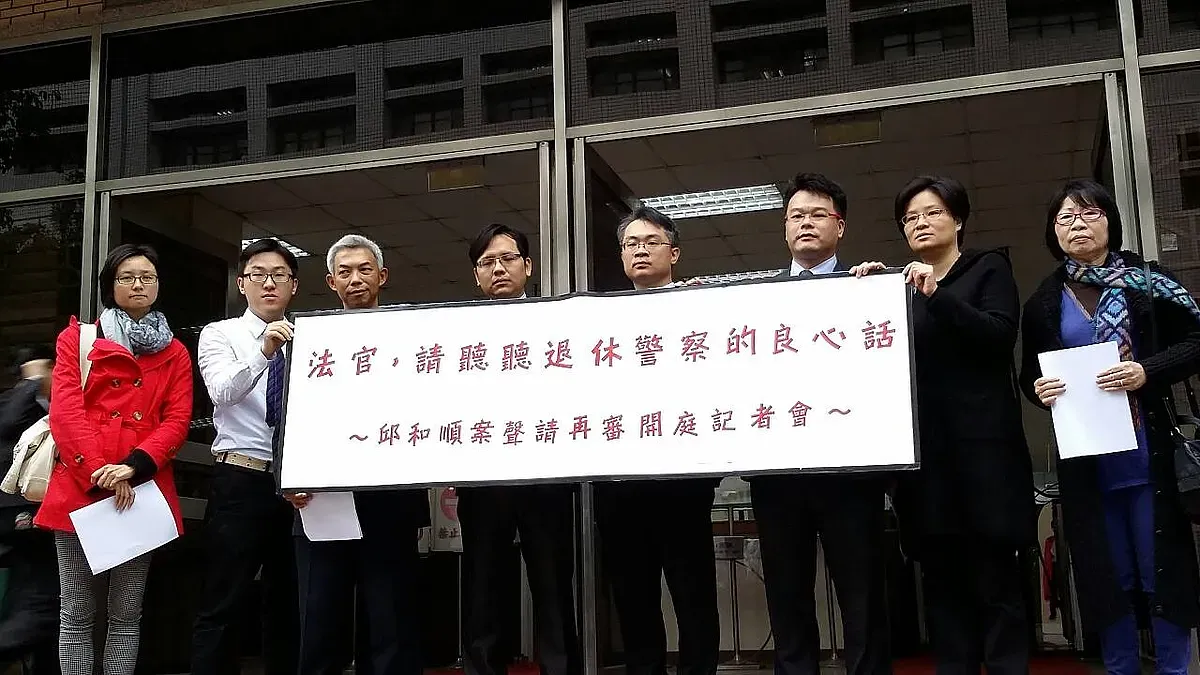
Judges, Please Listen to the Conscience of Retired Police Officers ~ Press Conference on the Motion to Reopen the Chiu Ho-Shun Case and Request for a Hearing
Last edited: 2026-08-29
"Having been a police officer for a lifetime, I harbored a deep regret in my heart that I can finally speak of now that I am retired, though I just don't know if there is still any hope." The greatest wish of a retired police officer surnamed Wu was to go to court and tell the truth about the Chiu Ho-Shun case (Note 1). When he was young, he saw police colleagues beat Chiu Ho-Shun and other defendants, threatening them with torture if they did not confess, before taking them to isolation rooms where he heard cries of lament and supplication, and their agreement to cooperate in making a record of questioning. He also participated in the verification work, discovering that the contents of the police records did not match the facts of the case, and that Chiu Ho-Shun and the others were not the perpetrators at all—the real culprits were someone else. For years, bound by his identity as a police officer, he could only keep the secret buried in his heart, until his retirement when he saw Chiu Ho-Shun's death sentence finalized, which caused him a crisis of conscience and inspired him to summon the courage to speak the truth.
To fulfill his wish, the pro bono defense team for the Chiu Ho-Shun case filed a motion for a retrial based on the testimonies of retired police officer Wu and another retired police officer surnamed Chen. However, the Taiwan High Court did not hold a hearing, nor did it summon the retired police officers to testify in court, hastily dismissing the motion for a retrial in just two weeks. Although the main text of Ruling Tai-Kang No. 855 issued by the Supreme Court on December 9, 2015, stated that "The original ruling is revoked. The motion regarding the aforementioned revoked part is dismissed," the reasoning section explained that the finalized substantive judgment in the Chiu Ho-Shun case was Judgment Tai-Shang No. 4177, in which the Supreme Court had previously dismissed Chiu Ho-Shun's appeal against the eleventh remand judgment. When the pro bono defense team filed for a retrial and suspension of sentence on behalf of Chiu Ho-Shun, Wu Shu-Chen, and Lin Kun-Ming, they had already concurrently filed a motion for a retrial and suspension of execution of punishment targeting the aforementioned Supreme Court Judgment Tai-Shang No. 4177. Surprisingly, the Taiwan High Court previously omitted and failed to review or rule upon this part of the motion when dismissing the current retrial request. Therefore, that court should render a separate ruling. Furthermore, on the 16th, pursuant to Supreme Court Official Letter No. 1040000004 (refactoring Criminal Division II 2015 Tai-Kang No. 855), which stated: "Regarding the motion for a retrial and suspension of execution of punishment filed by Chiou Ho-shun and others against this Court's finalized substantive Judgment 2011 Tai-Shang No. 4177, which was omitted from review and ruling, please handle according to law," the Supreme Court ordered the Taiwan High Court to review the current retrial motion in the Chiou Ho-shun case using the aforementioned Supreme Court Judgment 2011 Tai-Shang No. 4177 as the retrial target. This has reignited the hope that the retired police officers will be able to take the stand.
In the judicial history of Taiwan, wrongful, fabricated, and unjust cases manufactured by military, police, and intelligence units are too numerous to record. The Statute for Compensation on Improper Rebellion and Espionage Trials during the Martial Law Period alone redressed 8,000 wrongful cases and disbursed NT$20 billion in compensation. In contrast to its active efforts to soothe the trauma of victims, the state has been at a loss and has taken zero action to date in assisting perpetrators to confront historical issues. Taking retired police officer Wu as an example, he hoped to be a good officer, and within the scope of what he could decide, he strove to be a good officer. However, he was powerless to contend with the system, and became a member of the accomplice structure of wrongful imprisonment in the Chiu Ho-Shun case, a source of lifelong regret. Being helpless within an accomplice structure is not only the regret of retired police officer Wu, but also the regret harbored in the hearts of countless retired personnel from military, police, and intelligence units.
Only by speaking the truth can one confront the past and forge the future. The state has an obligation to assist everyone in moving past the harm inflicted by authoritarian rule, including the perpetrators of that era. Retired police officer Wu is willing to speak the truth about the Chiu Ho-Shun case, and the judiciary should open its doors and listen. Today, the pro bono defense team for the Chiu Ho-Shun case is submitting a statement of grounds for requesting a hearing on the motion for a retrial, calling upon the judges to hold a hearing and listen to the words of conscience that the two retired police officers wish to express. Through this hearing, the judiciary can demonstrate its prudent attitude toward cases where the death penalty has been finalized, and display its efforts to bring the truth to light in the pursuit of transitional justice.
The root of the Taiwanese people's distrust in the judiciary lies in the collusion between the judiciary and military, police, and intelligence units during the period of authoritarian rule, as well as the judiciary's indifference to and evasion of transitional justice after the lifting of martial law. The Chiu Ho-Shun case, which occurred in the year martial law was lifted, will serve as a litmus test for whether the judiciary will no longer evade transitional justice. We sincerely hope that the judiciary can begin with the Chiu Ho-Shun case, starting from listening to the conscience of retired police officers, to mark the difference between the judiciary of the present and the past, carry out judicial transitional justice, and establish a trustworthy judicial image in the hearts of the people.
※Note:Next Magazine, Issue 746, "Confession: I Owe You a Phone Call", September 10, 2015
Attachments
Supreme Court Official Letter No. 1040000004 (refactoring Criminal Division II 104-Tai-Kang-855)
Attendees
Pro Bono Defense Team for the Chiou Ho-shun Case
Attorney Yu Po-Hsiang
Attorney Lin Hung-Wen
Attorney Lin Chun-Hung
Attorney Cheng Kai-Hung
Attorney Chou Han-Wei
Attorney Sung I-Hsin
Attorney Hsu Li-Kung
Representatives of Rescue Organizations
Taiwan Association for Human Rights Secretary-General Chiu I-Ling
Tsai Jui-Yueh Cultural Foundation Chairperson Hsiao Wo-Ting
Taiwan Association for Human Rights / Judicial Reform Foundation CEO Kao Jung-Chih
Press Contacts
Pro Bono Defense Team for the Chiu Ho-Shun Case Attorney Yu Po-hsiang 02-23681966
Judicial Reform Foundation Specialist Hsiao I-Min 02-24521958
This article is an AI-generated translation of the original Chinese text. In the event of any discrepancy, the Chinese version shall prevail.