
JRF Newsletter
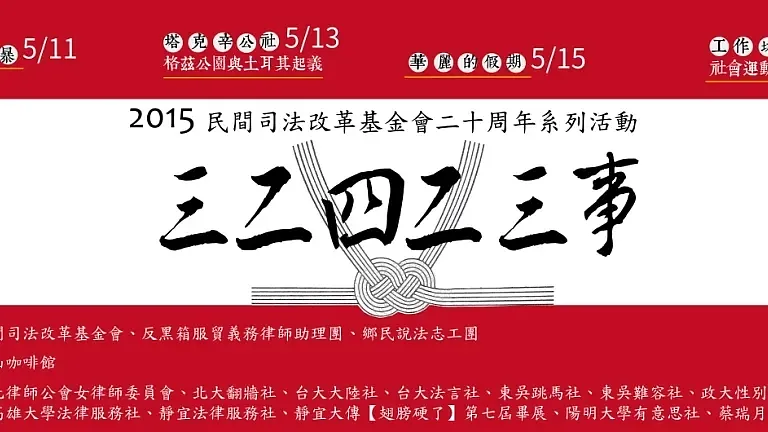
JRF 20th Anniversary Series Event: "March 24, 23 Things" Film Festival and Workshop
Last edited: 2026-07-27
The Judicial Reform Foundation enters its 20th year this year. On the path of judicial reform, our actions may be fast or slow, but every step is solid.
Faced with state suppression of people's freedom of speech and assembly, from the 2008 protests against Ch'en Yun-lin's visit to Taiwan to the 2013 Huanguang demolition protests, the JRF organized pro bono lawyer teams to vigorously fight back in litigation. Last year (2014) was a year of surging civil movements in Taiwan, and this massive momentum has not waned this year. Judicial issues are bound to be front and center in this wave calling for reform.
However, thriving civil movements always bear undue repression. After the "March 18 Anti-Black Box CSSTA Movement," the JRF connected pro bono lawyers to jointly assist hundreds of citizens prosecuted by the judicial system and condemn the state's violent response to public demands.
A year has passed. On the surface, this movement may be buried deep in our hearts, appearing distant and calm. But the images of water cannons spraying and police batons swinging during those two nights—March 24 at the Executive Yuan and April 28 during the anti-nuclear occupation of Chung-Hsiao West Road—have long been branded in everyone's hearts. The tentacles of state suppression have even reached into the judiciary, becoming an inescapable nightmare for both the prosecuted and the accusers.
To let more people experience the various facets of state suppression and social movements from different perspectives, we will hold a film screening and workshop event from May 11 to 16. At the same time, we want to remind the state that we will not forget those violent treatments, and we vow to fight undue judicial prosecution to the end!
Film Screenings & Post-Screening Discussions
Location: You-Chu Hall, Taipei Artist Village (1F, No. 7, Peiping E. Rd., Taipei City, Shandao Temple Station Exit 1, behind the National Police Agency)
| Time | Film Screening | Panelists |
| 5/11 (Mon) 18:30-22:00 |
Después de mayo (Runtime: 122 mins) |
Attorneys Li Yen-jung (Attorney, Anti-Black Box CSSTA Pro Bono Lawyer Team) Dr. Shen Ching-kai (Ph.D. in Philosophy, KU Leuven) Ms. Lin Jui-tzu (Respondent in the March 23 Executive Yuan Incident) |
| 5/13 (Wed) 18:30-22:00 |
Taksim Commune (Runtime: 32 mins) |
Attorney Yu Po-hsiang (Convener, Anti-Black Box CSSTA Pro Bono Lawyer Team) Prof. Lin Chia-ho (Department of Law, National Chengchi University) Mr. Freddy Lim (Lead Singer, Chthonic) |
| 5/15 (Fri) 18:30-22:00 |
May 18 (Runtime: 126 mins) |
Attorney Ku Li-hsiung (Convener, Anti-Black Box CSSTA Pro Bono Lawyer Team) Dr. Tung Szu-chi (Taiwan Northeast Asia Studies Association) Director Yen Szu-yu (Taiwan Association for Human Rights) |

5/11 (Mon) 《Después de mayo》
Image Source: Wikipedia
Introduction
In March 1968, students at the Nanterre Faculty of Arts and Humanities of the University of Paris occupied the school, and the protests quickly spread across the University of Paris. In May, police entered the campus, and the incident rapidly escalated into large-scale street protests, leading to a nationwide paralysis. Participants in the protests openly called for General Charles de Gaulle, who had been president for 11 years, to step down.
Set in 1970, after the May events and following De Gaulle's resignation, high school student Gilles and his classmates in the suburbs of Paris remain enthusiastic about anti-establishment activities, supported by the social atmosphere of the time. However, when participating in social movements becomes a trend, Gilles, who joined the movement following his classmates, gradually begins to feel lost amidst several clashes, doubting the meaning of being a "rebellious youth."
The film does not present any value judgments, merely depicting Gilles and his friends participating in the movement and their lives afterward. The entire film avoids preachiness, starkly polarized value judgments, or political demands; it contains only the confusion and hesitation of Gilles and his friends, along with their life connections to the currents of the era.
Film Review
Although *Después de mayo* chooses the familiar subject of the French May '68 student movement, it adopts an angle different from the past, bringing out the true side of student movements beyond fierce conflicts. After the police crackdown at the opening, the camera dives beneath the surface like water, focusing on the protagonist's lived experiences to portray the complex relationships within the student body. Through careful attention to the daily lives of students, the film turns the protest into a "process" rather than a short-lived clash. Only in this way can the "humanity" of students resisting state violence be made whole.
In addition, the protagonist's difficult choice between pursuing his dream as an artist or persisting in protest demonstrates the deeply personal psychological dilemma of a participant. Because the director closely follows the protagonist's trivial daily matters, the audience is able to realize how suffocating his psychological pressure and living environment are. This inevitably brings to mind the family disputes and psychological trauma continuously reported during the Sunflower Student Movement. When these personal factors are absent from the overall impression of a student movement, the protest events we perceive are reduced to media-crafted stereotypes, failing to approach reality. *Después de mayo* shows us a completely different facet of student movements, and its carefully arranged script highlights the diversity and importance of the participants. After all, the subject of a protest is people, not sensationalized conflict footage.


5/13 (Wed) 《Taksim Commune: Gezi Park and the Uprising in Turkey》
Image Source: 2013 Iron Horse Film Festival
Introduction
On May 28, 2013, about 50 environmentalists marched in the Turkish city of Istanbul to protest the government's expropriation of Taksim Gezi Park near the city center for redevelopment into a shopping mall. Turkish police suppressed the crowd with tear gas and even burned the tents set up by protesters. The news spread quickly, and the police's violent handling became the catalyst for the public's long-standing grievances against the government. Protests quickly evolved from preserving the park to demanding that the government lift the ban on public assembly and that the Prime Minister resign. Within just three days, Gezi Park gathered thousands of people, and tens of thousands took to the streets in major cities across the country.
A significant reason this occupation evolved into a nationwide movement was the Turkish people's dissatisfaction with the government's autocratic rule and economic development model. Turkey has been criticized by the Committee to Protect Journalists as "the world's biggest prison for journalists." In 2012, the number of imprisoned journalists in Turkey exceeded that of authoritarian countries like Iran and China. Regarding internet censorship, approximately 8,000 websites have been blocked, mostly news sites reporting on Turkey, with YouTube among them. According to statistics, from 2001 to 2009, a total of 35,117 people worldwide were imprisoned under the name of "terrorists," with Turkey accounting for one-third of them.
In 2011, Turkey had become the 18th largest economic entity in the world. However, the driving force behind this economy came from the privatization of state property and space. The privatization of state-owned enterprises triggered a wave of layoffs; historical monuments were auctioned off to developers for redevelopment; and urban public spaces continued to shrink, replaced by high-rise buildings.
The occupation of Gezi Park was not just a demonstration, but a backlash by the people against the continuous disappearance of public space by liberating their own way of life.
Film Review
Starting with Occupy Wall Street in 2011, the occupation movement has become a new protest model spreading across the globe. The 2013 Turkish documentary *Taksim Commune* reveals protests born precisely within this context. Prompted by public dissatisfaction with government policies, people chose to occupy local parks and squares as a new political arena, attempting to organize experimental communities featuring direct democracy and self-sufficiency. This film records the entire course of the occupation of Gezi Park and Taksim Square, providing a detailed introduction to the social background, participant demographics, and the government's ruthless response. Notably, much of the footage used in the film comes from live internet streaming at the time, which not only records the unique atmosphere of the crowd's protest but also captures many absurd acts by police during the crackdown. Furthermore, the interviewees in the film are all ordinary citizens, recounting their experiences of the protest process from different angles, discarding the old mindset of shaping "leaders" and using new techniques to adapt to new forms of protest.
*Taksim Commune* is like a quick and accurate briefing, clearly outlining the contours of the occupation movement in just thirty minutes. Amidst this ongoing wave of occupations, this film has left a profound footnote for future, larger political events.

5/15 (Fri) 《May 18》
Introduction
In May 1980, General Chun Doo-hwan, who had just seized power through a coup, announced an expansion of nationwide martial law. Seeing that a new dictator was about to rise in the Republic of Korea after Park Chung-hee's 18 years of authoritarian rule, large-scale city-wide demonstrations broke out in Gwangju.
Taxi driver Kang Min-woo and his younger brother Kang Jin-woo were living ordinary lives in Gwangju at the time. One day, while going to the movies with his girlfriend, nurse Park Shin-ae, he happened to encounter the military government's large-scale crackdown on Gwangju citizens. Facing the incoming state violence, should Min-woo, Jin-woo, and Shin-ae also plunge into the anti-government movement? And can Shin-ae's father, Colonel Park Heung-soo, avert the impending tragedy by attempting to negotiate with the government?
The 1980 "Gwangju Democratization Movement" is one of the pivotal events in Korea's democratization. Although President Chun Doo-hwan, who came to power afterward, tried to bury this history, the participants and bereaved families at the time strived to demand that the government uncover the truth, punish those responsible, and ultimately contributed to the collapse of the military regime in 1987, driving forward the process of Korea's democratization.
Film Review
*May 18* draws its subject matter from the Gwangju Uprising in Korea, with its storyline revolving around romance, family affection, and the pursuit of democracy and justice among the protagonists. In depicting movement participants, the film helps us deeply understand the importance of roles such as citizens, students, and priests, as well as the impact of the US military's stance on the South Korean government. It exposes the complex relationships behind a protest, filling in the general public's superficial impressions of historical events. The scenes of military massacre are deliberately filmed in long shots, treating the audience as distant onlookers watching a play, helplessly gazing as tanks filling the frame violently attack trapped citizens. This dramatized representation acts like a heavy blow, injecting startling historical fragments into modern living experiences through the simulation of film imagery. The only scene in the film without gunfire occurs when the colonel encounters a familiar young soldier; because of their deep mutual understanding, mutual comprehension embodies the value of "humanity." When the two sides are no longer on sharply divided ends of friend and foe, the false label of "rebel" dissipates accordingly.
As a film aiming to recreate historical events, *May 18* came rather late, but South Korea's domestic box office results affirmed the arduous road to redress. The most precious thing in the film may not be the self-sacrificing spirit draped in heroism, but rather the courage to turn the lens toward that dark history.

Newsletter Film Review / Wei Yu-hao, JRF Volunteer

"Before and After Social Movements" Workshop
Image Source: Satoyama Coffee
This workshop adopts the World Cafe format, communicating and discussing sincerely with one another through flexible small groups. During the discussion process, through procedural design, every participant has the opportunity to speak, while the facilitators also strive to foster a discussion atmosphere.
The workshop emphasizes that "dialogue is the core of the workshop, and what everyone says is important." In addition, by rotating groups, participants are enabled to engage in dialogue with different people as much as possible, spark different ideas, and thereby generate various possible action plans.
- Time: 5/16 (Sat) 13:00-18:00
- Location: Satoyama Coffee (No. 17, Lane 66, Yitong St., Zhongshan Dist., Taipei City)
- Capacity: 30 participants
- Discussion Subtopics:
- General impressions of social movements
- Personal feelings about participating in social movements
- Predicaments and failures of social movements?
- What are the elements of a successful social movement?
- How to practice social movements?
This article is an AI-generated translation of the original Chinese text. In the event of any discrepancy, the Chinese version shall prevail.