
JRF Newsletter
A Place in Our Hearts for Tsai Hsueh-liang
Last edited: 2026-08-29
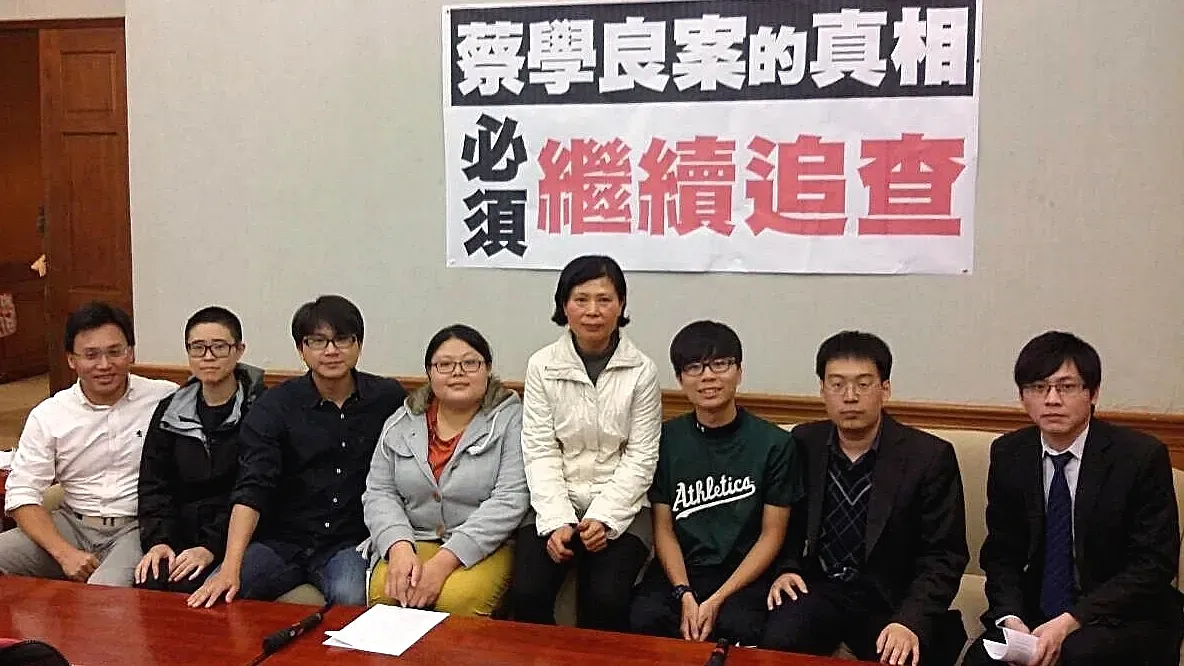
Photo/Group photo at the press conference for the second-instance ruling of the Tsai Hsueh-liang state compensation case on April 15, 2015
Dear Friends:
Air Force Sergeant Tsai Hsueh-Liang died from a gunshot wound at a shooting range, and his family has been seeking the truth behind his death for seven years. On November 25, 2014, the JRF established the Tsai Hsueh-liang Case Legal Team to take over the second-instance state compensation lawsuit. On April 15, 2015, the second instance ruled in favor of the plaintiffs, achieving a dramatic reversal, and the pursuit of the truth finally began to be taken seriously by state organs. This legal team, which achieved a major breakthrough, was composed of four young attorneys: Li I-ting, Shen Yuan-kai, Chen Cheng-chin, and Lo Shih-Hsiang, backed by a group of student volunteers. This young combination demonstrated extraordinary performance.
The two articles in this issue of the newsletter profile the pro bono legal team and student volunteers, respectively. If their stories move you with passion, please join us in supporting and participating in judicial reform!
The Young Legal Team That Reversed the Tsai Hsueh-liang Case
◎Lin Wei-Ting / Executive Secretary of the Judicial Reform Foundation
"The original judgment is set aside. The appellee shall pay the appellant NT$1,480,731..." Three judges of the panel read out the main text of the judgment at the scene, while standing below were a stunned Attorney Shih-hsiang and a stunned Mother Tsai...
This was the scene at 11:00 AM on April 15, 2015, when the judgment for the Tsai Hsueh-Liang state compensation case was delivered. Everyone present was shocked by this unexpected outcome. Shih-Hsiang led a dazed Mother Tsai out of the courtroom, and a crowd gathered around. "Mother Tsai, the Ministry of National Defense has to pay you 1.48 million!" someone gently told Mother Tsai. All of this seemed too surreal to those who had been supporting the Tsai Hsueh-Liang case. Because the pursuit of truth in the Tsai Hsueh-Liang case had long been ignored by state organs, and the first instance of the state compensation suit was an absolute defeat, none of us expected the court to rule that the Ministry of National Defense must pay Mother Tsai 1.48 million NTD.
After standing outside the courtroom for a while, everyone gradually recovered and began discussing the next steps. Shih-Hsiang quickly called Cheng-Chin. Cheng-Chin is the most passionate and proactive member of the legal team, and he had said early on that he would come to hear the verdict—why hadn't he shown up yet? After about 10 minutes, Cheng-Chin hurried over. When asked what happened, he sheepishly said, "Because I was worried about the verdict, I suffered from insomnia all night yesterday, and as a result, I overslept this morning!" While Cheng-Chin was so worried about the verdict that he couldn't sleep, Shih-Hsiang experienced "what you think about by day, you dream about by night." He had dreamed about the verdict! "I dreamed the judge ordered 30,000 in compensation!" Everyone at the scene laughed. Behind this laughter was actually the tacit understanding and shared effort of this young legal team...
A Young and Courageous Legal Team
The Tsai Hsueh-Liang case is a matter of high public concern, but due to the sloppy forensic evidence collection by the Ministry of National Defense back then, the truth remained unclear. To pursue the truth behind her son Tsai Hsueh-Liang's death, Mother Tsai filed a state compensation lawsuit. No one was optimistic about this compensation claim; everyone felt that Mother Tsai was bound to lose. However, a group of young lawyers, unburdened by baggage and armed only with courage, could not stomach the perfunctoriness and shirking of responsibility by the Ministry of National Defense. They believed that even if there was only a sliver of hope, they should do their utmost to clarify the truth. They gathered together and formed the JRF Tsai Hsueh-Liang Case Pro Bono Legal Team. They are Cheng-Chin, Shih-Hsiang, I-Ting, and Yuan-Kai. This legal team has no high-profile senior lawyers presiding over it; it is purely a young person's arena. There is no boss giving orders, only equal and enthusiastic discussions.
Entrusted in a Crisis, Going All Out
The JRF Tsai Hsueh-Liang Case Legal Team was officially formed halfway through the state compensation proceedings. At that time, in order to clarify whether Tsai Hsueh-Liang committed suicide by holding a T65K2 rifle, Mother Tsai proposed an expert appraisal plan involving a firepower test of the T65K2 rifle. However, all government agencies concerned refused to conduct the appraisal, and the case fell into a stalemate. To help break the deadlock and propose an effective and feasible test-firing appraisal plan, these four young lawyers decided to take on the case. Not long after taking the case, they received a court summons for a hearing on December 5. Caught off guard, they hurriedly convened their first legal team meeting three days before the hearing, drafting questions for the forensic doctor within three days to submit to the court! Afterward, the court held hearings about once a month. Amidst their busy work schedules, the four young lawyers had to squeeze out what little personal time they had left to review case files, hold meetings, draft legal briefs, and prepare for hearings. On the legal team's email group, one could often see them exchanging emails in the dead of night or over the weekend, reviewing brief contents or hearing strategies.
Disregarding Personal Gain, Complementing One Another
Throughout the litigation process, one could see the distinct personalities of the legal team members: Cheng-Chin took on the role of the engine, deeply valuing the Tsai Hsueh-Liang case, constantly urging everyone to do this and that, and speaking out boldly and fearlessly in the courtroom.

Photo/Cheng-Chin preparing for the legal team meeting at the JRF. Cheng-Chin expressed his feelings on participating in the Tsai Hsueh-Liang case in one sentence: "No regrets for grievances; no regrets for vows."
Although extremely busy, Shih-Hsiang always appeared calm and composed, serving as everyone's anchor and the legal team's mascot. I-Ting is the perfectionist of the legal team, writing briefs with meticulous content and flawless formatting.

Photo/Shih-Hsiang (right) and I-Ting (left) pose for a photo outside the courtroom after a hearing. Shih-Hsiang and I-Ting were in the same kindergarten class, went to the same elementary, junior high, and high schools, attended the same university department and graduate institute, worked at the same first law firm, and are now taking on the T'sai Hsueh-liang case together. Their "karmic bond" can be said to be unfathomable! I-Ting's motto: "Persist to the end"; Shih-Hsiang's: "Hoping for no more wrongful deaths in the military."
As an employed lawyer constrained by his firm's policies, Yuan-Kai was unable to appear in court as retained counsel, but whenever everyone was overwhelmed, he unselfishly shared the burden of drafting briefs, supporting the operation of the legal team.

Photo/Yuan-Kai participating in the JRF's third mock trial, playing the role of a prosecutor. Yuan-Kai's motto: "The state should bear the responsibility of thoroughly caring for soldiers and citizens who protect our home and country."
Some members of this legal team are aggressive, some steady, some outspoken, and some skilled in writing. Most importantly, everyone works for the public interest, putting aside self-interest, cooperating and complementing one another.
Devoting to Public Interest, Bearing the Future
In an era where legal practice is becoming increasingly difficult, it is indeed harder and harder for young lawyers to devote themselves to public interest without worries. Nevertheless, these four young lawyers remain willing to actively promote judicial reform. The passion and sense of mission that drive them forward in their hearts are deeply touching.
A young legal team like this is bound to shoulder the heavy responsibilities of judicial reform in the future!

Photo/Court observation on December 30, 2014
A Place in Our Hearts for T'sai Hsueh-liang
◎Lo Shih-Hsiang / Standing Executive Committee Member of the JRF, Member of the T'sai Hsueh-liang Case Legal Team
Before the verdict, the melody of "Life is Like a Dream" came to mind: "...In every dream I never see your person, my heart yearns for you night after night...". The prematurely lost Tsai Hsueh-Liang, and Mother Tsai, who has spent seven sleepless years.
Once, while chatting with Cheng-Chin about why we got involved in the Tsai Hsueh-Liang state compensation case, he nonchalantly mentioned that he had some rather unpleasant experiences during his military service, but without elaborating on what happened. His slightly uptight lips bore a forced smile. I also recalled when I first entered military recruit training, constantly at risk of being yelled at by squad leaders, squad leaders from other squads, platoon leaders, or whatever kind of leader. I think this must be a military experience shared by many. I vaguely remember someone couldn't bear it and dialed 1985. The accused squad leader and other officers gathered in a small circle to discuss the matter, and two days later everyone in the platoon knew who made that call. It was nearing the time for unit assignment, close to the moment when fried chicken and bubble tea would be served to let everyone unwind a little. How it turned out afterward, I have no idea. During that period, the song I hummed most often was the "Green Island Serenade." I could only pretend to hum it a few more times so that this period would pass quickly.
Talking any more about these bitter days of military service might make this article top the list of the most annoying gathering conversation topics. I suppose I will close with the first sentence Li I-Ting said at the press conference: "Anyone who has served in the military knows that you just want to be discharged safely." But some people could not... I know that although we did not know Tsai Hsueh-Liang, we were all once "Tsai Hsueh-Liang," or encountered a "Tsai Hsueh-Liang" in the military. A certain corner of our hearts is inhabited by Tsai Hsueh-Liang.
Last August, at a JRF rescue team meeting, the Tsai Hsueh-Liang case was formally discussed for the first time. Tsai Hsueh-Liang's materials were organized by the secretariat and several student volunteers, who drew a simple diagram of the shooting range and the positions of the individuals. This allowed people encountering the case for the one time to quickly enter the case files and engage in discussions. One could clearly sense the dedication of several students at the JRF to the case, including Yu-Sheng, who was deeply involved and later played an important role in the team.

Photo/Simple diagram of the shooting range and personnel positions drawn by student volunteers
In November, the JRF decided to officially take up the case, and Yu-Sheng immediately stepped up, serving as the case secretariat alongside the JRF's I-min and Wei-Ting. From then on, the Tsai Hsueh-Liang case went beyond merely organizing data. With civil court hearings imminent and moving forward with the progress of the hearings, the team had to pose questions to several expert witnesses right from the start—a very formidable challenge. The secretariat organized the opinions and discrepancies of each expert witness, which greatly aided the subsequent drafting of briefs. Meanwhile, Yu-Sheng coordinated from the center and took the initiative, despite still being an undergraduate law student.

Photo/Tsai Hsueh-Liang case volunteer Yu-Sheng. Yu-Sheng: "From taking on the case to forming the legal team, my identity also changed from an intern to a lawyer's assistant. This feeling is magical, but I also feel an even heavier responsibility. Honestly, I never thought this case would truly be reversed in the end, but this also means that as long as you strive to do things well, nothing is impossible."
Tsai Hsueh-Liang's death is, on one hand, a wrongful death in the military. The Hung Chung-Chiu case stirred up a wave of reform, yet the Executive Yuan's one-year Military Wrongful Death Appeals Committee closed its doors without being able to uncover the truth after accepting appeals. Tsai Hsueh-Liang is one of the military wrongful death cases still awaiting the truth, leaving his family with only the judicial system to hope for; on the other hand, the cause-of-death appraisal and on-site inspection in this case are fraught with doubts, and the conclusion of suicide by holding the gun barrel in the mouth is unconvincing. Mother Tsai's persistent desire to reconstruct the scene and conduct experiments remained controlled by various official organs, leaving an ordinary citizen with no way to initiate them. The family hoped to ascertain the truth through science, but the path was blocked. Moreover, Mother Tsai facing the military bureaucratic system alone in an absolute asymmetry of power is something one cannot bear to watch passively.
I think Yu-Sheng entered the Tsai Hsueh-Liang case based on an instinctive aversion to injustice, relying on the basic common sense of distrusting the essence of state power fostered by the development of civic movements over the years, as well as his expectations for justice as a law student, joining several lawyers with the sentiment of wanting to find the truth for Mother Tsai through the litigation.
On the day of the second-instance ruling, Yu-sheng's expression was quite solemn before the verdict, and remained so afterward. I guess he was probably still pondering what the judgment would entail, and which version of the facts the court would choose to believe to give us what kind of truth. Looking at Yu-Sheng's expression, I knew that we all have a place in our hearts where Tsai Hsueh-Liang resides.
This article is an AI-generated translation of the original Chinese text. In the event of any discrepancy, the Chinese version shall prevail.