
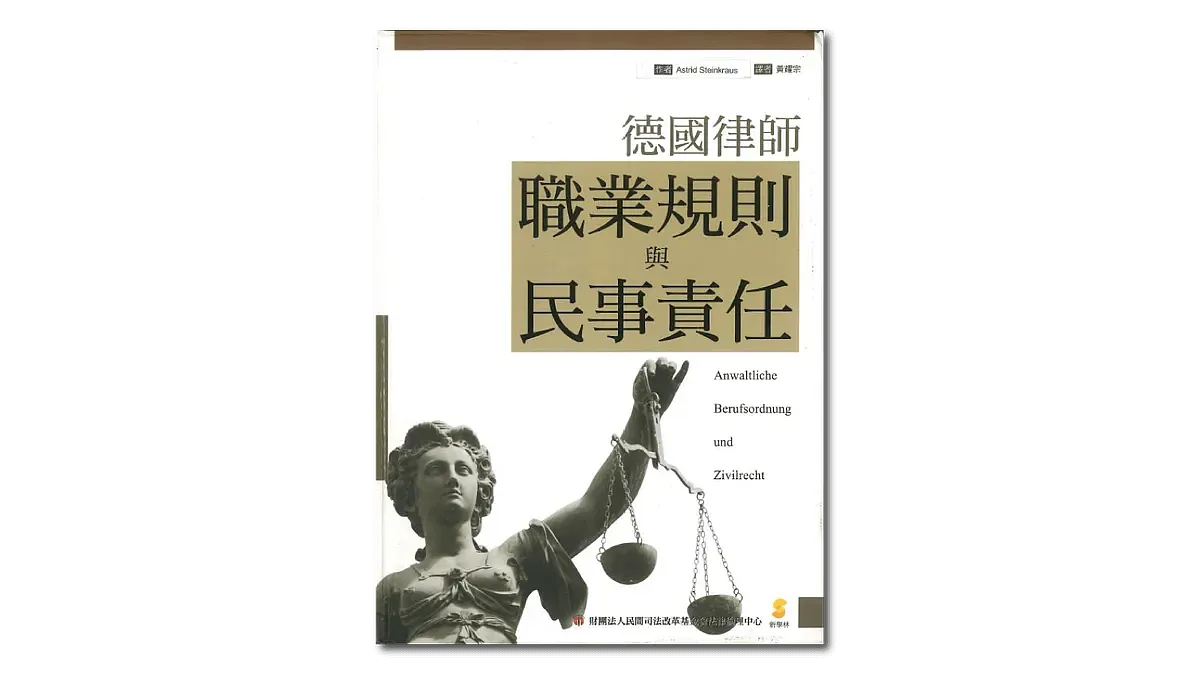
German Attorneys: Professional Rules and Civil Liability
Last edited: 2026-07-27
How to clarify the connection between an attorney's professional liability and civil liability—this book undoubtedly provides a German legal perspective on this crucial issue, offering brand-new insights for domestic legal research and practice.
Translator's Preface
Upon receiving the notification from the JRF inviting me to write this translator's preface for the book, I felt a mixture of apprehension. As the translator of a book, everything that can and should be said is already presented within the translation itself. What is expected is that readers, in the process of reading, can experience an intellectual engagement with the author regarding the written subject matter. Whether a translator can appropriately play the role of a medium is the exact standard for testing the quality of the translation. Therefore, any explanation by the translator outside of the translation itself feels like searching for excuses for one's own inadequacies. This is also the reason for my apprehension. That being said, it is difficult to decline such graciousness. Perhaps providing a brief explanation of the amendments to the German laws primarily discussed in the book, which took place between the original publication and the completion of the Chinese translation, can serve as an acceptable justification. I hope the translator's superfluous words will not burden the reader's experience.
The subject discussed in this book is the effect of German attorney professional rules under private law. Regarding the attorney professional rules, the provisions discussed in the book are from the 2003 version. The latest version at present is the 2011 version, comprising a total of thirty-five provisions. Among them, the provisions that have been amended or deleted include Article 3 (principles unchanged, only textual revisions with a fifth paragraph added), Article 4 (textual revision), Article 5 (textual revision), Article 6 (paragraph 2 deleted, original paragraphs 3 and 4 adjusted upwards), Article 7 (completely revised), Article 8 (revised), Article 9 (revised), Article 10 (items readjusted with textual revisions), Article 13 (deleted), Article 16a (added), Article 21 (paragraph 2 deleted), Article 23 (textual revision), Article 24 (revisions to paragraph 1, subparagraphs 2 and 3), Article 31 (deleted), and Article 32 (subparagraph 3 revised). Most of these are textual revisions, and amendments relevant to the content of this book appear in Article 3 (prohibition of representing conflicting interests), Article 6 (advertising), Article 7 (naming of professional fields), and Article 31 (prohibition of multiple associations). Interested readers may visit the German Federal Bar website to compare the similarities and differences between the old and new versions. Another major amendment is found in Part 3 of the book regarding the general clause in Article 1 of the Act Against Unfair Competition (UWG). Prior to the amendment, Article 1 of the Act Against Unfair Competition stipulated: "Whoever, for the purpose of competition, engages in commercial transactions contrary to public policy shall be liable for injunctive relief and damages." Following the comprehensive revision of the Act Against Unfair Competition in 2004, Article 3 established prohibitive provisions for unfair competitive practices (replaced by unfair trading practices in 2008), replacing the original general clause of Article 1, and Article 3 provided typified illustrative provisions for unfair competitive practices. The current Article 3 of the Act Against Unfair Competition stipulates: "Unfair trading practices that appreciably impair the interests of competitors, consumers, or other market participants shall be prohibited." Despite the legislative revision meaning that trading practices are no longer evaluated based on the standard of being contrary to public policy, and the discussion in the book on this aspect may appear somewhat outdated due to the legislative changes, a closer examination reveals that this is a process of further concretizing the evaluation standard through legislative means. This does not detract from the value of the book's discourse in legal dogmatics, and readers can still experience the joy of practical legal thinking through the author's meticulous legal argumentation.
I would like to thank the Legal Ethics Center of the JRF for their trust in entrusting me with the translation of this book. After the completion of the first draft of the translation, through regular reading groups, I was given the opportunity to participate in discussions, listening to criticisms and guidance on the translation from academia and practice. I benefited immensely from the process; without this encouragement from all sides, the current translation would not exist. The translator takes full responsibility for any errors and shortcomings in this translation.
Table of Contents
- Introduction
- Part I
- The Formative History of the Professional Rules for Attorneys (BORA)
- Part II
- Direct Effect of Professional Rules for Attorneys under Private Law?
- Part III
- Indirect Effect of Professional Rules for Attorneys under Private Law?
- Part IV
- Comprehensive Solution to the Case
- Part V
- Concluding Outline
- Appendix
- Translations of Relevant German Legal Provisions
This article is an AI-generated translation of the original Chinese text. In the event of any discrepancy, the Chinese version shall prevail.