
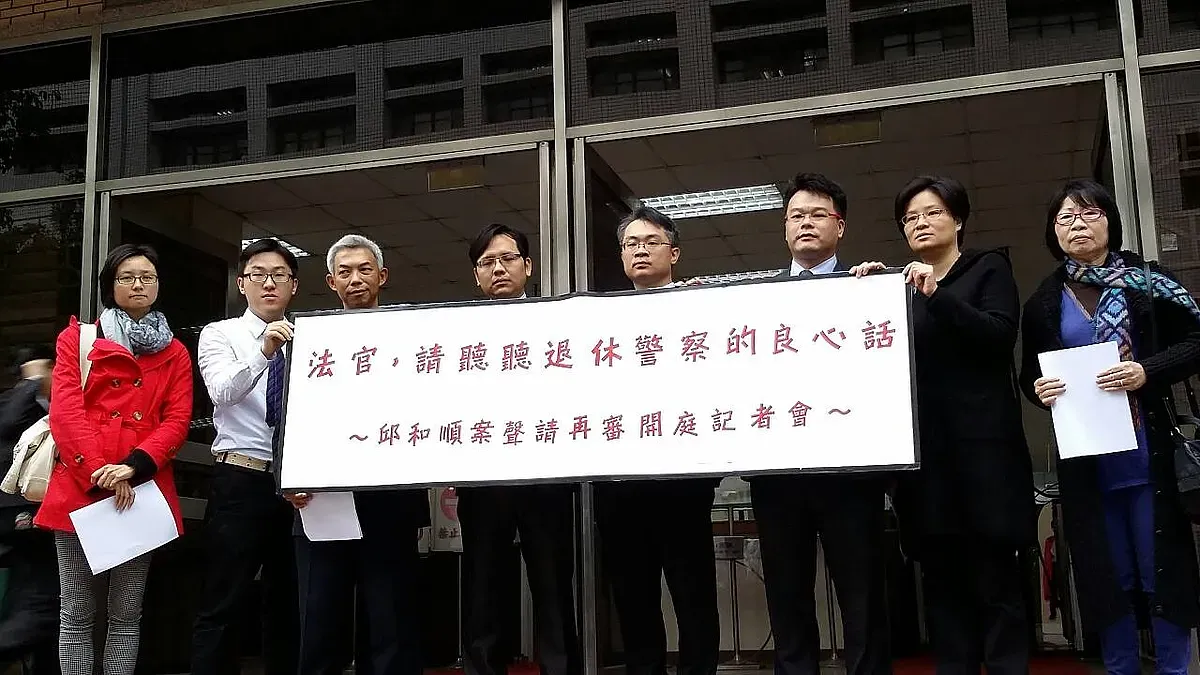
Retrial for Chiu Ho-Shun: Judges Are Struggling
Last edited: 2026-08-29
Failing to catch the real killer means justice is not served. Catching the wrong person lets the true culprit go free and creates another set of victims, which is a double injustice. Therefore, preventing wrongful convictions is a judge's primary mission. The strict procedures established in modern criminal procedure law are all designed to combat human weaknesses and avoid miscarriages of justice.
There are many causes of wrongful convictions: the pressure to solve cases, improper methods, false presumptions, unconscious bias, adherence to outdated notions, and the authoritarian background of trampling on human rights, to name just a few. However, the more serious the case, the more rigorous the procedure must be. The reason is simple: if a major case is to carry a heavy punishment, the procedure must be flawless. Because major cases may carry heavy punishments, procedures cannot be taken lightly.
In Taiwan's current judiciary, some cases are "shared historical burdens." Why are they called shared historical burdens? Because in many major cases, even though a death sentence has been finalized, if the same evidence and the same course of events were brought before a modern court and judged by contemporary judges under different times and circumstances, the outcome might be completely different. It would hardly be surprising if an acquittal were handed down due to extremely crude evidence evaluation. This represents progress within the judiciary itself, as the standards for evidentiary rigor have been raised, alongside the elevation of judges' own qualities and a stronger sense of mission to prevent wrongful convictions.
However, if these "shared burdens" were caused by predecessors or even past flawed systems, people easily shift the blame to the "spirit of the times." If the case also happens to attract public attention and involves a finalized death sentence, the "consequences of overturning it are unthinkable." Numbers speak for themselves; if judges did not consider these "consequences" at all, the approval rate for retrials in our country would not be vanishingly low.
Retrial for Chiu Ho-Shun: The Court Struggles
Judges often feel that retrials bring trouble to themselves and others. Rejecting a retrial is safe because more than 99% of judges do so. Rejection is the norm; granting one is strange. This is because a mindset still widely persists in the minds of current judges that a "retrial means overthrowing or slapping someone in the face." Within the judiciary's culture of "harmony above all," "nitpicking" is practically a taboo. For judges to use a retrial to remedy a wrongful conviction requires immense courage.
Furthermore, retrials offer no institutional incentives. The judge who grants a retrial must handle the case themselves. If it is an old, cold, serious, or major case with hundreds of volumes of case files, granting a retrial—given that judges are already overburdened with daily caseloads—is essentially "asking for trouble" and shooting oneself in the foot. Therefore, in a major case like Chiou Ho-shun's, even though retired police officers who worked on the case in the past are willing to step forward and speak out for his grievance, judges still appear hesitant, lingering in doubt over and over again.
Some clues can be gleaned from the recent rulings between the High Court and the Supreme Court regarding the application for a retrial in Chiu Ho-Shun's case. The Chiu Ho-Shun case is highly controversial; torture is a fact, and the police officers who committed the torture have been definitively convicted. Furthermore, due to contradictions between evidence and facts, as well as incomplete collection and loss of physical evidence, this case has dragged on for over twenty years without being finalized. Although it cannot be proven, the general legal circle believes it was precisely because of prolonged detention—fearing that Chiu would be released after the implementation of the "Criminal Speedy Trial Act," which would spark another wave of criticism against the judiciary—that the judges hardened their hearts and finalized his death sentence before the "Criminal Speedy Trial Act" took effect.
Preventing and Correcting Errors Is the Judiciary's Vocation
Fairly speaking, if Chiou Ho-shun's case had not occurred in 1987 (the 76th year of the Republic), shortly after the lifting of martial law, but had instead been prosecuted and sent to court only recently, I believe that under current judicial standards, it very likely would have resulted in a completely different judgment, or perhaps even a continuous series of acquittals until finalization.
Therefore, when the pro bono defense team received a call a few days ago from a retired police officer expressing willingness to step forward and testify for Chiu Ho-Shun, they were all overjoyed, feeling that there was finally a glimmer of hope for this case. Yet the High Court seemed entirely unmoved, dismissing the retrial application filed by the pro bono defense team in a very formulaic manner.
After the defense team appealed to the Supreme Court, the Supreme Court revoked the original ruling. Theoretically, if the main text of a ruling is "the original ruling is revoked," it usually means that the Supreme Court does not quite agree with the reasoning of the High Court's original ruling. Conversely, the Supreme Court should logically be more sympathetic to the defense team's arguments—meaning it believes the retrial proceedings for Chiou Ho-shun's case should be opened, or at the very least, that the two police officers should be summoned for questioning.
Interestingly and ambiguously, the Supreme Court used a very peculiar technique to draft its judgment. It split the "content" of the defense team's retrial application into two parts: the first part is the Supreme Court's original judgment finalizing Chiu Ho-Shun's death sentence (namely, the third-instance judgment of "dismissing the appeal"); and the second part is the High Court's original death sentence (appealed to the Supreme Court, namely the second-instance judgment). It then held that the High Court had only reviewed the second part while failing to review the first part. Consequently, the Supreme Court deemed the High Court's ruling erroneous and "revoked" the High Court's original ruling dismissing the defense team's application.
However, regarding the second part, which the High Court had "already reviewed," the defense team had appealed. The Supreme Court opined that the High Court had reviewed it, and that dismissing it after review was "justified." Yet, because the original ruling had already been "revoked," the Supreme Court could not simply ignore it, and thus took the rare step of "issuing its own ruling," directly dismissing the defense team's application. The conclusion remained the same, but the method was bizarre—effectively revoking the second part where the High Court had done "no wrong," only to rule on it again itself.
Next, regarding the first part that was "omitted from review," the Supreme Court used the method of "issuing an official letter" to demand that the High Court "re-evaluate" it. In other words, the Supreme Court considered this part to remain in the status of "the defense team has applied, but the court has yet to adjudicate." This is also very strange; when a superior court points out errors or omissions in a lower court's adjudication, it rarely does so through an "official letter" rather than a ruling or judgment.
In fact, the first-part judgment was based on the second-part judgment, and the two parts are continuous; treating them separately is truly exceptional. Saying that the High Court's original ruling was revoked seems to "endorse" the defense team's view. However, such a peculiar operational maneuver also seems aimed at avoiding making the High Court "unhappy" and preventing it from "mistakenly thinking" that the Supreme Court "agreed" with the defense team's view. Hence, it merely "issued a letter" asking the High Court judges to properly investigate the matter anew based on new facts and evidence.
Be that as it may, the ways of the Supreme Court are as inscrutable as heaven's, and we prefer not to speculate further. We only hope that the judges can truly empathize with the helplessness and tears of the wronged, and at least summon these courageous police officers—who feel deeply uneasy in their consciences if they do not step forward—to testify in court and hear them describe what actually happened at the time. Pursuing the truth is also a judge's mission.
These two police officers have no prior acquaintance with Chiu Ho-Shun, nor do they have any conflict of interest; their willingness to step forward and testify is already precious. Preventing and correcting errors is precisely the vocation of the judiciary. When judicial police officers show the courage to take the first step, can judges—who symbolize the final line of defense—be unwilling to take even the harmless half-step of summoning them to appear?
※This article was published on PNN PTS News Issues Center
This article is an AI-generated translation of the original Chinese text. In the event of any discrepancy, the Chinese version shall prevail.